There’s a bust of Yuri Gagarin tucked into a valley on Issyk-Kul’s south shore, because the first man in space liked to holiday here. The Barskoon Valley climbs south from the lake past a string of waterfalls, the best-known being Tears of the Snow Leopard, Manas’s Cup and Champagne Spray, then continues up a rough high road toward alpine pastures and viewpoints near the Kumtor gold mine. An easy, scenic day trip from Tamga or Tosor. You can see the main falls with barely any walking, which makes this one of the most accessible bits of dramatic scenery on the whole south shore.
Barskoon works as a half-day of waterfall-hopping or a full day pushing high up the valley for the big mountain views, depending on your vehicle and appetite. It’s a driving destination as much as a walking one, and knowing that up front saves disappointment: the reward scales with how far up the road you’re willing to go.
The Waterfalls
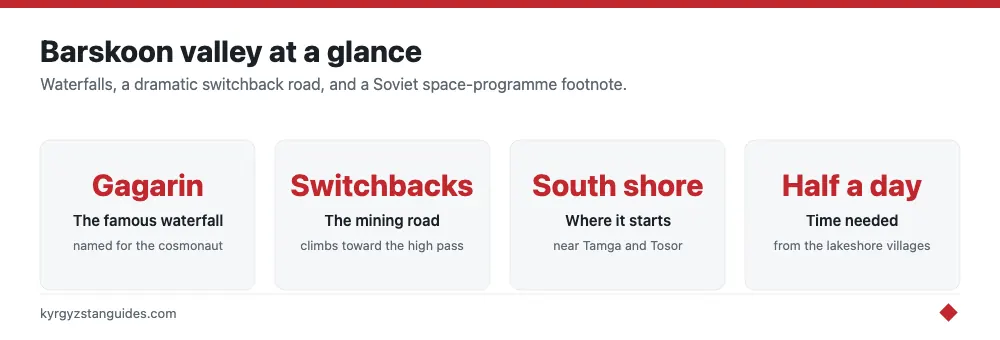
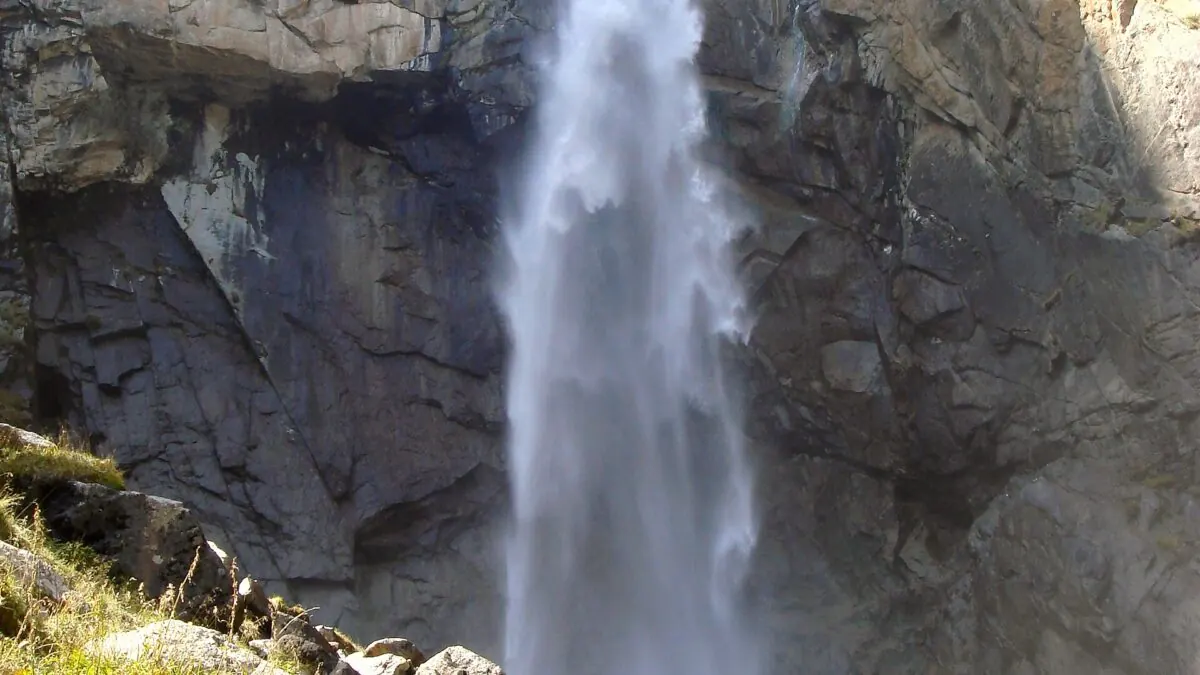
The valley’s headline sights are its waterfalls, strung up the gorge as the road climbs. Tears of the Snow Leopard is among the most photographed, a tall ribbon of white against dark rock, and Manas’s Cup and Champagne Spray are the other named falls; the Gagarin bust in the valley nods to the cosmonaut’s time relaxing here. Several more cascades line the route, some a short scramble from the road, others visible from a pull-off. Getting to the base of the taller falls usually means a short, steep walk of a few minutes to half an hour rather than a real hike, so this is scenery you can enjoy without committing to a trek. The water is fullest and loudest in early summer when the snowmelt is at its peak.
The High Road and the Viewpoints
Above the waterfalls, the valley road keeps climbing, this is the service road toward the high-altitude Kumtor gold mine, and it’s here that Barskoon opens up. Switchbacks haul you out of the tree line onto open alpine country, with sweeping viewpoints back down the valley and, on a clear day, glimpses of the high peaks and glaciers at the head of the basin. There’s a well-known lookout on the switchbacks that’s a favorite photo stop. The catch is the surface: this is a rough mountain road that climbs to serious altitude, so you want a capable vehicle and a driver who knows it, not a low city car. Note too that the road is a working mine route, so there can be checkpoints or access limits higher up — this isn’t a wilderness track but an industrial road that happens to run through spectacular country.
Making It a Day Trip
The natural bases are the lakeshore villages of Tamga and Tosor on the south shore, both a short drive from the mouth of the Barskoon Valley. From either, a half-day covers the waterfalls comfortably, while a full day lets you push high up the road to the alpine viewpoints and back. There’s no useful public transport up the valley itself, so the standard approach is to arrange a car and driver. Most south-shore guesthouses can set this up, and splitting a vehicle between a few travelers keeps the cost sensible. If you’re touring the lake, Barskoon slots easily into a south-shore day alongside the region’s other draws; see our Issyk-Kul travel guide for how the shore fits together and our Skazka (Fairy-Tale) Canyon guide for another south-shore stop that pairs well on the same loop.
When to Go
Late spring through early autumn (roughly May to September) is the practical window. The waterfalls run hardest with the early-summer snowmelt, and the high road is only reliably passable once the snow has cleared from the upper switchbacks, so June to August is the sweet spot for combining both. Even in summer, the top of the valley is cold and the weather can change quickly, so carry a layer and a shell even if the lakeshore is warm. Winter shuts the high road down entirely, though the lower waterfalls can still freeze into something striking for those who venture in.
What to Bring
- Warm layers and a windproof shell for the high, cold upper valley
- Sturdy shoes for the short scrambles to the waterfall bases
- Cash in small som notes; there are no card facilities up the valley
- Water and snacks — there’s nothing to buy above the lakeshore villages
- Sun protection for the exposed high switchbacks
- A capable vehicle or a hired driver who knows the mine road
For a full trip kit, our Kyrgyzstan packing list covers the rest.
Is Barskoon Worth It?
Yes. With a caveat. If you only make it to the waterfalls, it’s a pleasant hour or two but not a reason to reshape your itinerary. The valley comes into its own when you commit to the high road and the alpine viewpoints, which turn a modest waterfall stop into one of the more memorable half-days on the south shore. So the verdict is simple: do Barskoon if you can arrange the vehicle to go high, treat the waterfalls as the appetizer, and save it for a clear day when the views up top will actually pay off.
The waterfall height nobody agrees on
You will read that Tears of the Snow Leopard drops a hundred metres. The Barskoon local administration’s own page says the highest waterfall in the gorge is 24 metres. Those cannot both be true, and the official figure is the one with a name behind it.
What that page does confirm: the gorge runs roughly 30 km into the Terskey Ala-Too from the south shore near Tamga, about 140 km along the Bishkek-Karakol road, with passes at the head reaching around 4,000 m. The named falls are Tears of the Snow Leopard, Manas’s Cup and Champagne Spray. It also confirms that Yuri Gagarin visited after his spaceflight, which is the one part of the Gagarin story that is properly sourced — the monument’s dimensions and the exact year are not.
Gagarin is not the only figure remembered in the gorge. It also carries a memorial plaque to Tagai Biy — whom tradition identifies with Muhammad Kirghiz, the first Kyrgyz leader named in writing.
The 1998 cyanide spill
This valley carries the road to the Kumtor mine, and on 20 May 1998 that had consequences that are still being litigated.
Around midday a truck carrying 20 tonnes of sodium cyanide left the road on a sharp bend, broke through a bridge parapet and fell into the Barskoon river. Two of the twenty packages burst, releasing 1,700 to 1,800 kg of sodium cyanide into the water, 8 km upstream of Barskoon village and its seven thousand people. The mine operator reported the accident to local officials six to eight hours later. Both main irrigation inlets three kilometres downstream were wide open and were closed only hours after the spill.
What happened next is genuinely disputed, and the most useful source is the Dutch national public health institute RIVM, which ran the two WHO missions and published its report in 2000.
On contamination, RIVM measured a week afterwards and found total cyanide in soil not exceeding 1 mg/kg, and water at the river mouth in Issyk-Kul below 0.001 mg/L. It concluded there was no threat to environment, human or animal health, and that the mass evacuation could not be justified by the concentrations it measured.
On casualties, the same report records the disagreement rather than resolving it. Authorities estimated deaths in the first two weeks at between one and four. The official toll settled at three or four. Some Kyrgyz politicians claimed up to eighty. The later official summary gives four dead, around 2,600 poisoned, over 1,000 hospitalised and more than 17,000 seeking medical assistance between 20 May and 1 August, with about 5,000 Barskoon residents evacuated to the north shore in early June. An independent Russian-Canadian scientific panel found no evidence of direct linkage between the spill and illness or fatalities.
Both things are in the record: very low measured concentrations, and thousands of people who sought treatment. Anyone telling you confidently which of those is the real story is going beyond the evidence.
Compensation, and the road today
The environment minister announced a suit for 160 million som, about $8.4 million. Parliament put the damage at roughly $1 million. A government commission eventually assessed it at 91,279,467 som, about $4.5 million. The operator reported spending 9 million som compensating 7,200 Barskoon and 3,600 Tamga residents, 11 million on resort rehabilitation and 10 million on a piped water system. In December 1998 villagers blockaded the Kumtor road for a week over a promised 6.5 million som for contaminated produce.
It has not ended. In August 2020 a court ordered surviving plaintiffs 400,000 som each, around $5,700. An earlier $4.6 million settlement was reached, and reporting notes it is unclear whether any of it reached Barskoon.
For a visitor today the road is open and busy. As of August 2026 the director of the state directorate responsible said passage to Kumtor is maintained round the clock during reconstruction of the 57 km Kumtor-Barskoon section. Day tours run up the valley to the Arabel plateau at around 4,000 m and the Suyok pass at 4,022 m, roughly 330 km return and seven to nine hours of driving.
On whether you need a permit up there, the sources conflict and I am not going to invent a rule. The Barskoon administration says travel to Arabel is unrestricted; the Karakol destination organisation says only that a passport is required on the tour because of proximity to the Chinese border; other sources claim a propusk is needed past Kara-Say. Carry your passport and ask your driver.
Frequently Asked Questions
Where is the Barskoon Valley?
It runs south from the south shore of Lake Issyk-Kul, near the villages of Barskoon, Tamga and Tosor, climbing into the Terskey Ala-Too mountains. The mouth of the valley is a short drive from the lakeshore, making it an easy day trip from a south-shore base.
What waterfalls are in the Barskoon Valley?
The named falls are Tears of the Snow Leopard, Manas’s Cup and Champagne Spray, along with several other cascades lining the road up the gorge; a bust of Gagarin in the valley marks the cosmonaut’s visit. Most are reached by a short walk of a few minutes to half an hour from the road.
Can you drive up to the viewpoints near the gold mine?
The high road above the waterfalls is the service route toward the Kumtor gold mine and climbs to alpine viewpoints, but it’s rough and reaches serious altitude, so you need a capable vehicle and ideally a local driver. Because it’s a working mine road, expect possible checkpoints or access limits higher up.
When is the best time to visit Barskoon?
June to August is the sweet spot, when the waterfalls run full from snowmelt and the high road is clear enough to reach the upper viewpoints. Winter closes the high road entirely, though the lower falls can freeze into something worth seeing.
Do you need a permit to drive up to the Arabel plateau?
The sources conflict. The Barskoon administration says travel to Arabel is unrestricted; the Karakol destination organisation says only that a passport is required on the tour because of proximity to the Chinese border; other sources claim a propusk is needed past Kara-Say. Carry your passport and ask your driver.
What happened in the 1998 Barskoon cyanide spill?
On 20 May 1998 a truck on the Kumtor mine road carrying 20 tonnes of sodium cyanide fell into the Barskoon river, releasing 1,700 to 1,800 kg of it 8 km upstream of Barskoon village. The later official summary gives four dead and around 2,600 poisoned, while the RIVM-run WHO missions measured very low cyanide concentrations a week afterwards. Both are in the record, and the dispute has not been settled.