Kol-Ukok is the easiest way to sleep beside an alpine lake in central Kyrgyzstan without earning it the hard way. From Kochkor it is a two-day, one-night trek to a lake at roughly 3,000 m, and the biggest decision you make is whether to walk the climb or ride a horse up it.
Here is the shape of it. Day one is a steady 5–7 hour climb of about 1,000 vertical meters from the trailhead to the lake; you camp on the shore. Day two is the same ground in reverse, mostly downhill, in 3–5 hours. It is a genuine moderate trek. No technical ground, no high pass — which is exactly why it works as a first taste of Kyrgyz mountains or a warm-up before something bigger.
Walk it or ride it
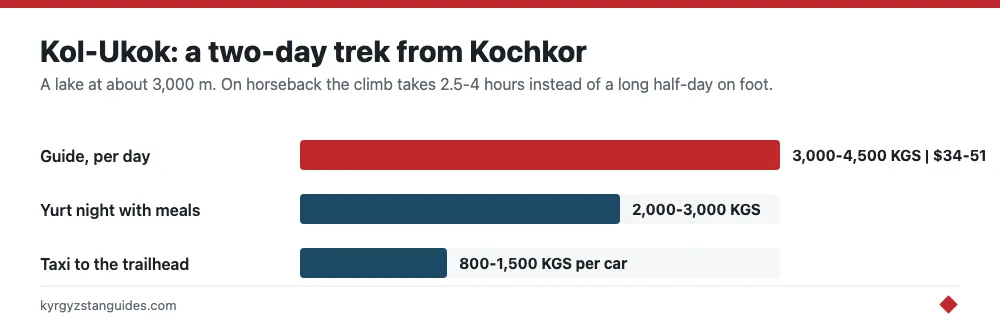
The horse option is the reason many people pick Kol-Ukok, and it is not cheating. Kochkor is a hub for Kyrgyzstan’s community-based tourism, and arranging a riding horse plus a guide here is routine. On horseback the climb to the lake takes roughly 2.5–4 hours instead of a long half-day on foot, which turns the whole thing into a relaxed overnight even if your fitness is average. If riding a horse up a mountain valley is new to you, our horse trekking guide covers what the day actually feels like.
Walking is the cheaper, quieter choice, and the trail is clear enough that route-finding isn't the worry it is on some Kyrgyz treks. The gradient is honest but never cruel. Either way, a local guide is worth it, not because you'll get lost, but because they know which shepherd families sell kymyz and where the driest camp pitches are.
The lake, and what waits above it
Kol-Ukok sits in a broad basin ringed by grassy ridges that give way to scree and, in early summer, lingering snow. The name loosely means “lake in a chest” (a basin cupped in the hills) and that is exactly how it reads when you crest the last rise and the water opens up below you. Shepherds graze the surrounding jailoo (summer pasture) through July and August, so you're rarely truly alone up there, and that's part of the appeal.
If you have energy on the morning of day two, a steeper side trip climbs toward the smaller glacial lake and the icefield feeding Kol-Ukok, another hour or two of gaining altitude. Skip it if the weather has turned; the upper basin is exposed.
The trailhead sits above the village of Isakeev, a short drive south of Kochkor, and the first hour or two follows a jeep track up a broadening valley before the real climbing begins. It is unglamorous ground at first (grazing land, the odd farm building) which is why some people take a 4WD or a horse for the lower section and start walking higher up. The reward comes in the upper third, where the valley steepens and the pasture opens into the amphitheater that holds the lake.
Sleeping on the shore
Booked through CBT, you sleep in shepherds’ yurts (more on that below). Done independently, this is a camping trek. You pitch a tent by the lake, and in high season a seasonal yurt or two may be set up on the pasture where you can buy tea or a bed, but without a booking never plan around them being there. Bring a tent, a bag rated to at least -5°C because nights bite even in July, and a stove, since firewood doesn't exist at this altitude. Water from the lake and inflowing streams should be filtered; livestock graze upstream. If a felt-tent night does materialize and it is your first, our yurt stay guide sets expectations.
Costs, season, and arranging it
There are no permits or entry fees. Your money goes on getting to the trailhead and on optional help. A taxi from Kochkor to the trailhead runs roughly 800–1,500 KGS ($9–17) for the car; a guide is about 3,000–4,500 KGS ($34–51) a day, and a riding or pack horse 1,500–2,500 KGS ($17–28). A yurt night with meals, where available, is 2,000–3,000 KGS. Arrange the lot through a CBT-style office in Kochkor, which can package the transport, guide, and horses in one booking. Figures are 2026 rates at around 88 KGS to the dollar, and a self-supported walking trip sits comfortably inside any Kyrgyzstan travel budget.
CBT offers the trek from mid-May to early October, but the most dependable window is mid-June to mid-September. Early June can still hold snow near the lake, and by late September the nights freeze hard and the shepherds start leaving the jailoo. July and August are the safe bet for snow-free ground and open pastures, with the usual caveat that afternoon thunderstorms are common, start early and be off the high ground by mid-afternoon.
A note on altitude, since it is the one thing people underestimate here. Three thousand meters is not extreme, but if you have flown into Bishkek at 800 m a day or two earlier and driven straight up, you may feel the thin air on the climb. A headache, breathlessness, poor sleep at the lake. It's rarely serious at this height, but pace the ascent, drink more water than feels necessary, and don't treat an easy trek as an excuse to rush. Pairing Kol-Ukok with a Song-Kul yurt stay, also around 3,000 m and an easy add-on from Kochkor, makes a natural two-part loop for a first week in the country.
The verdict: if you want one alpine-lake night in Kyrgyzstan and only have 48 hours and modest legs, Kol-Ukok is the smart pick. It is close to the road, cheap, forgiving, and it lets you ride if you would rather not grind up on foot, which is more than you can say for the country’s marquee treks.
The numbers, and the lake above the lake
Kol-Ukok sits at 3,048 m — some sources say 3,046 — and is a moraine-dammed lake left behind by a retreating glacier. It runs 2,330 m long and 530 to 730 m wide. A depth of 72 m appears on one site and is not corroborated anywhere else, so treat it as single-sourced.
The reason to carry on past it is Kol-Tor, in the Karakum gorge about 3 km further up, roughly 700 m long. Its elevation is quoted at 3,481 m by one source and 3,400 m by tour operators, which is a real spread. Either way it is one and a half to two hours above Kol-Ukok and it is what turns a pleasant two-day walk into a proper mountain day.
Do not confuse this Kol-Tor with the Kol-Tor near Bishkek, or with an Ukok pass at 3,871 m that one operator sells as part of a four-day expedition — that is a different feature and I could not verify it.
How CBT actually structures this trek
Community Based Tourism runs a named product for this, and its shape tells you what the trip really is. The standard version is two days, with a three-day variant running 1 July to 20 August. It starts in Kochkor with a thirty-minute car transfer to Isakeev village, then five to six hours of trekking a day, or four to five on horseback. Places are capped at twelve.
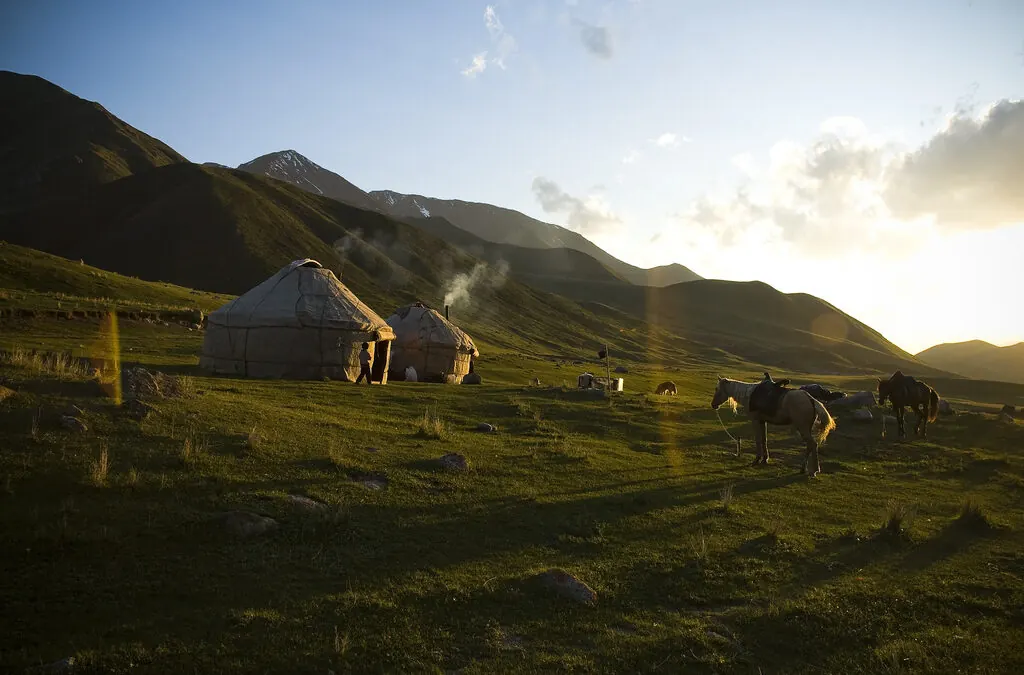
The important detail is where you sleep on the CBT version: in working shepherds' yurts, at the Ters-Tor jailoo and at the lake itself. This is not a tourist yurt camp with a booking system. It is why CBT's season runs mid-May to early October and not a day longer, because it tracks the jailoo season — when the herders come down, the beds go with them.
Times to the lake vary by mode, pace and source: CBT's own three-day itinerary allows about four hours on horseback and five on foot one way from Isakeev. The distance from Kochkor is given as 20 km straight-line by one source and 30-35 km by another, which is the usual gap between map and trail.
One thing CBT does not give you: a package price. CBT Kochkor's own page for this trek lists what is included but publishes no figure at all, so the costs earlier in this guide are typical rates for the separate pieces, not a CBT quote. Email or message the Kochkor office for a current quote, and expect the cost to sit mostly in the transfer, the horse and the yurt nights rather than in any fee, because there is no permit and no entrance charge for this valley.
FAQ
How high is Kol-Ukok lake?
3,048 metres, or 3,046 depending on the source. It is moraine-dammed, left by a retreating glacier, and runs about 2,330 m long by 530-730 m wide.
How long is the Kol-Ukok trek?
Two days standard, with a three-day variant from CBT running 1 July to 20 August. Reckon five to six hours of walking a day, or four to five on horseback, starting from a thirty-minute transfer out of Kochkor to Isakeev.
Can you ride a horse to Kol-Ukok?
Yes, and many people do. On horseback the climb takes up to about four hours one way against five or more on foot, and the horse option is the reason this trek works as a first taste of the Kyrgyz mountains.
Where do you sleep at Kol-Ukok?
On the CBT trip, in working shepherds' yurts, at the Ters-Tor jailoo and at the lake. These are not tourist camps, which is why CBT runs the trek only from mid-May to early October — when the herders leave, so do the beds. Walking independently, carry a tent and camp on the shore.
What is above Kol-Ukok?
Kol-Tor, about 3 km further up the Karakum gorge, roughly 700 m long. Its elevation is given as either 3,400 m or 3,481 m depending on the source. It is one and a half to two hours above Kol-Ukok.
Do you need a permit for Kol-Ukok?
No. There is no permit and no entrance fee for this valley. Your costs are the transfer from Kochkor, any horse hire and the yurt nights.