There is no equivalent of the Alpine rescue system here. There is no number you call that reliably puts a helicopter in the air over a valley at 3,500 metres.
What there's: a small Mountain Rescue Service that can mobilise a helicopter, a requirement that you pre-register with it, a minimum insurance threshold, and a set of costs that can run into six figures if things go badly.
This is the least glamorous guide on this site and possibly the most useful one, and it applies doubly if you are climbing rather than walking. Most people trekking here have no idea what the actual chain of events looks like.
The realistic picture
Kyrgyzstan is large, mountainous, thinly populated and short of resources. Those four facts determine everything.
No public helicopter network for tourists. Helicopters exist, military, commercial, expedition charter. But there's no standing publicly funded mountain air rescue comparable to Switzerland or Austria.
Distances are enormous. A casualty in a remote valley may be a full day from a road, and the road may be several hours from a hospital of any capability.
Medical facilities outside Bishkek are limited. Serious trauma or altitude illness frequently means evacuation to Bishkek, and in some cases onward to Almaty or further for critical care.
Mobile coverage is patchy. Reliable in towns and along main roads, absent in most of the places you will actually be walking.
None of this makes Kyrgyzstan dangerous to trek in. It means self-reliance matters far more here than in a European range, and that the plan can't be "call for help".
The Mountain Rescue Service
The Kyrgyzstan Mountain Rescue Service is the organised body most likely to be involved in a genuine mountain rescue. It has the capacity to mobilise a helicopter and it has the personnel.
Two things to know:
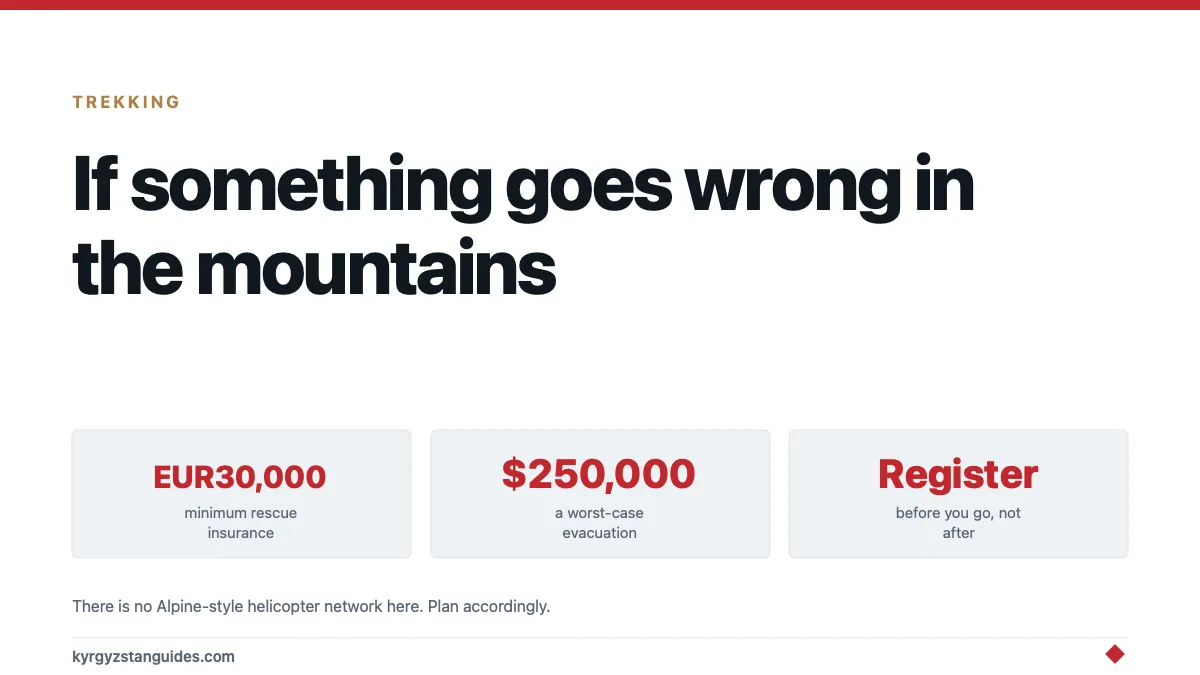
It requires pre-registration. You register before you go, not while you're lying on a moraine. This takes a few minutes online and it's free or nominal.
It requires evacuation insurance guaranteeing a minimum level of cover. The figure stated is at least €30,000.
That is the minimum. It isn't the recommended amount.
Their service page sets out the current registration process and requirements, which do change.
What it can actually cost
Real numbers, because the abstraction doesn't help.
A mountain helicopter evacuation from the Pamir-Alay combined with a critical-care bed in Almaty has been costed at around $250,000.
A straightforward helicopter lift from a base camp area with local hospital admission is far less, but is still thousands of dollars and is payable by you or your insurer, not by the state.
The practical implication: insure for at least $50,000 of medical evacuation cover, and more if you are going above base-camp altitude or into remote valleys. Our travel insurance guide covers what to look for in a policy; the two things that matter most here are medical evacuation and repatriation and the altitude ceiling.
Analysis of evacuation costs in comparable mountain regions gives a sense of how fast the numbers escalate once a helicopter and an intensive care bed are both involved.
Check the altitude clause specifically. A great many standard policies exclude trekking above 3,000 or 4,000 metres, which rules out a substantial share of what people come here to do. Including the walk to Pik Lenin's Camp 1 and most of Ala-Kul.
The local requirement
Kyrgyzstan has moved toward requiring foreign visitors to hold medical insurance valid in the country. Locally issued policies are inexpensive — reported figures are roughly 400–500 som a day, with a five to seven day policy around 3,000 som, and total costs generally in the 3,000–10,000 som range.
Understand what that's and is not. A cheap local policy satisfies a requirement and covers basic medical treatment. It isn't a substitute for a real evacuation policy, and nobody should confuse the two. Reporting on the new insurance rules covers the direction of travel.
Requirements change. Check the current position before you travel rather than relying on any blog, this one included.
What to actually do
Before you go:
- Register with the Mountain Rescue Service if you're going into the mountains - Buy evacuation cover with an adequate altitude limit, and carry the policy number offline - Tell somebody your route and your expected return, and tell them when to escalate - Carry a satellite messenger or PLB if you're going anywhere remote. This is the single highest-value piece of equipment for this specific country - Save emergency numbers and your embassy's contact offline
In the mountains:
- Your guide, your group and the nearest shepherd are your first-line rescue, not a helicopter - Herders on the jailoo have horses and know the ground. In many real incidents they are the evacuation - Phone signal is often available from a ridge when there's none in the valley
If something happens:
- Stabilise, shelter and warm the casualty first. Cold kills people who were survivable - Send two people for help if you can, not one - Note your coordinates. "Up the valley from the camp" isn't a location
The honest risk assessment
Trekking in Kyrgyzstan is not unusually dangerous, and the thing most likely to hurt you is not exotic.
Road travel is the largest single risk to visitors, by a wide margin, and it is covered in our mudflow and road hazard guide.
Altitude illness is the most common serious mountain problem, and it is very largely preventable by ascending slowly. See our altitude guide.
River crossings kill trekkers here. Glacier-fed rivers rise through the afternoon; cross early.
Simple injuries in remote places are the scenario that turns bad. A broken ankle is trivial in the Alps and serious two days' walk from a road.
The mitigations are unromantic and effective: go slower, cross rivers early, carry a satellite messenger, buy the right insurance, and tell somebody where you are.
FAQ
Is there mountain rescue in Kyrgyzstan?
Yes, but not comparable to Alpine systems. The Kyrgyzstan Mountain Rescue Service can mobilise helicopter rescue, requires pre-registration, and requires evacuation insurance with cover of at least €30,000.
How much does helicopter rescue cost in Kyrgyzstan?
It varies widely. A helicopter evacuation from the Pamir-Alay plus critical care in Almaty has been costed at around $250,000; simpler evacuations cost thousands rather than hundreds of thousands.
How much evacuation insurance do I need?
Aim for at least $50,000 of medical evacuation cover, and check that your policy's altitude limit covers the trekking you plan to do. Many standard policies exclude activity above 3,000 or 4,000 m.
Do I need insurance to enter Kyrgyzstan?
Requirements have been tightening toward mandatory medical insurance valid in-country. Local policies are cheap, roughly 3,000–10,000 som, but they aren't evacuation cover. Check the current rules before travelling.
Should I carry a satellite messenger in Kyrgyzstan?
Yes, if you're going anywhere remote. Mobile coverage is absent across most trekking areas and a messenger or PLB is the most useful safety item you can carry here.
What is the biggest risk to travellers in Kyrgyzstan?
Road travel, by a considerable margin, followed by altitude illness and river crossings. Dramatic mountain accidents are rarer than any of these.