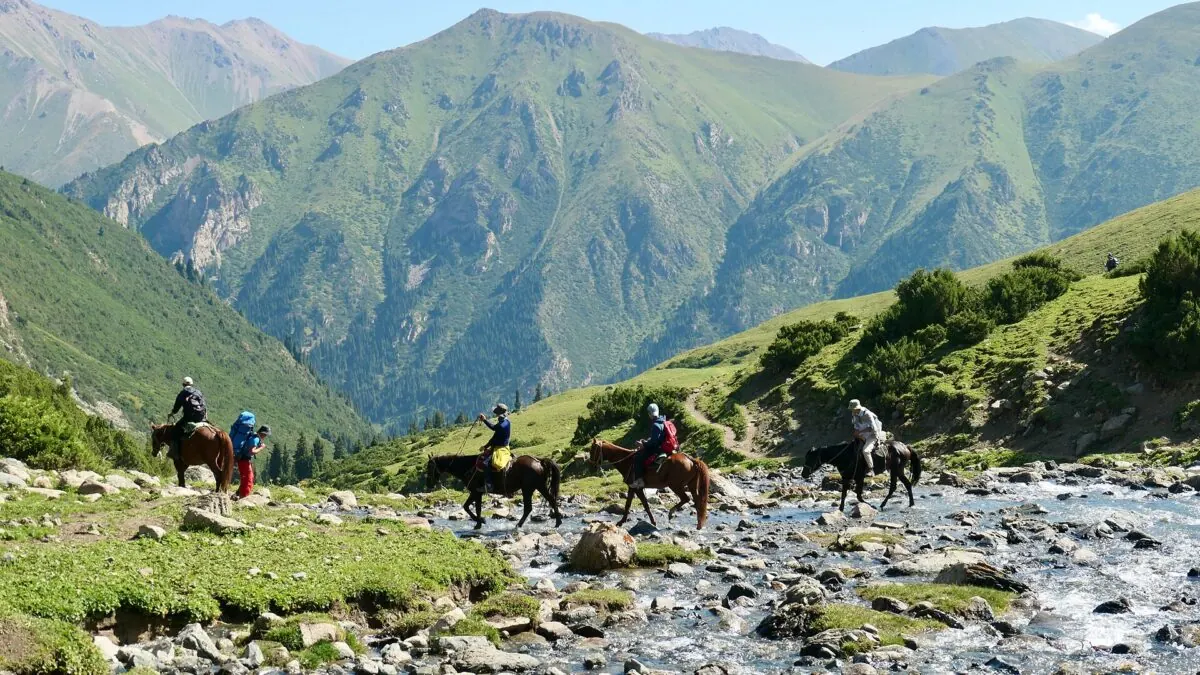
Altitude is the risk most Kyrgyzstan trekkers underestimate, because the country flies under the radar next to Nepal — yet its best-loved routes climb well past the line where altitude sickness starts. Symptoms typically begin above about 2,500 m, and Kyrgyzstan’s signature spots sit right in that zone: the Ala-Kul pass tops out near 3,860 m, Song-Kul sits around 3,000 m, and Pik Lenin base camp is roughly 3,600 m with the mountain itself soaring far beyond. The good news is that altitude illness is largely preventable with a sensible pace, and the warning signs give you time to act if you respect them.
A note before we go further: this is a researched overview for trip planning, not medical advice, and we write it from India, not from a clinic in Karakol. If you have a heart or lung condition, are pregnant, or have had altitude problems before, talk to a travel doctor before you book. What follows is where altitude matters in Kyrgyzstan, how to recognize the symptoms, how to prevent them through acclimatization, an honest note on Diamox, and, the part that saves lives — knowing when to turn around and go down.
Where Altitude Actually Matters in Kyrgyzstan
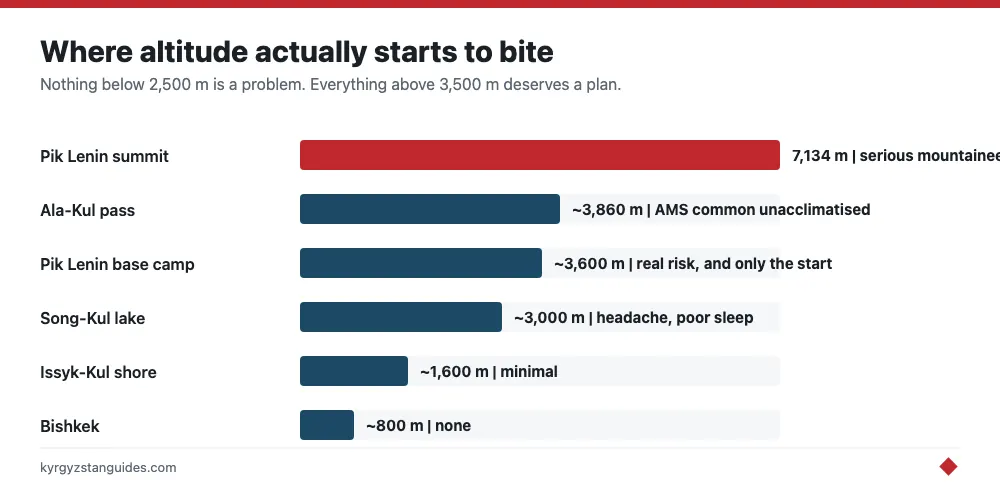
Not every Kyrgyzstan trip involves altitude. Bishkek sits at a comfortable 800 m, and Issyk-Kul’s shore is around 1,600 m. Low enough that most visitors feel nothing. The trouble starts when you head into the mountains, which is, of course, exactly why most people come. The single most popular hard trek in the country, the Ala-Kul route out of Karakol, crosses a pass close to 3,860 m, and plenty of people attempt it without a single acclimatization day.
Song-Kul, the high alpine lake ringed by yurt camps, sits around 3,000 m, high enough that a first night there can bring a headache and broken sleep even without any strenuous walking. And at the serious end, Pik Lenin base camp sits near 3,600 m, advanced camps far higher, and the 7,134 m summit is genuine high-altitude mountaineering that demands a structured acclimatization program. Here is how the headline spots compare.
| Place | Elevation | Altitude risk |
|---|---|---|
| Bishkek | ~800 m | None |
| Issyk-Kul shore | ~1,600 m | Minimal |
| Song-Kul lake | ~3,000 m | Mild — headache, poor sleep possible |
| Ala-Kul pass | ~3,860 m | Real — AMS common if unacclimatized |
| Pik Lenin base camp | ~3,600 m | Real, and only the start of the climb |
| Pik Lenin summit | 7,134 m | Serious high-altitude mountaineering |
The Symptoms: What to Watch For
Acute mountain sickness (AMS) is the common, mild form, and its hallmark is a headache, usually with one or more of nausea, dizziness, fatigue beyond what the effort explains, loss of appetite, and disturbed sleep. It often feels like a hangover, and it typically shows up several hours after arriving at a new height rather than immediately. Mild AMS is a signal, not an emergency: it means stop going up until you feel better.
The two dangerous forms are rarer but they kill. HACE (high-altitude cerebral edema) shows as confusion, loss of coordination, a stumbling, drunk-looking walk, and severe headache; HAPE (high-altitude pulmonary edema) shows as breathlessness at rest, a wet or gurgling cough, and extreme fatigue. Both are medical emergencies. The response to either is the same and it's not optional: descend immediately, as far down as you can get, and seek help.
Prevention Starts With Pace
Almost all altitude illness comes down to going up too fast, so the fix is to slow down. The mountaineer’s rule of thumb, climb high, sleep low, means your sleeping elevation is what counts, and above roughly 3,000 m you want to avoid raising it by more than about 300-500 m per night, with a rest day every 1,000 m or so of net gain. On a short trek like Ala-Kul that's hard to obey to the letter, which is exactly why so many people feel rough on it; the practical version is to arrive in the region already spending time at moderate height rather than driving straight from Bishkek to a high trailhead.
- Hydrate hard. Altitude and dry air dehydrate you fast, and dehydration mimics and worsens AMS
- Skip alcohol and go easy on sleeping pills for the first nights up high; both blunt your breathing
- Eat plenty of carbohydrates even when your appetite fades. Your body burns more up high
- Walk at a conversational pace; if you can't talk in full sentences, you are going too fast
- Spend a night or two at a middle elevation before the big day rather than sprinting to the top
Building In Acclimatization
The single best thing you can do is sequence your trip so height comes on gradually. If Ala-Kul is your goal, spend your first days around Karakol and Issyk-Kul at 1,600-2,500 m before climbing to the pass, and treat Altyn-Arashan (around 2,600 m) as a natural stepping stone — it's a lovely place to spend a night on the way up anyway. Our Ala-Kul trek guide lays out an itinerary that gives your body a fighting chance rather than shocking it.
For Song-Kul, the acclimatization is gentler but still worth respecting: arrive rested, take the first evening easy, and don't be alarmed by a mild headache or restless first night, which usually settle by morning. For Pik Lenin, acclimatization is not a nicety but the entire structure of the expedition — a program of carrying loads high and sleeping progressively higher over days. Our Pik Lenin base camp trek guide covers what that rotation looks like. Whatever the route, building slack into the schedule matters: the traveler on a tight itinerary is the one who skips the rest day and pays for it.
A Word on Diamox
Acetazolamide, sold as Diamox, is a prescription drug that speeds acclimatization and can reduce the odds of AMS. Plenty of trekkers on higher Kyrgyzstan routes carry it, and some doctors recommend it prophylactically for fast ascents like Ala-Kul or for anyone with a history of altitude trouble. It's not a license to climb faster, though, it aids acclimatization; it does not replace it, and it does not treat the severe forms.
Because it is a prescription medication with real side effects (tingling fingers, a metallic taste, more frequent urination, and it doesn't suit people with a sulfa allergy), the decision to take it belongs with a doctor before you travel, not with a stranger’s blog. We flag it here because you'll hear it discussed on the trail constantly, and it is better to have asked your own physician in advance than to be improvising at 3,500 m.
Knowing When to Descend
This is the rule that matters more than all the others combined, so we will state it plainly. If mild symptoms aren't improving, don't go higher. If they are getting worse, go down. And if you see any sign of the severe forms — confusion, a staggering walk, breathlessness at rest, a wet cough — descend immediately, day or night, without debating it. Altitude illness reverses fast when you lose height, and even a few hundred meters down can turn things around.
The trap is summit fever: you have come a long way, spent good money, and the pass is right there. People die because they talk themselves past clear warnings. A missed pass is a trip you retake next year; the mountain doesn't move. Treat the decision to turn around as a success, not a failure — the experienced trekkers are precisely the ones who descend without ego. For the wider risk picture around trekking here, our Kyrgyzstan trekking guide puts altitude alongside weather, remoteness, and rescue realities.
The takeaway is simple enough to carry in your head on the trail: ascend slowly, drink more than feels necessary, never sleep higher when symptoms are present, and go down the moment things get worse instead of better. Do that, and Kyrgyzstan’s high routes are within reach of any reasonably fit walker. Ignore it in a rush to bag a pass, and you turn an avoidable illness into a real emergency in a country where the nearest hospital can be many rough hours away.
FAQ
At what altitude does altitude sickness start in Kyrgyzstan?
Symptoms typically begin above about 2,500 metres, and Kyrgyzstan's signature destinations sit squarely in that zone: the Ala-Kul pass tops out near 3,860 metres, Song-Kul sits around 3,000, and Pik Lenin base camp is roughly 3,600.
Is altitude a real risk in Kyrgyzstan?
It is the risk trekkers most underestimate here, because the country flies under the radar next to Nepal while its best-loved routes climb well past the line where altitude illness starts.
Can altitude sickness be prevented?
Largely, yes, with a sensible pace. Altitude illness is mostly preventable by ascending gradually, and the warning signs give you time to act if you respect them rather than pushing through.
Which Kyrgyz destinations are highest?
Among the popular ones: the Ala-Kul pass near 3,860 metres, Song-Kul around 3,000, and Pik Lenin base camp at roughly 3,600 with the mountain itself far above that. Roughly ninety per cent of the country sits above 1,500 metres.
Should I see a doctor before a high trek in Kyrgyzstan?
If you have a heart or lung condition, are pregnant, or have had altitude problems before, yes. This guide is a researched overview for trip planning rather than medical advice, and it is written from India rather than from a clinic in Karakol.
How do I build altitude into an itinerary?
Climb gradually rather than jumping. A route that goes Bishkek at 800 metres, then Kochkor at 1,800, then Song-Kul at 3,016 has you sleeping at increasing altitude for several nights before any high pass, which is the whole reason the standard loops run in that order.