A single helicopter evacuation from the Tien Shan can run $8,000 to $15,000 or more — and in Kyrgyzstan, there is no state mountain-rescue service quietly waiting to send it. That one number is the entire argument for travel insurance here, and it’s why we treat it as non-negotiable rather than optional.
You should not travel to Kyrgyzstan without insurance that specifically covers high-altitude trekking, emergency helicopter evacuation, and medical repatriation — a standard beach-holiday policy will not do. This is a mountainous country where the best experiences involve altitude, remote valleys days from a hospital, and activities that budget insurers quietly exclude. Get the right policy and it costs a few dollars a day; get the wrong one, or none, and a bad day in the mountains becomes a financial catastrophe. Here’s exactly what to look for.
Why Kyrgyzstan specifically demands it
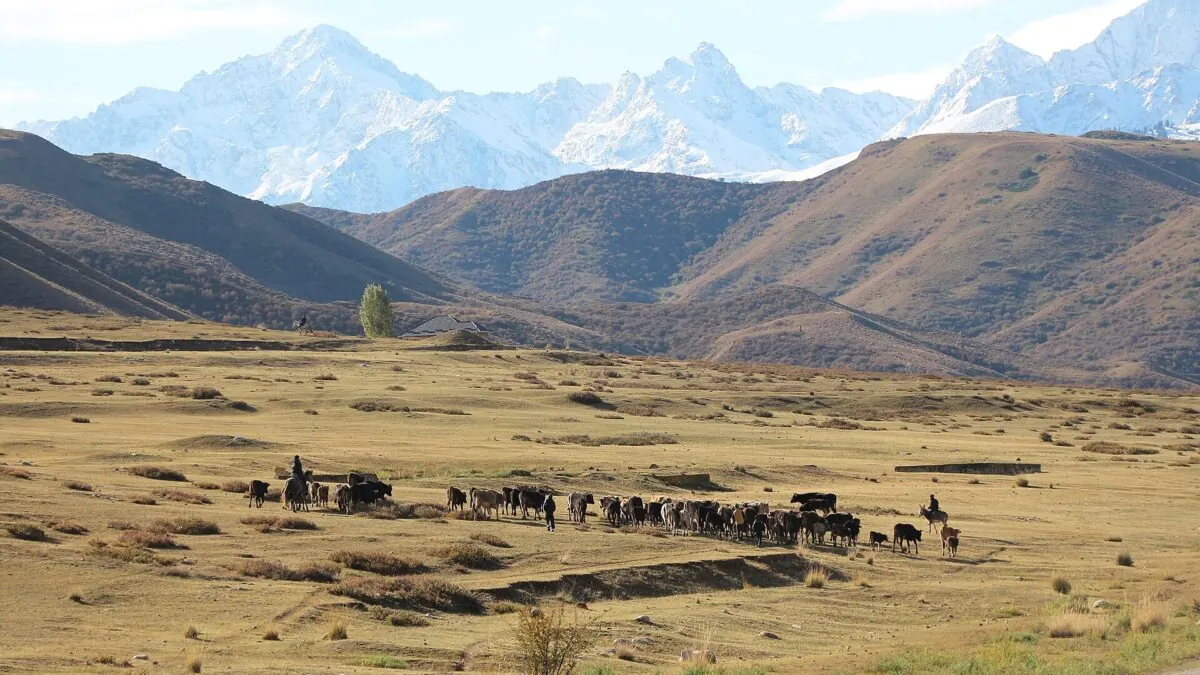
Plenty of countries are forgiving of the uninsured traveler. Kyrgyzstan is not, and the reasons stack up. First, the terrain: the reason you’re coming, Ala-Kul, Song-Kul, the Pik Lenin region, puts you high, often above 3,000 and sometimes above 4,000 meters, where altitude sickness is a real and occasionally serious risk. Our Kyrgyzstan trekking guide lays out just how remote these routes get.
Second, remoteness. On many treks you are one, two, or three days’ walk from the nearest road, let alone a hospital. If something goes wrong, a broken ankle, severe altitude sickness, appendicitis, getting you out isn’t a taxi ride. It may mean horses, then a rough jeep track, then hours to a regional clinic, or in the worst case a helicopter. That evacuation chain is slow, difficult, and expensive.
Third, and this is the part travelers underestimate: there's no free, organized mountain rescue. Unlike the Alps, no public rescue helicopter is dispatched on a phone call. A helicopter has to be arranged and paid for privately, often up front, and organizing one at all can take precious hours. Your insurer’s assistance line becomes the machinery that actually makes a rescue happen: which is why a policy that doesn’t cover it is close to useless in a genuine emergency.
Finally, local healthcare. Bishkek has decent private clinics for routine problems, but for anything serious, major surgery, intensive care, a complex injury, many travelers will want to be repatriated or moved to a hospital in Kazakhstan, Turkey, or home. That repatriation is itself a five-figure cost your policy needs to shoulder.
The features that actually matter
Not all travel insurance is built for this. When you compare policies, ignore the marketing and check for these specific things, the difference between a policy that pays out and one that leaves you exposed lives entirely in the fine print.
| What to check | Why it matters in Kyrgyzstan |
|---|---|
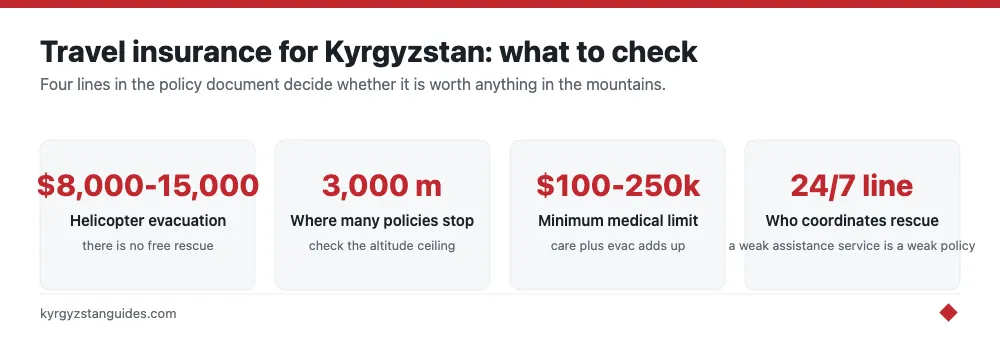
| Helicopter / emergency evacuation cover | The single most important line. There’s no free rescue; evac can cost $8,000-15,000+. Confirm it’s explicitly included, not an optional extra you skipped. |
| High-altitude trekking limit | Many policies cap trekking cover at 2,500-3,000 m. Kyrgyzstan’s best treks exceed this. Check the altitude ceiling and buy up if needed. |
| Medical repatriation | Covers moving you to a better hospital or home for serious cases. Look for a high limit (ideally unlimited or $500,000+). |
| Overall medical limit | Aim for at least $100,000-250,000. Serious care plus evacuation adds up fast. |
| Named activities | Horse riding, hiking, and multi-day trekking should be listed as covered. Mountaineering with ropes/crampons usually needs a specialist add-on. |
| 24/7 assistance line | The number that coordinates the actual rescue. A policy without a responsive assistance service is far weaker in the field. |
The altitude clause is the one that catches people out. A cheap policy might cover “trekking” but bury a 3,000-meter limit in the terms — and then decline a claim because your incident happened at 3,800 meters on a completely normal Kyrgyz trail. Read that number, and if your itinerary goes higher, pay the small premium for the higher tier. The same goes for activities: if you plan to ride horses (and in Kyrgyzstan, you probably will), make sure horse riding is covered, since some insurers treat it as a hazardous activity.
What it actually costs
Here’s the reassuring part: proper cover is cheap relative to what it protects. For a typical two-week trip with adventure and altitude cover, most travelers pay somewhere in the region of $40-90 depending on age, home country, and coverage limits. Specialist adventure insurers that handle high trekking as standard sit at the higher end but are often worth it for the peace of mind and the responsive assistance line.
A few honest notes on the numbers:
- Age drives price sharply — travelers over 65 pay considerably more, and coverage gets harder to find, so shop early.
- Adventure-specific insurers (the ones built for trekkers and mountaineers) cost more than a mainstream travel policy but are far less likely to wriggle out of a mountain claim.
- Buying a whole-year multi-trip policy can be cheaper than a single trip if you travel more than once a year.
- The cheapest policy is almost never the right one here. A $15 bargain plan that excludes altitude and evacuation is a false economy.
Set that $40-90 against a $12,000 helicopter bill and the math makes itself. For context on how the rest of your budget breaks down, our Kyrgyzstan travel budget shows just how small an insurance premium is next to flights and weeks on the ground.
A note for travelers from India
If you’re flying from India, insurance is doubly worth sorting carefully. Indian travel insurers do offer adventure and trekking add-ons, but the base policies often exclude high-altitude activity by default, so you must actively add it and confirm the altitude ceiling. Some travelers find that an international adventure-specialist insurer offers better mountain and evacuation terms than a standard domestic plan, even if the premium is a little higher — compare both. Whatever you choose, make sure repatriation cover is generous, since bringing someone home from Bishkek is a long and costly journey.
The claims reality, read this before you assume you’re covered
Having a policy is only half the job; knowing how to use it is the other half, and this is where good intentions unravel. Insurance in a remote country runs on documentation and phone calls, not goodwill.
The golden rule: call the assistance line before you incur a major cost, whenever it’s physically possible. Insurers strongly prefer to authorize and arrange an evacuation or hospital transfer themselves, and a claim you organized entirely on your own can be questioned or reduced. In the mountains you may have no signal to make that call — which is exactly why you leave your policy number and the assistance number with your guide and your guesthouse, so someone can dial it on your behalf.
Then there’s paperwork. Reimbursement claims live and die on documentation:
- Keep every receipt, medical report, and payment record. In a remote clinic, ask for anything written down, even if it’s basic.
- Get a police report for theft or loss; insurers routinely require one, and getting it after the fact is painful.
- Photograph documents as backup in case paper originals get lost or ruined on the trail.
- Note that many clinics and rescue operators expect payment on the spot, so you may pay first and claim back later — carry a card with headroom, or access to emergency funds.
That last point is the practical sting. Even with excellent insurance, you might have to front a significant sum in the moment and be reimbursed weeks later. Budget for that possibility rather than assuming the insurer pays the hospital directly. Sometimes they do, often they don’t.
None of this is meant to scare you off the mountains. Kyrgyzstan is a wonderful and generally safe place to trek, our is Kyrgyzstan safe guide puts the risks in perspective, and the overwhelming majority of visitors never file a claim. But the whole point of insurance is the rare bad day, and in a country with no free rescue and long distances to serious care, that bad day is the one you can't afford to face uninsured.
The short checklist before you buy
Run through this before you pay for any policy, and you’ll avoid the traps that catch most travelers:
- Does it explicitly cover emergency helicopter evacuation and repatriation? (Non-negotiable.)
- What’s the maximum trekking altitude, and does it exceed the highest point on your route?
- Are hiking, multi-day trekking, and horse riding named as covered activities?
- Is the overall medical limit at least $100,000-250,000?
- Is there a 24/7 assistance line, and have you saved that number offline and shared it with your guide?
Tick all five and you can head into the Tien Shan with the one worry that actually matters taken care of. Skip any of them and you’re gambling with the exact scenario insurance exists for.
Frequently Asked Questions
Do I really need travel insurance for Kyrgyzstan?
Yes, more so than for most destinations. Kyrgyzstan is mountainous and remote, with no free state mountain-rescue service, so an emergency helicopter evacuation can cost $8,000-15,000 or more that you would otherwise pay yourself. Insurance covering high-altitude trekking, evacuation, and repatriation is strongly recommended for any trip that involves the mountains.
Does normal travel insurance cover trekking in Kyrgyzstan?
Often not adequately. Many standard policies cap trekking cover at around 2,500-3,000 meters and exclude helicopter evacuation, while Kyrgyzstan’s best treks go higher and are far from roads. Check the altitude limit, confirm evacuation and repatriation are included, and buy a higher adventure tier if your route exceeds the ceiling.
How much does travel insurance for Kyrgyzstan cost?
For a typical two-week trip with adventure and altitude cover, most travelers pay roughly $40-90, depending on age, home country, and coverage limits. Adventure-specialist insurers cost more than mainstream plans but handle mountain claims far better. It’s a small sum next to the five-figure cost of an evacuation.
Is there a mountain rescue service in Kyrgyzstan?
Not in the way the Alps have one. There is no free, publicly dispatched rescue helicopter; an evacuation must be arranged and paid for privately, often up front, and can take hours to organize. This is why your insurer’s 24/7 assistance line is the practical machinery that makes a rescue happen, and why evacuation cover is essential.
Does travel insurance cover horse riding in Kyrgyzstan?
Not automatically. Some insurers treat horse riding as a hazardous activity, so check that it is named as a covered activity alongside hiking and multi-day trekking. Mountaineering with ropes or crampons usually needs a specialist add-on.
What should I do first if I need evacuation or hospital care?
Call your insurer’s assistance line before you incur a major cost, whenever that is physically possible, because a claim you organized entirely on your own can be questioned or reduced. Since there may be no signal in the mountains, leave your policy number and the assistance number with your guide and your guesthouse so someone can call on your behalf, and expect that you may have to pay up front and claim back later.