Entry fees in Kyrgyzstan are small enough that nobody warns you about them, which is precisely why they catch people out, a national park gate wants about 500 som in cash, a vehicle costs extra on top, and the two or three places most worth seeing want something you cannot buy at the gate at all.
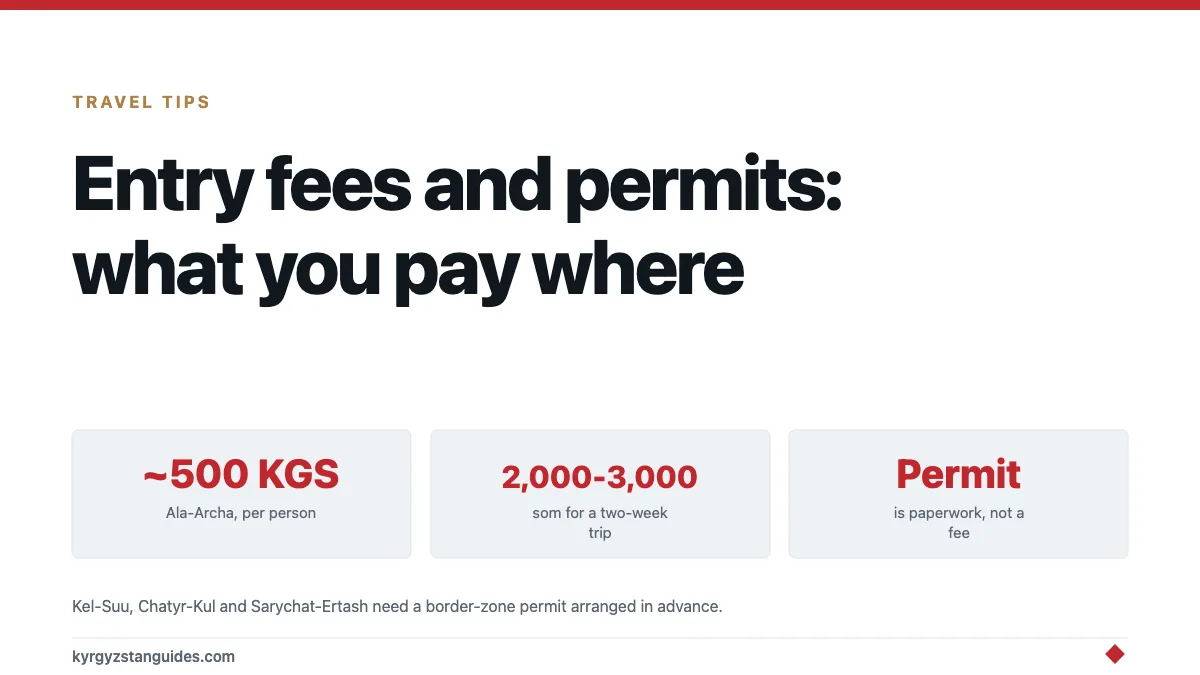
That last group is the one to get right before you leave home. Kel-Suu, Chatyr-Kul and the Sarychat-Ertash reserve sit inside controlled border zones, and turning up without a permit means turning around.
What each place charges
Figures below are what our own guides record for 2026, paid in cash at the gate unless stated. Rates here get adjusted without announcement, so treat them as the order of magnitude rather than a quote.
| Place | Per person | Vehicle | Notes |
|---|---|---|---|
| Ala-Archa National Park | ~500 KGS (~$6) | 300–500 KGS | Cheaper for Kyrgyz citizens |
| Sary-Chelek Biosphere Reserve | 500–700 KGS | 100–300 KGS | Per person, per entry |
| Burana Tower | 100–150 KGS | — | Includes the museum |
| Tash-Rabat Caravanserai | 100–150 KGS | — | Yurt camp is separate |
| Skazka Canyon | 50–100 KGS | — | Collected at a barrier on the track |
| Besh-Tash National Park | Small fee at the checkpoint | — | Bring small notes |
| Konorchek Canyons | Free | — | No gate, no barrier |
| Kel-Suu | Border permit required | — | Arranged in advance |
| Chatyr-Kul | Border permit required | — | Through an operator |
| Sarychat-Ertash | Permit + licensed operator | — | Hundreds of dollars for a trip |
Assume roughly 87–89 som to the dollar, the rate through most of 2026.
The vehicle fee people forget
Ala-Archa is the one that surprises visitors, and it's worth understanding why rather than just knowing the number.
You pay per person, and then you pay again for the car. If you've taken a taxi up from Bishkek, that second charge may or may not be inside the price you agreed with the driver, and the moment to establish that's before you set off, not at the barrier with the meter running. A wait-and-return deal for the day typically runs 2,500–3,500 KGS for the car, and whether the park's vehicle fee is bundled into that's entirely down to what you and the driver said to each other.
It isn't a scam, incidentally. It's just two separate fees that arrive at the same window, and a driver who assumed you knew.
Sary-Chelek works the same way if you bring a vehicle into the reserve. Most people don't, because the walking starts near Arkyt anyway.
Border permits are a different animal
Here's the distinction that actually matters, and the one that ruins itineraries when it's missed: an entry fee is money, and a border permit is paperwork with a lead time.
Large parts of eastern and southern Kyrgyzstan run along the Chinese and Tajik frontiers, and the state controls access to them. Kel-Suu lies inside a restricted zone on the Chinese border. So does Chatyr-Kul, where visiting legally means a border-zone permit arranged ahead through a tour operator. You cannot drive up and have a look. Sarychat-Ertash needs the permit plus a licensed operator plus a ranger-guide, since independent walking in the protected core generally isn't allowed.
The Alay valley in the south is the same story against Tajikistan. Anyone walking to Lenin Peak base camp is inside a controlled zone and has to carry a permit tied to their passport, physically, along with the passport itself. The CBT office in Sary-Mogol handles them alongside homestays, guides and horses, and wants a day or two of notice.
How far ahead do you need to start? For the CBT-arranged permits in Alay, a couple of days on the ground is usually enough. For Kel-Suu and Chatyr-Kul, you're going through an operator, and that means sorting it before you arrive in the country rather than after. The paperwork itself takes a fortnight at the outside; the part that catches people is not knowing they needed it until they were already in Naryn.
Community Based Tourism Kyrgyzstan is the practical starting point for the southern permits, and Caravanistan remains the most reliable running record of what's currently required where.
Where you pay nothing
A genuinely large share of the best walking in this country is free, which is worth saying because the fee table above can make it look otherwise.
Konorchek has no gate at all. You start from the old Kok-Moinok bridge on the Bishkek–Balykchy road and walk up a dry riverbed. Most of the valleys around Karakol and Jyrgalan are open. Wild camping is unrestricted across the jailoos, including beside lakes like Boz-Uchuk, where nobody will come to collect anything from you. The great majority of passes, ridges and meadows in Kyrgyzstan are simply not gated.
What you are paying for at Ala-Archa or Sary-Chelek is a managed protected area with rangers and a road. What you get for free elsewhere is everything else.
So how much cash do you actually need for gates?
For a two-week trip taking in three or four of the ticketed sites, budget 2,000–3,000 som for entry fees, plus vehicle charges if you're driving in. That's a small enough number that the real issue isn't the total. It's the form it arrives in.
Nowhere on the list above takes a card. A few want something close to exact change, and a park gate is not the place to discover your smallest note is a 5,000. Small denominations, carried deliberately: 100s, 200s and 500s, drawn before you leave the last town with an ATM.
Our guide to what actually works for paying in Kyrgyzstan covers why cards and local apps mostly won't help you here, and the national parks guide compares the protected areas themselves.
What we couldn't pin down
Besh-Tash charges at the checkpoint, but we could not confirm a current figure from an official source and haven't guessed one. Several smaller sites collect ad hoc amounts that vary by who is at the barrier. And none of these fees are published on a government page that updates reliably, which is why the table says "order of magnitude" rather than "price list".
If you've paid something different recently, our editorial policy explains how corrections get made.
FAQ
How much is entry to Ala-Archa National Park?
Around 500 KGS per person for foreigners, roughly $6, plus 300–500 KGS for a vehicle. Kyrgyz citizens pay less. It's cash at the barrier, and the ticket is worth keeping until you leave.
Do I need a permit to visit Kel-Suu?
Yes. Kel-Suu sits inside a restricted border zone along the Chinese frontier, and a border-zone permit has to be arranged in advance. It isn't something you can buy on arrival, and without it you'll be turned back.
Are Kyrgyzstan's national parks free?
Some are, some aren't. Ala-Archa, Sary-Chelek and Besh-Tash charge at the gate. Konorchek has no fee at all, and most unmanaged valleys, passes and jailoos are open with nothing to pay.
Can I pay park entry fees by card?
No. Every gate on this list is cash only, in som. Draw what you need before leaving the last town with an ATM, and carry small notes rather than 5,000s.
How long does a Kyrgyzstan border permit take?
The paperwork itself generally runs up to about two weeks. For the Alay valley, the CBT office in Sary-Mogol can usually sort one with a day or two of notice. For Kel-Suu and Chatyr-Kul, arrange it through an operator before you arrive in the country.
How much should I budget for entry fees on a two-week trip?
About 2,000–3,000 som if you visit three or four ticketed sites, plus vehicle fees if you drive in. Border-zone trips are a different scale — a guided Sarychat-Ertash visit runs into the hundreds of dollars.