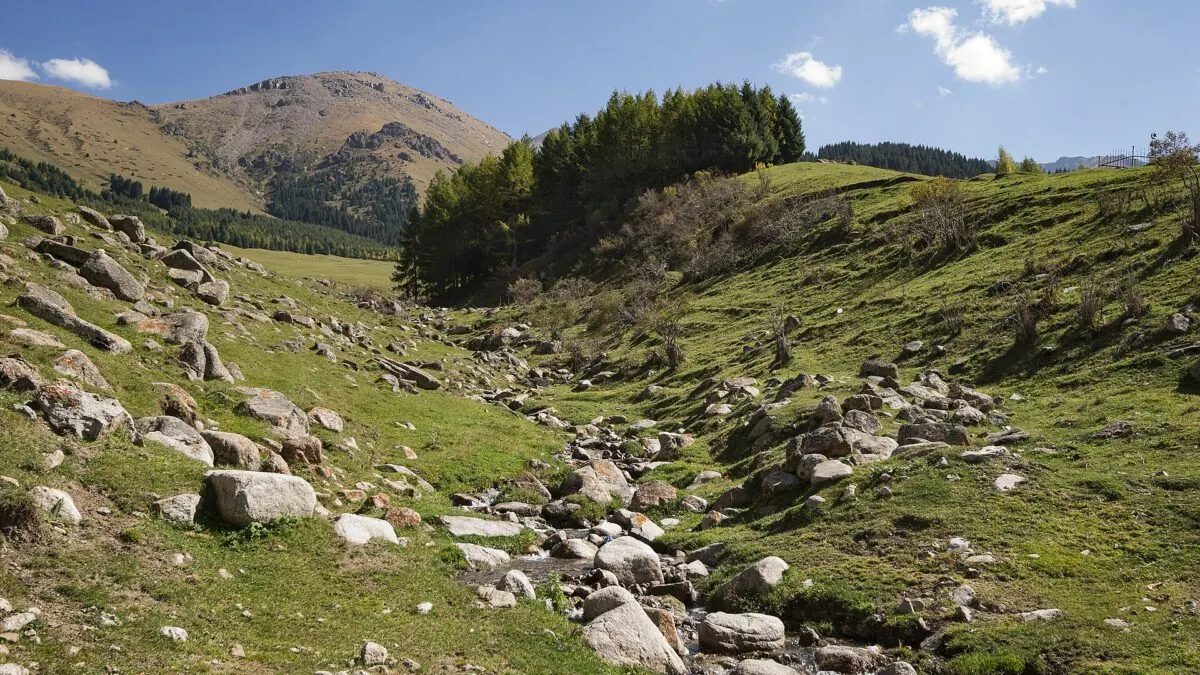
Kyrgyzstan protects a surprising share of its territory — roughly 6-7% of the country sits inside national parks, state nature reserves (zapovedniks), and other protected categories. But the system isn’t uniform: a zapovednik like Sarychat-Ertash is a strict scientific reserve with tight access controls, while a national park like Ala-Archa is essentially a day-hiking area 40 minutes from the capital. Knowing which is which saves you from planning a casual afternoon around a place that actually requires a border permit, or skipping a park that’s genuinely easy to visit.
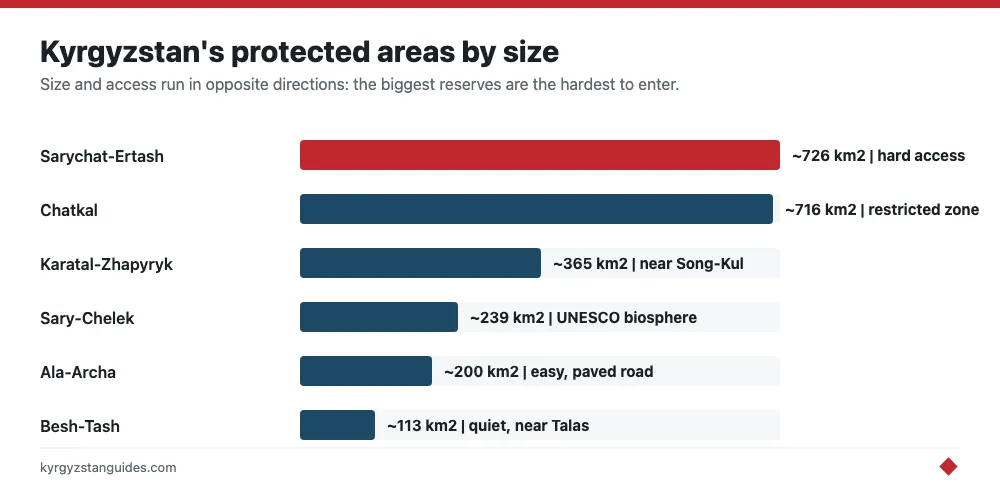
Below is a working comparison of the six protected areas travelers ask about most, followed by notes on how the permit and fee system generally works.
The parks and reserves compared
| Protected area | Location | Approx. size | Highlights | Accessibility |
|---|---|---|---|---|
| Ala-Archa | 30-40 min south of Bishkek | ~200 km² | Glacial valley, day hikes, alpine peaks visible from the trailhead | Easy — paved access road, marked trails, no permit needed |
| Sary-Chelek | Jalal-Abad region, western Kyrgyzstan | ~239 km² (core zone) | Turquoise lake, walnut-fruit forest, UNESCO biosphere reserve status | Moderate — remote approach roads, best with local transport |
| Chatkal | Western Tian Shan, near the Uzbek border | ~716 km² | Dense forest, rare flora, limited tourist infrastructure | Hard — restricted zones, mostly for researchers and specialist groups |
| Besh-Tash | Near Talas, northwest Kyrgyzstan | ~113 km² | Quiet alpine valley, five-peak namesake ridge, uncrowded trekking | Moderate — rough road from Talas, little tourist traffic |
| Karatal-Zhapyryk | Around Song-Kul’s southern approaches | ~365 km² | Argali sheep habitat, high pastureland ecology | Moderate — accessible via Song-Kul routes, no dedicated tourist setup |
| Sarychat-Ertash | Eastern Tian Shan, near the Chinese border | ~726 km² | Snow leopard research zone, ibex, remote high-altitude terrain | Hard — border-zone permit and specialist operator required |
The pattern is fairly consistent: proximity to Bishkek and existing tourist infrastructure roughly predicts how easy a park is to visit, while proximity to international borders roughly predicts how much paperwork you’ll need. Ala-Archa sits at one extreme — a spontaneous day trip — and Sarychat-Ertash sits at the other, requiring weeks of lead time.
Ala-Archa: the accessible default
Most travelers’ first, and sometimes only, Kyrgyz national park. Ala-Archa Gorge cuts straight into the Kyrgyz Range south of Bishkek, with a paved road running to the entrance and a network of marked trails ranging from a gentle riverside walk to serious alpine routes toward Uchitel Peak and the glacier basins beyond. It works as a half-day outing from Bishkek or a multi-day base for more ambitious trekking, and it’s the one park on this list you can reasonably show up to without advance planning.
Sary-Chelek: the biosphere reserve
A UNESCO-designated biosphere reserve — part of the transnational Western Tien-Shan World Heritage site — built around a striking turquoise lake surrounded by walnut-fruit forest — a forest type that’s rare globally, since Kyrgyzstan’s Fergana Valley foothills hold some of the largest remaining wild walnut forests on Earth. It’s in the west, well off the standard Bishkek-Issyk Kul-Karakol circuit, which keeps visitor numbers modest. Access generally means a long drive from Jalal-Abad or Osh and a night or two locally rather than a day trip.
Chatkal and Besh-Tash: the quiet ones
These two rarely appear on standard itineraries, and that’s largely the point for the travelers who do seek them out. Chatkal Reserve, hard against the Uzbek border in the western Tian Shan, protects dense forest and rare plant species with limited tourist access — it functions more as a scientific reserve than a destination. Besh-Tash, near Talas in the northwest, is a underused alpine valley with a rough access road and almost no tourist infrastructure, appealing mainly to independent trekkers comfortable arranging their own logistics.
Karatal-Zhapyryk and Sarychat-Ertash: high pasture and high wilderness
Karatal-Zhapyryk sits near Song-Kul’s southern approaches and protects argali sheep habitat across high pastureland — most travelers pass near its edges without realizing it while heading to or from Song-Kul, rather than visiting it as a distinct destination. Sarychat-Ertash, covered in more depth elsewhere on this site, is the strictest and most remote of the group: a border-zone snow leopard reserve requiring advance permits and a specialist operator, not a park you add to a loop casually.
How the permit and fee system generally works
Entry fees at accessible parks like Ala-Archa are modest, typically in the range of a few hundred KGS per person for foreign visitors, collected at a checkpoint near the entrance, with vehicle fees charged separately. Nothing about this requires advance booking — you pay on arrival.
The system changes sharply for reserves near international borders. Chatkal and Sarychat-Ertash both sit in or near restricted border zones, which means access isn’t just a matter of paying an entry fee — it requires a separate border-zone (pogranzona) permit processed through Kyrgyz authorities, generally arranged by a tour operator on the traveler’s behalf rather than by the traveler directly. This processing can take from several days to a couple of weeks, so it needs to be built into trip planning well ahead of arrival, not handled as a same-week decision.
A useful rule of thumb: if a protected area sits within roughly 50 kilometers of the Chinese, Uzbek, or Tajik border, assume a permit process is involved and check with a local operator before finalizing dates. If it’s within a couple of hours of Bishkek and doesn’t border another country, assume it works like Ala-Archa — pay at the gate and go.
Which park fits which trip
For a first Kyrgyzstan trip with limited time, Ala-Archa is the obvious pick — it delivers real alpine scenery without eating a travel day. For travelers building a longer, research-heavy itinerary who want landscapes most visitors skip, Sary-Chelek and Besh-Tash reward the extra driving. For anyone specifically drawn to wildlife and willing to plan months ahead and pay a premium, Sarychat-Ertash is the standout, though it demands the most preparation of anything on this list. Chatkal and Karatal-Zhapyryk are, realistically, for specialists and researchers rather than general travelers, given the access restrictions and thin infrastructure.
If you’re building a route around several of these, it helps to pair park visits with nearby anchor destinations rather than treating each as a separate expedition. Ala-Archa slots naturally alongside a broader look at Ala-Archa’s trails, Sary-Chelek pairs with the wider Sary-Chelek lake guide, and anyone planning multi-day routes through several of these areas should read our general Kyrgyzstan trekking guide first. Timing also matters more here than on a standard city-to-city itinerary — check the best time to visit before locking in dates, since several of these parks are effectively closed by snow for half the year, and review a proper packing list given how much altitude and weather variation is involved.
Kyrgyzstan national parks FAQ
Do I need a permit for Ala-Archa?
No. Ala-Archa only requires paying the standard entry fee at the checkpoint near the park entrance. No advance permit or paperwork is needed for foreign visitors.
Which parks require a border-zone permit?
Chatkal and Sarychat-Ertash both sit in or near restricted border areas and require advance permits, typically arranged through a tour operator. Other parks on this list don’t require border-zone paperwork.
Can I visit more than one of these parks on a single trip?
Yes, though it takes planning given the distances involved — Sary-Chelek and Besh-Tash are both in the west, Ala-Archa is near Bishkek, and Karatal-Zhapyryk and Sarychat-Ertash are in the east. Grouping by region rather than trying to see all six on one loop is far more realistic.
Are entry fees different for foreigners than for Kyrgyz citizens?
Yes, most parks charge a higher rate for foreign visitors than for locals, though the foreign rate is still modest by international park standards — typically a few hundred KGS.
Is camping allowed inside these parks?
At accessible parks like Ala-Archa, yes, generally in designated areas. At stricter reserves like Sarychat-Ertash, camping is part of an organized, permitted trip rather than something arranged independently.