Sarychat-Ertash is a 726-square-kilometer state nature reserve tucked into the eastern Tian Shan, hard against the Chinese border near the Enilchek glacier system. It exists to protect one of Central Asia’s densest known snow leopard populations, along with the ibex herds the cats depend on. You almost certainly won’t see a snow leopard here — camera-trap studies suggest a few dozen animals across a vast, cliff-riddled range — but you will be standing in genuine, unmanaged high-altitude wilderness, which is its own reward.
Visiting requires a border-zone permit, a licensed operator, and a realistic budget in the hundreds of dollars for a multi-day trip. This isn’t a reserve you drop into on a whim from Karakol; it’s a planned expedition, usually booked weeks ahead.
What the reserve actually protects
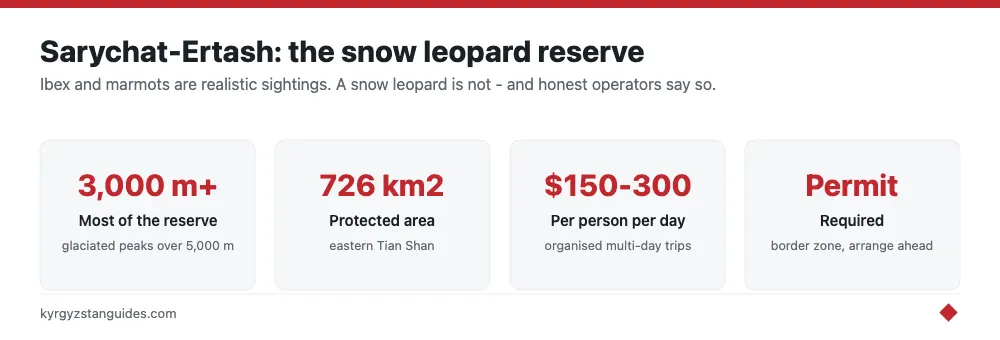
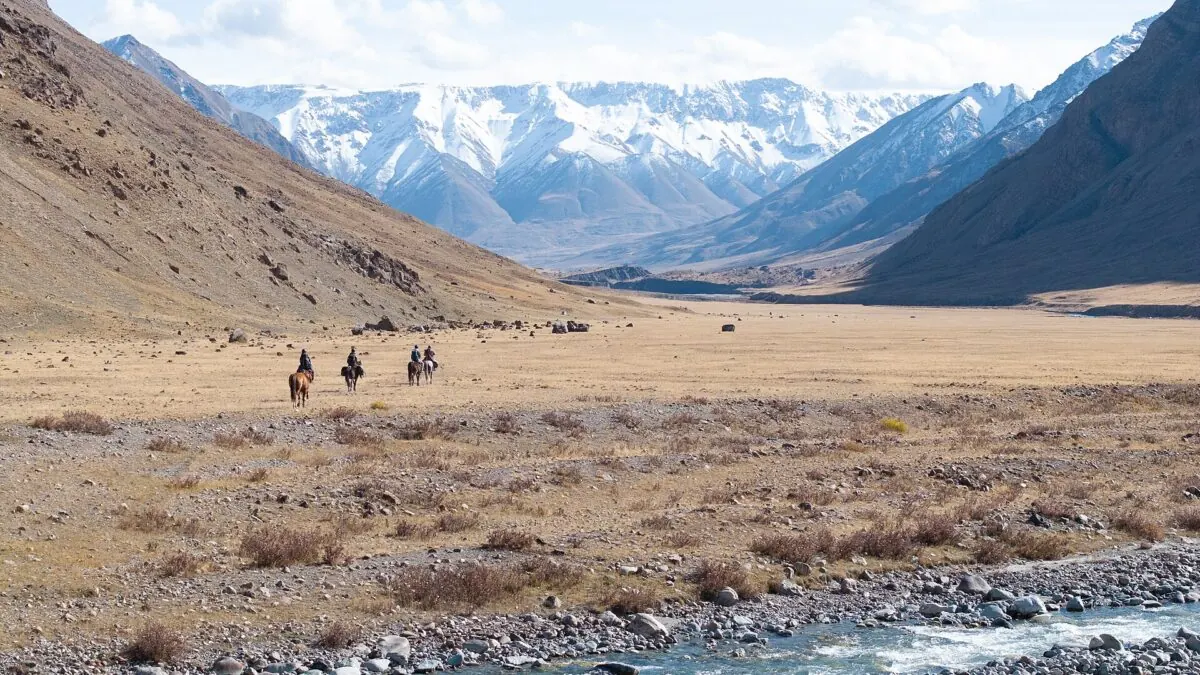
Sarychat-Ertash sits at elevations mostly above 3,000 meters, climbing toward glaciated peaks over 5,000 meters near the Chinese frontier. The terrain is a mix of river valleys, scree slopes, and rocky ridgelines — exactly the broken, vertical ground snow leopards favor because it lets them stalk prey unseen. The reserve was established in 1995 specifically around this predator-prey relationship, and it has become one of the reference sites for Central Asian snow leopard research, with camera-trap and GPS-collar studies run in partnership with international conservation groups such as the Snow Leopard Trust.
The reserve’s namesake rivers, the Sarychat and the Ertash, cut through the core zone and feed into the Enilchek river system. This is remote even by Kyrgyz standards — closer to the Chinese border than to any town of consequence, and well beyond mobile signal for most of the route in.
What you’re realistically likely to see
Set expectations correctly and the trip is deeply satisfying; go in expecting a snow leopard photo op and you’ll be disappointed. A rough hierarchy of what sightings are actually plausible:
- Siberian ibex — the most commonly spotted large mammal, often in herds on the valley slopes
- Marmots — abundant near the river valleys, especially in early morning and evening
- Golden eagles and lammergeiers (bearded vultures) working the thermals above the ridgelines
- Argali sheep in the higher, more remote sections, though these are harder to reach
- Snow leopard tracks or scat, which trained rangers can sometimes point out even when the animal itself stays hidden
- An actual snow leopard sighting — possible, documented, but not something to plan a trip around
Guides and rangers who spend weeks at a time in the reserve have, understandably, seen far more than any short-stay visitor will. If a snow leopard sighting genuinely matters to you, a longer stay with an experienced local ranger improves the odds, but there’s no guarantee at any length.
Permits and how access actually works
Because Sarychat-Ertash sits inside Kyrgyzstan’s border security zone near China, independent access isn’t really an option. You need a border-zone (pogranzona) permit processed in advance, plus reserve entry permission, and in practice both are arranged by a specialist tour operator or the reserve administration itself rather than by a solo traveler filling out forms. Processing typically takes at least several days to a couple of weeks, so this has to be planned well ahead of arrival — not something to sort out from a guesthouse in Karakol two days before you want to go.
Most visits are organized through operators based in Karakol or Bishkek who specialize in the eastern Tian Shan and have existing relationships with the reserve administration. They handle the permit paperwork, provide a 4×4 for the approach roads, and supply a ranger-guide for the reserve itself, since independent hiking inside the protected core zone generally isn’t permitted.
Logistics: getting there, staying there, cost
The approach usually starts from Karakol or the Enilchek area, following rough 4×4 tracks up the Sarychat and Ertash valleys — there’s no paved road anywhere near the reserve core. Depending on the route and starting point, the drive-in alone can take a full day. Inside the reserve, travel is on foot or horseback, with rangers based at a handful of remote outposts.
Accommodation is camping — there are no guesthouses or yurts for tourists inside the reserve — so trips typically run as multi-day camping expeditions with a cook, driver, and ranger-guide included in the package. Budget for a organized multi-day trip typically runs from around $150-300 per person per day depending on group size, duration, and how much of the logistics (4×4, staff, permits, food) are bundled in; smaller groups pay more per head. Solo travelers should expect to pay a premium or try to join an existing small group through an operator.
Best season to visit
Late June through September is the realistic visiting window. Snow blocks the approach roads and high passes outside this period, and the reserve’s own operations scale back significantly in winter. Within that window, July and August offer the most reliable road conditions and the best chance of clear high-altitude weather, though afternoon thunderstorms are common at altitude. Wildlife visibility doesn’t change dramatically month to month within the season, but cooler shoulder weeks in June and September can mean more animal movement at lower elevations as ibex follow the fresh grass.
Who this trip is actually for
Sarychat-Ertash rewards travelers who care about the ecosystem more than the photograph. If your goal is a guaranteed snow leopard sighting, this reserve — or arguably anywhere on Earth — can’t promise that; even researchers with months of camera-trap data consider a direct sighting a rare event. If your goal is multi-day trekking through untouched high-altitude terrain, real ibex and marmot populations, and the chance (not the certainty) of something extraordinary, it’s one of the most rewarding remote destinations in the country.
It pairs naturally with other eastern Tian Shan itineraries out of Karakol, and it makes sense to fold it into a broader Kyrgyzstan trekking plan rather than a standalone visit, given the permit lead time. Anyone routing through this border region should also check current border crossing conditions and confirm their visa situation well before booking, since border-zone permits are processed alongside, not instead of, standard entry requirements.
Sarychat-Ertash FAQ
Can I visit Sarychat-Ertash independently, without a tour operator?
In practice, no. The reserve sits inside a border security zone requiring advance permits, and independent hiking inside the protected core generally isn’t allowed. Nearly all visits go through a licensed operator or the reserve administration directly.
What are my actual odds of seeing a snow leopard?
Low, even on a multi-day trip. The reserve is one of the better-documented snow leopard habitats in Central Asia, but the animals are elusive by nature. Ibex, marmots, and raptors are the sightings to actually expect; a snow leopard is a bonus, not a plan.
How far in advance should I book?
At least a few weeks, given permit processing times for the border zone and reserve entry. Peak summer slots with reputable operators can also fill up, so earlier is safer if you have specific dates in mind.
For passage and moulting rather than resident species, see bird migration over Kyrgyzstan, where around 40 per cent of the Central Asian ruddy shelduck population moults on one lake.
How big is Sarychat-Ertash reserve?
726 square kilometres in the eastern Tian Shan, hard against the Chinese border near the Enilchek glacier system. It is a state nature reserve rather than a national park, which is why access is controlled.
Why does Sarychat-Ertash exist?
To protect one of Central Asia's densest known snow leopard populations and the ibex herds the cats depend on. Camera-trap studies suggest a few dozen animals across a vast, cliff-riddled range.
What does it cost to visit Sarychat-Ertash?
A realistic budget in the hundreds of dollars, because visiting requires a border-zone permit and a licensed operator. This is not somewhere you reach on a marshrutka and a day's notice.