Kyrgyzstan isn’t marketed as a birdwatching destination the way Kenya or Costa Rica are, and it shouldn’t be oversold as one. But the country sits on a real migratory corridor between Siberia and South Asia, and Issyk-Kul — a vast, largely ice-free alpine lake — functions as a significant stopover and wintering site for waterfowl moving through the region. For travelers with a genuine interest in birds, rather than a checklist obsession, there’s real substance here, concentrated around a handful of specific sites and seasons rather than spread evenly across the country.
Between 327 and 407 bird species have been recorded in Kyrgyzstan depending on which authority you take across its lake, wetland, steppe, and high-mountain habitats. The honest framing: this is a country where birding rewards travelers already headed to Issyk-Kul or the high plateaus for other reasons, more than one worth flying in specifically for birds alone — unless you’re chasing a specific species or building a broader Central Asian birding trip.
Issyk-Kul: the main event
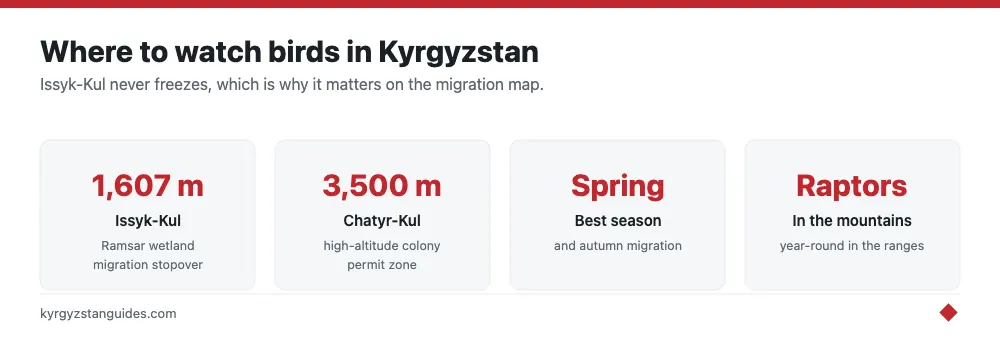
Issyk-Kul’s size and unusual chemistry — it’s a saline lake that rarely freezes even in harsh winters — make it an important wintering ground for waterfowl that would otherwise need to continue much further south. Large numbers of ducks, grebes, and coots overwinter on the lake, along with less common species that draw in dedicated birders specifically: greater flamingos have been recorded here as vagrants in small numbers, a genuinely unusual sighting this far from typical flamingo range, alongside more regular visitors like the whooper swan and various diving ducks.
The lake’s marshier bays and river-mouth wetlands, particularly toward the eastern end near Karakol, tend to concentrate the most bird activity, since these areas offer the shallow feeding grounds open water doesn’t. Cholpon-Ata’s surrounding shoreline and the quieter southern shore, away from the main resort strip, are both worth a slow walk with binoculars during migration season.
Chatyr-Kul: the high-altitude colony
Chatyr-Kul, a remote high-altitude lake near the Torugart pass at over 3,500 meters, is a different kind of site — colder, harsher, and far less visited, but ecologically significant enough to carry Ramsar wetland status. It supports breeding colonies of birds adapted to extreme conditions, and its isolation means fewer disturbances than lower, more accessible wetlands. It’s not an easy add-on; reaching it means being in the Naryn-Tash-Rabat region already, generally as part of a trip toward the Torugart border crossing rather than a dedicated birding detour. For travelers already making that trip, though, it’s worth the short diversion if time and weather allow.
Raptors in the mountains
Away from the lakes, Kyrgyzstan’s mountain ranges support a solid resident raptor population. Golden eagles are the headline species — still used in traditional falconry in parts of the country — and are regularly spotted working thermals above valleys like Ala-Archa and the eastern Tian Shan. Lammergeiers (bearded vultures), Himalayan griffon vultures, and various falcon species round out the higher-altitude raptor community, typically spotted from trekking trails rather than dedicated birding hides, since Kyrgyzstan doesn’t really have a built-out hide-and-blind birding infrastructure the way some destinations do.
This is arguably the most accessible birding in the country in practice: anyone trekking in the mountains for entirely non-birding reasons has a reasonable chance of raptor sightings without any special effort, simply by looking up during a rest stop on an exposed ridge or pass.
Best seasons for birding
Spring migration (roughly April through May) and autumn migration (September through October) are the strongest windows for variety, as birds move through the region between wintering and breeding grounds. Winter (November through February) is better specifically for waterfowl concentration on Issyk-Kul, since the lake’s ice-free water draws birds that have moved on from frozen wetlands further north — cold, but potentially rewarding if waterfowl are the priority. Summer is the season for the mountain raptors and any breeding activity at high-altitude sites like Chatyr-Kul, and it’s also, not coincidentally, the easiest season to actually reach these places given road and pass conditions.
Setting realistic expectations
Kyrgyzstan doesn’t have the dedicated birding lodges, hides, or specialist guide network that established birding destinations offer, and general tour operators here are set up primarily for trekking and cultural tourism rather than birding specifically. A handful of guides and naturalists with genuine ornithological knowledge do operate, mostly out of Karakol and Bishkek, and they’re worth seeking out directly if birding is a serious priority for your trip rather than a pleasant addition to it.
For most travelers, the realistic approach is to build birding into a broader Issyk-Kul or trekking itinerary rather than plan a trip around it. Bring binoculars, keep an eye on the lake’s quieter bays during a stay around Issyk-Kul, and treat raptor sightings on mountain routes as a bonus layered onto Kyrgyzstan trekking you’d likely be doing anyway. Cholpon-Ata’s shoreline is a reasonable base for lake-focused birding if you’re staying on the northern shore — see our Cholpon-Ata guide for logistics — and timing a visit around the best time to visit more broadly will also tell you what else is realistic to combine with a birding-focused stretch of the trip.
Why the species count varies by eighty
The number you get depends entirely on who is counting, and the spread is wide enough to be worth explaining rather than papering over.
BirdLife International says 330, with 19 globally threatened and no endemics. OSME, the regional ornithological society, says 327. A 2011 Kyrgyz zoological volume says 368. eBird holds 382 all-time. The national online checklist runs to 407, of which 86% are photographed.
The low figures are analytic lists maintained for conservation assessment. The high ones are full national checklists that include vagrants and one-off records. Neither is wrong; they are answering different questions.
One structural gap worth knowing if you plan to submit records: OSME states plainly that there is no rare birds committee in Kyrgyzstan and no BirdLife partner organisation. The Kyrgyz Association for Conservation of Biodiversity, founded in 2011, does citizen-science monitoring and states an ambition to become one.
The flamingo question, answered properly
This gets asked constantly and the marketing answer is wrong, so here is the record.
Greater flamingo is on the Kyrgyz national checklist. But eBird holds only ten observations for the entire country, nine with photographs, and weekly frequency is zero for most of the year. The most recent record is a single bird on 15 July 2025 at Chatyr-Kul — not Issyk-Kul.
The national photo archive holds 37 dated series taken between December 2017 and January 2023, by seven photographers, mostly at Balykchy at the western end of Issyk-Kul. The 2022 series span nine different months at the same spot, which is consistent with one or a few long-staying individuals rather than a seasonal influx.
Against that: BirdLife's Kyrgyzstan list does not include greater flamingo at all, and the peer-reviewed review of Issyk-Kul wintering birds never mentions them. If you read that flamingos winter at Issyk-Kul or arrive in flocks, that text is usually lifted from material describing the Kazakh and Iranian populations. There is no evidence of flamingos breeding in Kyrgyzstan.
The numbers that actually matter at Issyk-Kul
The lake is a genuine wintering site of international importance, and the counts are the reason. Its Ramsar listing describes it as of primary importance for wintering migratory waterbirds, with up to 70,000 birds recorded annually, and the lake never freezes despite sitting at 1,609 m.
Broken down by area, the western Issyk-Kul Important Bird Area holds 25,000 to 80,000 wintering waterbirds, including 2,000-6,000 red-crested pochard, 400-8,000 black-necked grebe and 200-500 whooper swan. The eastern end takes 9,000 to 22,000 on passage, with 2,000-6,000 demoiselle crane and 6,000-12,000 northern pintail.
The long-run trend is the most interesting dataset here. A peer-reviewed review of counts running back to the 1940s gives wintering totals of roughly 100,000 in the 1940s, 60,000 in the 1960s, 50,000 in the 1970s, 35,000-45,000 in the 1980s, 65,000 in the 1990s and 46,000-60,000 in the 2000s, with more than forty species annually. Coot dominate at 25,000-30,000; red-crested pochard 15,000-20,000; five grebe species 6,000-10,000; swans around 2,500.
Distribution matters for where you stand: 40-50% in the western shallows, 25-30% in the eastern bays, 10-15% in the north and only about 5% in the south.
A caveat on all of it: the Ramsar figure comes from a record last updated in 2013 and the eastern IBA counts date from 1976 to 1986. These are the published numbers, not current ones.
Three Ramsar sites, and what each is for
Issyk-Kul — Ramsar site 1231, designated 12 November 2002, 626,439 hectares. Also a UNESCO biosphere reserve. It was first listed by the USSR in 1976 and placed on the Montreux Record, the register of sites facing ecological change, in July 1990.
Chatyr-Kul — site 1588, designated 8 November 2005, 16,100 hectares, a saline lake at 3,530 m. It is a moulting site for nine duck species and holds around 40% of the world population of ruddy shelduck. It sits inside the border zone, so see our permit guide before planning a trip.
Son-Kul — site 1943, designated 23 January 2011, 36,869 hectares, with breeding bar-headed goose, black-necked grebe, gulls and terns, and as a refuge for great bustard and saker falcon.
Of the eleven Important Bird Areas in the country, all eleven were identified for migratory species, all eleven face identified threats and 55% are under high or very high pressure. Those assessments are dated 2010.
Birdwatching in Kyrgyzstan FAQ
Is Kyrgyzstan a serious birdwatching destination?
It’s a genuine but niche one. Issyk-Kul’s migratory and wintering waterfowl, plus mountain raptors, offer real substance, but the country lacks dedicated birding infrastructure found in established birding destinations. It rewards travelers already visiting for other reasons more than it justifies a birding-only trip.
When is the best time for birdwatching around Issyk-Kul?
Spring (April-May) and autumn (September-October) migration windows offer the widest variety. Winter is better specifically for concentrated waterfowl numbers, since the lake rarely freezes.
Can I really see flamingos in Kyrgyzstan?
Greater flamingos have been recorded as vagrants on Issyk-Kul in small numbers. It’s a genuine but uncommon sighting, not something to expect on a standard visit.
Do I need a specialist guide for birding here?
Not strictly, but a handful of naturalists with real ornithological knowledge operate out of Karakol and Bishkek, and they’re worth booking if birding is a priority rather than a bonus activity on a broader trip.
For passage and moulting rather than resident species, see bird migration over Kyrgyzstan, where around 40 per cent of the Central Asian ruddy shelduck population moults on one lake.