At-Bashy sits at roughly 2,000 meters in a vast, flat-bottomed valley south of Naryn, a livestock town strung along the road that ends at the Chinese border. It's the last real town before Tash-Rabat, Chatyr-Kul, and the Torugart Pass — the last ATMs, fuel stations, shops, and mobile signal for a long way — and that alone would justify a stop.
But At-Bashy is more than a supply halt. It's one of the most concentrated pockets of working horse culture in Kyrgyzstan, a place where kok-boru is a weekend reality rather than a festival performance, and where homestays put you inside ordinary rural life instead of alongside it. Spend a night here on your way to Tash-Rabat and the trip gets measurably better.
What At-Bashy actually is
Do not picture an alpine resort. At-Bashy is a functional agricultural town: wide dusty streets on a Soviet grid, single-story houses behind blue and green gates, a bazaar that peaks on market mornings, and livestock moving through at the edges of the day. The setting is what elevates it: the wall of the At-Bashy range rises directly to the south, snow-streaked into summer, and the valley light in the evening is extraordinary. The pleasure of the place is watching a high-altitude herding economy go about its business with zero performance for visitors.
Kok-boru country
The Naryn region is the heartland of kok-boru (the horseback game in which two teams wrestle a goat carcass toward opposing goals) and At-Bashy is one of its strongholds. Village matches happen on open fields around town, most reliably during autumn celebrations, weddings, and national holidays like Independence Day (August 31) and Nooruz (March 21). There is no fixture list; the method is to ask your homestay host whether anything is happening while you're around, and to say yes if the answer is yes. Watching a match on a village field, with spectators on horseback drifting along the sidelines, is a rawer version of what stadium crowds see at the World Nomad Games.
Sleeping there: homestays or nothing
At-Bashy has essentially no hotels; accommodation means guesthouses and homestays, and that is a feature. Expect a warm room in a family compound, dinner and breakfast at the family table, and hot water with a little advance notice. Prices typically run around 1,000–1,800 som per person with two meals — hedge upward slightly each season. The CBT (Community Based Tourism) network in Naryn can arrange At-Bashy homestays, drivers, and yurt stays deeper in the valleys, and booking a day or two ahead by phone or WhatsApp is usually enough outside peak weeks.
Using At-Bashy as a base
Tash-Rabat
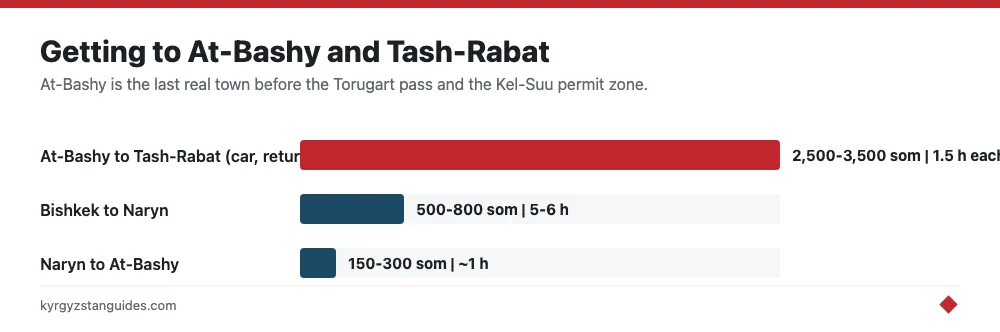
The 15th-century stone caravanserai at Tash-Rabat lies about 60 km away, up a side valley at 3,100 m — the single best day trip from town and one of the most atmospheric monuments in Central Asia. A hired taxi for the round trip typically costs around 2,500–3,500 som with waiting time. Our full Tash-Rabat guide covers the site, the yurt camps beside it, and the day hikes above it.
Chatyr-Kul and the Torugart Pass
Beyond Tash-Rabat, the road climbs to Chatyr-Kul, a huge, bleak, beautiful lake at 3,500 m near the Chinese frontier. The lake and the Torugart crossing sit inside a border zone that requires a permit, normally arranged through a tour agency one to two weeks ahead. Crossing Torugart into China has its own choreography of pre-arranged transport on both sides; our border crossings guide explains why this is the one crossing you cannot improvise.
The Ak-Sai valley and Kel-Suu
East of At-Bashy, the Ak-Sai valley leads toward Kel-Suu, the fjord-like lake locked between cliffs at 3,500 m that has become one of Kyrgyzstan’s most photographed remote destinations. It also requires a border-zone permit and a serious 4WD; most travelers arrange the whole package, permit, vehicle, yurt camp, from Naryn or Bishkek, but At-Bashy is the last town the route passes through.
Getting there
| Route | Time | Typical cost |
|---|---|---|
| Bishkek → Naryn (marshrutka or shared taxi) | about 5–6 hours | around 500–800 som |
| Naryn → At-Bashy (shared taxi) | about 1 hour | around 150–300 som per seat |
| At-Bashy → Tash-Rabat (hired taxi, round trip) | about 1.5 hours each way | around 2,500–3,500 som per car |
| At-Bashy → Kel-Suu region (arranged 4WD) | half a day | agency package pricing |
Shared taxis to At-Bashy leave from Naryn when full, most reliably in the morning; there's no meaningful public transport beyond the town itself, so onward legs mean hiring a driver or joining a tour vehicle. The broader logic of marshrutkas, shared taxis, and when to just hire a car is laid out in our getting around guide.
Practical notes
- Cash: withdraw in Naryn or Bishkek. At-Bashy has limited banking and card acceptance is effectively zero.
- Season: June through September is prime. The valley floor is livable in shoulder months, but the high side valleys close under snow, and winter here is genuinely severe.
- Connectivity: mobile signal is decent in town and vanishes fast up the side valleys — download offline maps before arrival.
- Fuel: fill up in At-Bashy if self-driving; it's the last dependable fuel before the border zone.
- Altitude: the town itself at ~2,000 m troubles almost nobody, but day trips jump to 3,100–3,500 m. Pace your first days accordingly.
Our verdict
At-Bashy isn't a destination you photograph; it is a destination you use. And in using it, you end up somewhere real. As a logistics base it beats rushing Tash-Rabat as a long day trip from Naryn. As a cultural stop it offers something the show-villages cannot: horse games played for their own sake, homestays that are simply homes, and a valley that still runs on herds and seasons. Give it one night on the way in and you'll likely wish you had planned two.
The border permit, and who actually issues it
Almost everything written in English about Kyrgyzstan's border-zone permit says the same two things: that you get it through a tour operator, and that it costs $30 or so. Both are descriptions of the agency market, not of the rule. The rule is public, and it is worth knowing before you pay somebody.
The governing instrument is the Rules of the border regime and border-strip regime, approved by Government Decree No. 172 of 4 April 2016 and amended five times since, most recently on 10 April 2026. I read the current edition in the Ministry of Justice legal database rather than relying on summaries, because the summaries disagree. Under it:
Applications do not go to the border service. They go to the authorised body for population registration, the State Registration Service, or its territorial subdivisions, including through the State Portal of Electronic Services. The security and border-guard bodies only clear the application; the permit itself is signed and issued by the head of the registration body.
Foreigners may apply as individuals. The Rules set out the documents for foreign citizens and stateless persons applying in their own name: the application form, a passport with a valid visa or registration record, and the duty receipt. Nothing in them requires a licensed tour operator.
The statutory clock is four working days: one for the registration body to pass the file to the security and border-guard bodies, two for their clearance, one to issue. If your documents are defective you are told by the next working day and have ten working days to fix them.
The state duty is 250 som for a foreign citizen, and 50 som for a Kyrgyz one. That is item 14 of the schedule of state duties, Government Decree No. 159 of 15 April 2019, in the edition in force from 23 July 2026. At September 2026 rates it is about three US dollars.
So why do agencies quote €30-35 and six to ten working days, and advise applying a fortnight ahead? Because they are selling the running around, and because in a remote valley with one road that is often a sensible thing to buy. But the €30 is a service fee, not a permit price, and the two should never be quoted as one number. If a guesthouse in Naryn tells you the permit costs thirty dollars, they are telling you what they charge.
Other provisions worth knowing: a permit runs for the period requested but never more than a year and cannot be extended; a lost permit is not reissued; the minimum age to hold one is 16, and under-16s travel only with an adult whose permit lists them.
Which ground the permit actually covers
The regime is defined by a line, not by a vibe about remoteness. For Naryn oblast, the rear boundary of the Kyrgyz-Chinese border territory runs through the Akbeyit, Uyurme and Kyndy passes and a series of named spot heights. Everything between that line and the Chinese border is border territory requiring a permit, which puts the Ak-Sai valley, Kel-Suu and Chatyr-Kol inside it. Within that, an inner border strip of 5,000 m from the state border is tighter still.
One honest gap: Tash-Rabat sits essentially on that rear boundary line, and the decree's text is too close to call either way. Most visitors reach it without a permit, but if your plan involves going beyond it toward Chatyr-Kol or Torugart, you are unambiguously inside the zone. Ask the Naryn registration office rather than a forum.
Koshoy-Korgon, and a dating nobody has settled
About 12 km from At-Bashy village, at 2,500 m in the middle of the valley, is a square earthwork that most people drive past. Koshoy-Korgon is a mud-block and pakhsa enclosure of 250 by 245 metres, its walls still standing 4 to 8 metres, ringed by a ditch 11 to 14 metres wide. It is identified with the medieval city of At-Bash. There has been a site museum since 2007.
Its dates are contested. UNESCO's tentative-list file puts its main life in the 9th to 12th centuries, still occupied in Timurid times. The head of the Kyrgyzrestavratsiya institute, speaking in May 2026, described it instead as an 8th to 14th century fortress with about 60 towers and walls once close to 10 metres high. Other Russian-language sources say around fifty towers. The first serious excavations were run by Alexander Bernshtam in the 1950s to 1970s, and an ornamented incense burner from the site is in the Kyrgyz State Historical Museum.
The walls are eroding badly, which is the other thing worth saying out loud.
Tash-Rabat is in trouble, and is not a World Heritage site
Two corrections to what you will read elsewhere. First, Tash-Rabat is not inscribed. It sits on Kyrgyzstan's tentative list. The country's actual Silk Roads World Heritage components are in the Chuy valley, not here.
Second, its condition. As of May 2026 the slate is delaminating, stones are coming out of the masonry and the mortar has reduced to powder. A low protective canopy has gone up as a stopgap, and the present campaign is the first restoration in roughly 45 years — the Soviet work began with research in the 1970s, when the central dome and several small domes had already partly collapsed and cement was introduced into the masonry.
What you are looking at, structurally: a square building of slate slabs, about 32.4 by 35 metres externally at 3,200 m, with a central corridor, a square hall, one large dome and nineteen small ones, built in Karakhanid times in the 11th or 12th century and in use until Timur's era.
Further on, Chatyr-Kol at 3,530 m is Ramsar Site No. 1588, designated 8 November 2005 over 16,100 hectares. Its basin holds around 40% of the world's moulting ruddy shelduck. That is the kind of number that makes the permit worth the four working days.
What the April 2026 amendment did, and did not, change
The rules were amended again on 10 April 2026, and it is worth knowing what that did, because it was reported at the time as a simplification.
It simplifies things for Kyrgyz citizens doing grazing and agricultural work in the border zone: they may now stay on the strength of an identity document plus named lists certified by the head of the local administration, valid for one calendar year, filed in advance with the border-protection body. For foreigners it changes nothing at all. If you read a 2026 headline about border-zone rules being relaxed, that is the one, and it is not about you.
One honest counterweight to everything above. The rules plainly allow a foreigner to apply directly, and I have read them. But Kyrgyzstan’s tourism board states that in practice tourists normally cannot, that licensed operators and CBT offices file on travellers’ behalf, and that do-it-yourself applications are "rarely accepted". That is a claim about administrative practice rather than law, and I cannot verify it from a state source. Treat it as a real possibility: know your rights under the decree, budget for an agency anyway, and do not arrive at a registration office three days before your trek assuming the four-day clock is yours.
FAQ
Who issues the Kyrgyz border-zone permit?
The State Registration Service or its territorial subdivisions, including via the State Portal of Electronic Services — not the border service, which only clears the application. This is set out in Government Decree No. 172 of 4 April 2016 as amended.
How much does a border-zone permit cost in Kyrgyzstan?
The state duty is 250 som for a foreign citizen and 50 som for a Kyrgyz one, about three US dollars at September 2026 rates. Agencies charge €30-35 or more, but that is their service fee, not the permit price.
How long does a border-zone permit take?
Four working days by statute: one to forward the file, two for security clearance, one to issue. Agencies advertise six to ten working days and advise applying a fortnight ahead, which reflects their own process rather than the legal timetable.
Can foreigners apply for a border permit themselves?
Yes. The Rules list the documents for foreign citizens applying as individuals, and nothing in them requires a tour operator. In practice many people still use an agency for the legwork, which is a reasonable purchase — just not a legal requirement.
Do you need a permit for Tash-Rabat?
Unclear from the text. Tash-Rabat sits essentially on the rear boundary of the border zone, and the decree is too close to call. Going beyond it toward Chatyr-Kol or Torugart definitely requires one. Ask the Naryn registration office.
Is Tash-Rabat a UNESCO World Heritage Site?
No. It is on Kyrgyzstan's tentative list only. As of May 2026 it is also in poor condition, with delaminating slate and powdered mortar, undergoing its first restoration in about 45 years.