Kok-boru, the headless-goat-carcass game, gets most of the write-ups, and fairly so. But it’s one event on a much longer nomad sports calendar. At any given nomad games weekend or regional festival, you’ll find horseback wrestling, a chase game where a rider tries to catch and whip another, a bone-tossing game played by seated elders, and grown men leaning off a galloping horse to snatch coins off the ground. None of it's staged for tourists — these are competitive sports with rules, judges, and rankings, and most towns have a version played at weddings and holidays long before any visitor shows up.
This is a field guide to the other five: what they're, how they’re scored, and where you can realistically expect to see one being played rather than reenacted.
Er enish: horseback wrestling
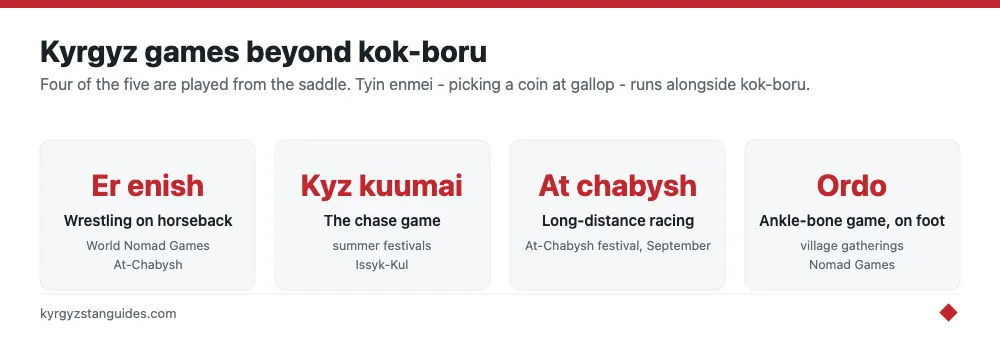
Two riders, two horses, one goal: pull your opponent out of the saddle. Er enish (sometimes transliterated oodarysh) looks simple and isn't. Riders grip each other by the belt or shoulders and try to unbalance the other while both horses are moving, which means the contest is as much about horsemanship as upper-body strength: a rider with a weaker grip but better balance and a smarter horse can still win. Matches are short, usually under a few minutes, and end the moment one rider’s body touches the ground or they’re forced out of the saddle entirely. It’s judged one-on-one, tournament-style, with weight classes at the bigger events so a 90kg wrestler isn’t matched against someone half his size.
It’s one of the more physically dangerous nomad sports, falls happen at a gallop-to-canter pace, and injuries aren’t rare, which is part of why it draws a crowd. You’ll see it at the World Nomad Games and at At-Chabysh’s annual gathering near Bishkek.
Kyz kuumai: the chase game
Kyz kuumai translates roughly to “catch the girl,” and the setup is a genuine courtship game turned competitive sport: a female rider gets a head start, a male rider chases her over a set distance, and if he catches her before the finish line, he claims a kiss. What tourist write-ups tend to skip is the return leg. On the way back, the roles reverse, the woman now chases the man, and if she catches him, she’s allowed to whip him with her riding crop, hard, for as long as she can before he crosses the line. It’s played for laughs at festivals now, but the horsemanship on display is real; both riders are moving at speed over open ground, and closing the gap on a good horse takes real skill, not choreography.
You’ll most often catch it as a lighter, crowd-facing event slotted between the more serious competitions at regional aiyt (festival) days, particularly around Issyk-Kul in summer.
At chabysh: distance horse racing
At chabysh is the plainest of the games to explain (it’s a horse race) but the distances separate it from anything you’d see at a Western track. Traditional courses run anywhere from 10 to 30 kilometers across open steppe or valley floor, well beyond sprint distance, which rewards a horse’s stamina and a rider’s pacing judgment over raw speed. Jockeys are often teenagers, chosen for low body weight, and it’s genuinely common to see a 12- or 14-year-old riding a race that adults have trained the horse for months to run. The annual At-Chabysh festival near Bishkek (usually held in September) is built around exactly this event and is one of the more accessible ways to see it without traveling to a remote valley.
Ordo: the ankle-bone game
Ordo is the outlier on this list because it’s played on foot, seated, with no horse involved at all. Closer to marbles or bocce than to the games above. Players use small dried ankle bones (chuko) arranged in a circle drawn in the dirt, and take turns flicking a larger “striker” bone (usually from a cow or horse) to knock the smaller bones out of the ring. Whoever clears the most bones from the circle wins. It’s a game older people in rural areas still play in courtyards and at gatherings, largely uncommercialized, which means you’re more likely to stumble on it at a village event than see it programmed as a headline attraction at a big festival: though the World Nomad Games does include an ordo competition.
Tyin enmei: picking coins at a gallop
Coins (traditionally silver ones, now often just marked tokens) are scattered along a stretch of ground, and riders gallop past at speed, leaning down from the saddle to grab as many as they can without dismounting or slowing. It sounds like a party trick until you watch someone attempt it — leaning that far off a moving horse without losing your seat takes serious core strength and trust in your horse’s footing, since a stumble at that lean angle throws the rider straight into the ground. It’s usually run as a short, high-energy segment within a larger festival program rather than a standalone event, so it tends to show up as one act in an afternoon that also includes er enish and kok-boru.
Where and when to actually see these games
Realistically, three routes get you there:
- The World Nomad Games — held every two years, the biggest single showcase, with most of these sports run as formal tournaments with international competitors.
- The At-Chabysh festival near Bishkek — an annual, smaller-scale event specifically built around horse culture, usually in September, and a more manageable day trip than chasing a village match.
- Regional toi (celebration) days and local aiyt festivals, especially around Issyk-Kul and Naryn in summer, the least predictable option since there’s no central calendar, but often the most genuine version of these games, played for a local crowd rather than an audience of visitors.
If you’re planning around the culture side of a trip generally, it’s worth reading up on nomadic culture more broadly before you go, since most of these games only make sense in that wider context of seasonal herding, weddings, and jailoo (summer pasture) life.
| Game | On horseback | Best chance to see it |
|---|---|---|
| Er enish | Yes | World Nomad Games, At-Chabysh |
| Kyz kuumai | Yes | Summer festivals, Issyk-Kul region |
| At chabysh | Yes | At-Chabysh festival (September) |
| Ordo | No | Village gatherings, World Nomad Games |
| Tyin enmei | Yes | Festival side-programs alongside kok-boru |
Frequently asked questions
Can tourists take part in any of these games?
Not in competitive matches, but some horse-trekking outfits and yurt camps run informal, low-stakes versions of tyin enmei or a gentler kyz kuumai for guests as an activity. It’s worth asking directly rather than assuming, most operators are honest about the difference between a demo and the real thing.
Is er enish dangerous to watch?
It’s dangerous for the riders more than for spectators, but keep a reasonable distance from the arena rope regardless. Horses do occasionally veer off course mid-match.
Do these games happen year-round?
No. Most cluster in the warmer months, roughly May through September, when herders are up on the jailoo and festival season is active. Winter travel means you’re very unlikely to see any of these live.
Where can I buy souvenirs related to these sports?
Markets in Bishkek and Karakol sell whips, small felt-and-leather figurines of riders, and ordo bone sets; our souvenir guide covers what’s genuine craftsmanship versus mass-produced.