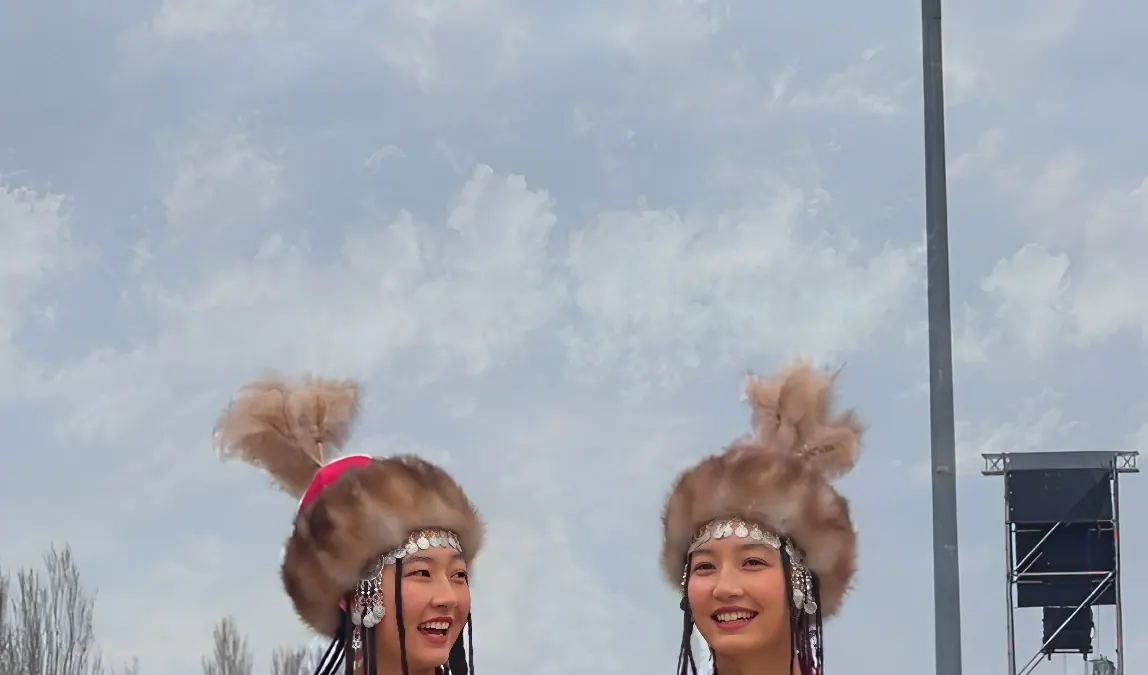
A warning before the calendar: almost no festival date in Kyrgyzstan can be trusted from a website. Events shift with weather, funding, and local decisions; last year’s Facebook post is often the only trace online, and it's usually wrong by the time you read it. The two dates you can carve in stone are Nooruz on March 21 and Independence Day on August 31. Everything else on this page should be treated as a season and a region, then confirmed on the ground — we explain exactly how at the end.
That fragility is also why Kyrgyz festivals are worth chasing. Nothing here's staged nightly for tour buses. A kok-boru match happens because two villages want to beat each other; an eagle festival happens because the hunters of Bokonbaevo still fly birds. Time a trip around even one of these and it'll likely outrank every lake and pass on your itinerary.
The year at a glance
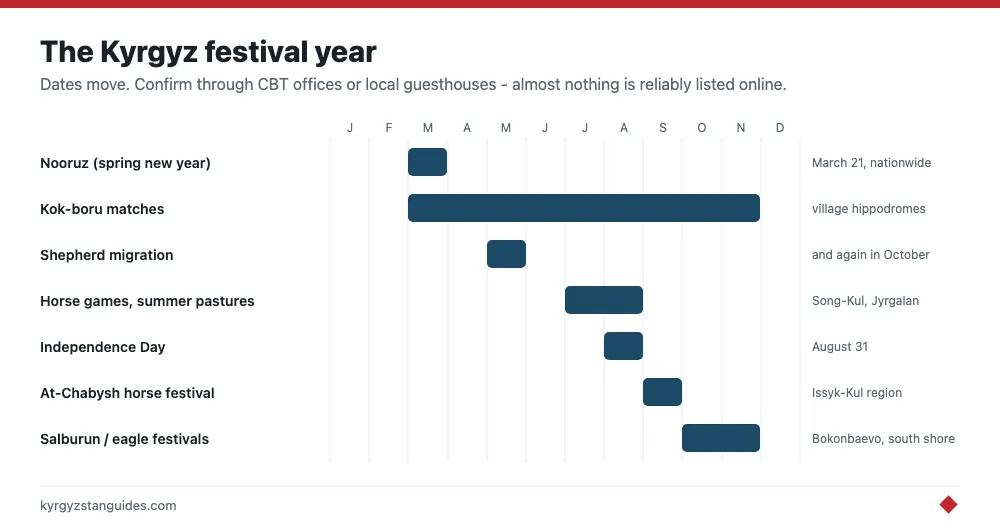
| When | Event | Where |
|---|---|---|
| March 21 | Nooruz (spring new year) | Nationwide; biggest in Bishkek and Osh |
| March-November | Kok-boru matches | Village hippodromes; biggest around holidays |
| May & October | Shepherd migration periods | Roads to/from summer pastures |
| July-August | Horse games and community festivals | Song-Kul, Jyrgalan, Issyk-Kul south shore |
| August 31 | Independence Day | Nationwide; hippodrome games in Bishkek |
| September (varies) | At-Chabysh horse festival | Historically Barskoon/Issyk-Kul region |
| October-November | Salburun / eagle hunting festivals | Bokonbaevo and south Issyk-Kul |
| Every 2 years | World Nomad Games | Rotating host country |
Nooruz — March 21
The Persian-rooted spring equinox festival is Kyrgyzstan’s biggest fixed celebration and a public holiday. Bishkek’s Ala-Too Square fills with yurts, concerts, and families in felt kalpaks; the essential ritual is sumolok, a wheat-germ porridge stirred in giant cauldrons all night, with every stirrer making a wish. Villages celebrate harder than cities in some ways — horse games often accompany Nooruz in rural hippodromes. It falls in mud season for trekking, so consider this the one cultural event worth a trip when the mountains are closed. Cold-weather logistics apply; late March in Bishkek can still bite.
Kok-boru, the national obsession
Kok-boru, two mounted teams wrestling a goat carcass toward a goal. Is not a festival but a sport with a season, and stumbling into a match is easier than most travelers assume. Matches cluster around public holidays (Nooruz, Independence Day) at hippodromes in Bishkek, Osh, and county towns, and summer community festivals almost always include a game. Ask at any regional CBT office whether a match is happening that week; the answer is yes more often than not between spring and late autumn. It is loud, fast, occasionally alarming, and completely hard to forget, the centerpiece of the horse culture we unpack in our nomadic culture guide.
Summer horse games — July and August
High summer is when jailoo (summer pasture) life peaks, and with it the informal festival circuit. Yurt camp operators around Song-Kul stage horse-game demonstrations, er enish (horseback wrestling), kyz kuumai (the kiss-chase race), ulak tartysh, some laid on for guests, others genuine community contests that visitors happen to catch. Jyrgalan and the Issyk-Kul south shore villages run small summer festivals mixing games, felt-making, and food. The line between “real” and “for tourists” is blurrier than purists like to claim: the riders are the same either way, and the falls are real. If riding rather than watching appeals, our horse trekking guide covers multi-day options from the same valleys.
Independence Day — August 31
The second fixed date. Expect concerts on Ala-Too Square, flags everywhere, and (the real draw) major kok-boru and horse racing at the Bishkek hippodrome and regional grounds. It lands at the tail of peak trekking season, so many travelers can catch it with zero rerouting. Book Bishkek accommodation a little earlier than usual for that week.
At-Chabysh: the horse festival
At-Chabysh began in the 2000s as a revival festival for Kyrgyz horse breeds and traditional racing, historically held in autumn in the Issyk-Kul region (Barskoon has hosted repeatedly) with long-distance races, games, and music. It's the flagship example of the confirm-before-you-go rule: the festival has changed dates, locations, and scale across its history, and some years it's hard to verify it happened at all. If your dates land in September around Issyk-Kul, ask locally, if it is on, reroute for it.
Salburun and the eagle hunters — autumn
Salburun is the traditional Kyrgyz hunting complex: golden eagles, taigan hounds, and horseback archery. Bokonbaevo on Issyk-Kul’s south shore is its heartland, and autumn — usually October into November, when hunting season opens. Is when festivals happen: eagles stooping to lures at full speed, hounds coursing, archers shooting from the saddle. Smaller demonstrations can be arranged year-round through Bokonbaevo’s community tourism network, which is the honest fallback if your dates miss a festival. The autumn events are the real thing, though, tied to the working calendar of actual hunters rather than the tourist season. A big reason we rate autumn highly in our best time to visit breakdown.
World Nomad Games, the big one
The Olympics of nomadic sport, kok-boru, wrestling on horseback, eagle hunting, mas-wrestling, dozens more — was born in Kyrgyzstan at Cholpon-Ata in 2014 and ran there through 2018 before rotating abroad (Turkey 2022, Kazakhstan 2024). The games run on a two-year cycle, the official World Nomad Games site lists the next edition, and Kyrgyzstan continues to campaign to host again; when it does, it'll be the single best week to be in the country. Track the cycle and history in our World Nomad Games guide. Meanwhile, Kyrgyzstan runs national-level nomad games and ethno-festivals in the off years, same sports, smaller scale, far fewer cameras.
Harvest season and the quiet events
Autumn brings a scatter of harvest-flavored events that never make international listings: walnut harvest gatherings around Arslanbob in September-October, apple and apricot fairs in Issyk-Kul villages, honey festivals when the season cooperates. None are reliable enough to plan around; all are worth asking about when you arrive in a region. The pattern by now should be obvious — in Kyrgyzstan, the event listings live in people, not on websites.
How to actually confirm dates
Our working method, in order:
- CBT offices. Community Based Tourism has offices in Karakol, Bokonbaevo, Naryn, Osh, Kochkor, and beyond. Walk in or message them: they know what's happening in their valley this month, because they are usually helping organize it.
- Destination Karakol and regional tourism groups, plus Discover Kyrgyzstan channels, post summer and autumn event announcements: typically only weeks ahead. Check close to travel, not months out.
- Your guesthouse or yurt camp host. Ask on arrival, every time, in every town: “any festivals or horse games this week?” This one habit finds more events than all online research combined.
- Instagram and Facebook over Google. Kyrgyz organizers announce on social media in Russian or Kyrgyz. Search the event name in Cyrillic (Нооруз, кок-бору, салбурун) for current-year posts.
- Build slack into your route. Festivals reward travelers who can lose a day. Rigid itineraries drive straight past the best afternoon of the trip.
FAQ
What is the biggest festival in Kyrgyzstan?
Nooruz, on March 21, is the biggest annual celebration: a public holiday with yurts, concerts, sumolok porridge, and horse games nationwide. In World Nomad Games years when Kyrgyzstan hosts, that event eclipses everything else.
When can I see kok-boru in Kyrgyzstan?
Matches run roughly March through November, clustering around Nooruz, Independence Day (August 31), and summer village festivals. Ask at a CBT office or your guesthouse in any region — informal matches happen most weeks somewhere in season.
When are the eagle hunting festivals held?
The main salburun festivals happen in autumn, usually October-November, centered on Bokonbaevo on Issyk-Kul’s south shore. Outside festival dates, smaller eagle-hunting demonstrations can be arranged there year-round through local community tourism contacts.
Why can’t I find confirmed festival dates online?
Because most Kyrgyz festivals are community-organized and announced weeks ahead on Russian- or Kyrgyz-language social media, if at all. Only Nooruz (March 21) and Independence Day (August 31) are fixed. Confirm everything else through CBT offices and hosts once in the country.