Why does a tall, four-cornered white felt hat show up on government buildings, national holiday posters, and half the tourist stalls in Bishkek? Because the kalpak isn’t a costume piece revived for visitors — it’s a genuine national symbol, formally recognized by UNESCO as intangible cultural heritage in 2019, and men across Kyrgyzstan still wear one on national holidays, at weddings, and in some rural areas as ordinary daily headwear. If you buy one, you’re buying into a live tradition, not a museum piece, which is exactly why it’s worth knowing the difference between a real one and a $5 tourist-market version before you hand over money.
What the shape and pattern actually mean
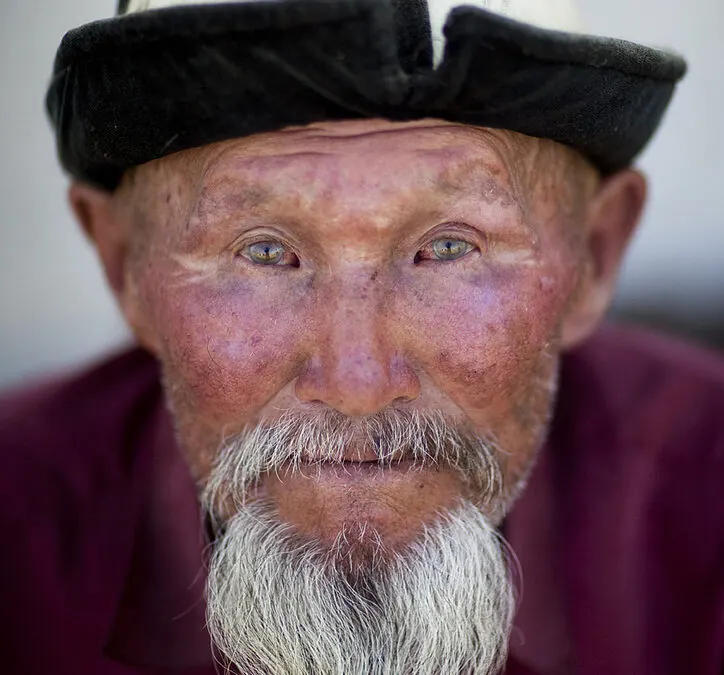
The kalpak’s silhouette: tall, four triangular panels rising to a point, a folded-up brim — isn’t decorative accident. Some accounts tie the four panels to the four points of the compass or the idea of unity across Kyrgyz tribal groups; others link the shape more loosely to the mountains that dominate the country’s geography. Either reading is common enough locally that you’ll hear both depending on who you ask, and neither is treated as more “official” than the other.
What does vary in a documented, regional way is the trim. Black velvet piping along the edge and embroidered patterns near the brim are common in the north, around Chuy and Issyk-Kul; southern styles, around Osh and Jalal-Abad, tend toward slightly different proportions and embroidery motifs, often with more color in the trim rather than pure black-and-white. None of this is rigid, you’ll find crossover everywhere, but if you’re buying from a maker rather than a generic stall, ask where the pattern is from. A good seller will actually know.
How a real one is made
A proper kalpak starts as sheep’s wool felt, hand-pressed and shaped, not cut-and-sewn synthetic fabric. The white outer layer is usually felt from white wool specifically (undyed, or lightly treated), lined on the inside, with the black trim added as a separate velvet or wool strip stitched around the folded brim edge. Making the felt itself — the flat sheet before it’s shaped into the hat form — is the same wet-felting process used for yurt panels and shyrdak rugs: wool is laid out, wetted, and worked by hand until the fibers lock together into a solid, dense material. It’s slow, and a hat made this way should feel notably heavier and stiffer than a cheap version, with a felt surface that has some texture and irregularity rather than a uniform, machine-smooth finish.
When it’s actually worn — and the etiquette around it
Outside major cities, older men in particular still wear a kalpak as everyday headwear, not just for occasions. In Bishkek and other cities it’s more strongly associated with national holidays (Nooruz, Independence Day), weddings, and formal cultural events, though it’s not unusual to spot one on a random weekday either. A few etiquette points worth knowing if you’re gifted one or invited to wear one: it’s a mark of respect and adulthood in Kyrgyz culture, traditionally not meant to be handled carelessly, tossed on the ground, or worn as a joke or costume prop at a party where it isn’t the context. If a host offers you one to try on as part of a cultural experience, some yurt stays and guesthouses do this, treat it the way you’d treat being handed a traditional garment anywhere: with a bit of care, not as a photo prop to be worn backwards.
Buying a genuine one vs. a tourist-market version
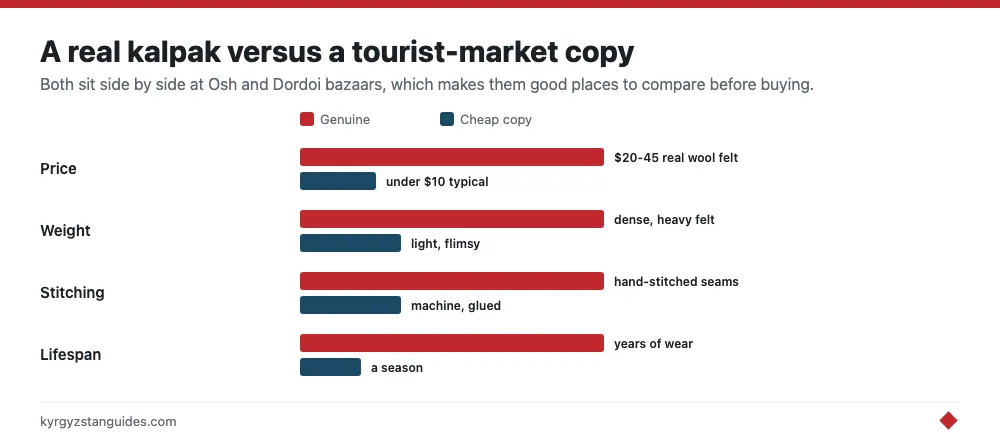
The giveaway signs of a cheap version: light weight, a smooth and slightly shiny synthetic-feeling exterior, machine-stitched trim that looks perfectly uniform, and a price under roughly $8-10. Those aren’t necessarily bad souvenirs if that’s all you want, but they’re not felt in the traditional sense, often a cotton or synthetic blend pressed to look like felt.
A genuine wool-felt kalpak from a proper maker or a cooperative shop typically runs somewhere in the $20-45 range, sometimes more for detailed embroidery or a larger size, and should feel dense and slightly stiff, hold its shape without support, and show small hand-finishing irregularities rather than machine perfection. Osh Bazaar and Dordoi Bazaar in Bishkek both sell kalpaks at every price point side by side, which actually makes them decent places to compare a $6 version against a $30 one in the same stall row before deciding what you actually want. Karakol’s craft cooperatives and some shops geared toward felt goods generally (rather than tourist trinkets broadly) tend to stock the better-made versions, sometimes with a small tag noting the maker.
If you’re weighing this purchase alongside other crafts, our souvenirs guide covers shyrdak rugs, felt goods generally, and where the genuinely handmade stuff tends to concentrate versus the mass-produced stalls aimed squarely at tour groups. Kalpaks show up in both places, so the same rule applies: touch it, weigh it, ask who made it.
Where to look while you’re traveling
Bishkek is the easiest starting point simply on volume: between Osh Bazaar, Dordoi, and craft shops around the center covered in our Bishkek guide, you’ll see enough options quickly to calibrate what “genuine” actually looks and feels like before you commit to buying. Osh, in the south, is worth a look too if your route takes you that way. The city’s own bazaar culture runs deep, and southern-style trim patterns are easier to find there than in the north. Wherever you buy, factor the hat into your luggage plan; a properly stiff felt kalpak doesn’t compress well and travels better in a day pack or worn than crushed into a packed suitcase.
Bottom line: treat the price tag as a rough proxy for authenticity, but let your hands do the real check: weight, stiffness, and stitching tell you more than any sign claiming “handmade” ever will.
What UNESCO actually recorded
The inscription is worth reading rather than just citing, because it settles a question the guidebooks leave open. Ak-kalpak craftsmanship, traditional knowledge and skills in making and wearing Kyrgyz men's headwear was added to the Representative List on 12 December 2019, at the committee's 14th session in Bogotá, Colombia.
On the shape, UNESCO's own description is specific: the kalpak resembles a snow peak, and its four sides represent the four elements — air, water, fire and earth. That is the reading the state party submitted and the committee accepted. You will still hear the compass-points and the tribal-unity explanations locally, and they are genuinely current, but if you want the documented version, it's the four elements. It's a small correction and a useful one to have in your pocket when a seller tells you something different.
Two other details from the file change how you look at a market stall. First, UNESCO records more than eighty distinguishable kinds of ak-kalpak, each with patterns carrying their own meaning and history — so the regional variation is not a vague impression, it's a documented typology. Second, the craft is transmitted by craftswomen, through oral coaching and joint making in workshops. The hat is worn by men and made, overwhelmingly, by women. The listing also notes something easy to miss: people from other ethnic groups in Kyrgyzstan wear it on holidays and at funerals as a gesture of solidarity.
Ak-Kalpak Day, and why you might see thousands at once
If you are in Kyrgyzstan on 5 March, you'll see the hat everywhere at once. Ak-Kalpak Day started as an unofficial celebration in 2011, on the initiative of the director Rysbek Zhabirov, and was given official status in 2016, three years before the UNESCO listing. Schools, ministries and universities mark it, and the streets of Bishkek carry a density of white felt you won't see on any ordinary day.
It's the single best day of the year to buy one, for a practical reason rather than a sentimental one: makers bring stock out for it, including the good hand-felted pieces that normally sit in workshops rather than on tourist stalls, and you can compare twenty of them side by side instead of squinting at three. If your dates don't line up, aim for the run-up to Nooruz later the same month for a weaker version of the same effect.
FAQ
What does the kalpak's shape mean?
UNESCO's inscription describes it as resembling a snow peak, with the four sides representing the four elements — air, water, fire and earth. Locally you'll also hear it explained as the four compass points or as a symbol of unity between Kyrgyz tribes; both readings are current, but the four elements is the documented one.
When did the kalpak become UNESCO heritage?
On 12 December 2019, at the 14th session of the Intangible Cultural Heritage Committee in Bogotá, Colombia, under the title "Ak-kalpak craftsmanship, traditional knowledge and skills in making and wearing Kyrgyz men's headwear".
How many types of kalpak are there?
UNESCO records more than eighty distinguishable kinds, each with its own patterns and associated meanings. Northern styles around Chuy and Issyk-Kul typically use black velvet trim; southern styles around Osh and Jalal-Abad tend toward more colour in the trim.
When is Ak-Kalpak Day in Kyrgyzstan?
5 March. It began unofficially in 2011 on the initiative of director Rysbek Zhabirov and received official status in 2016. It's the best day of the year to buy one, because makers bring out stock that normally stays in workshops.
Who makes kalpaks?
Craftswomen, almost entirely. UNESCO's file records the skills as passed down by women through oral coaching, hands-on training and joint making in workshops. The hat is worn by men and made by women.
Can foreigners wear a kalpak in Kyrgyzstan?
Yes, and it is generally taken well rather than as appropriation — UNESCO's own file notes that people from other ethnic groups wear it on holidays and at funerals to express solidarity. Wear it upright and do not put it on the ground.
The women’s side of the same tradition — the elechek, the shökülö and the beldemchi, and what is genuinely still worn — is in Kyrgyz women’s dress.