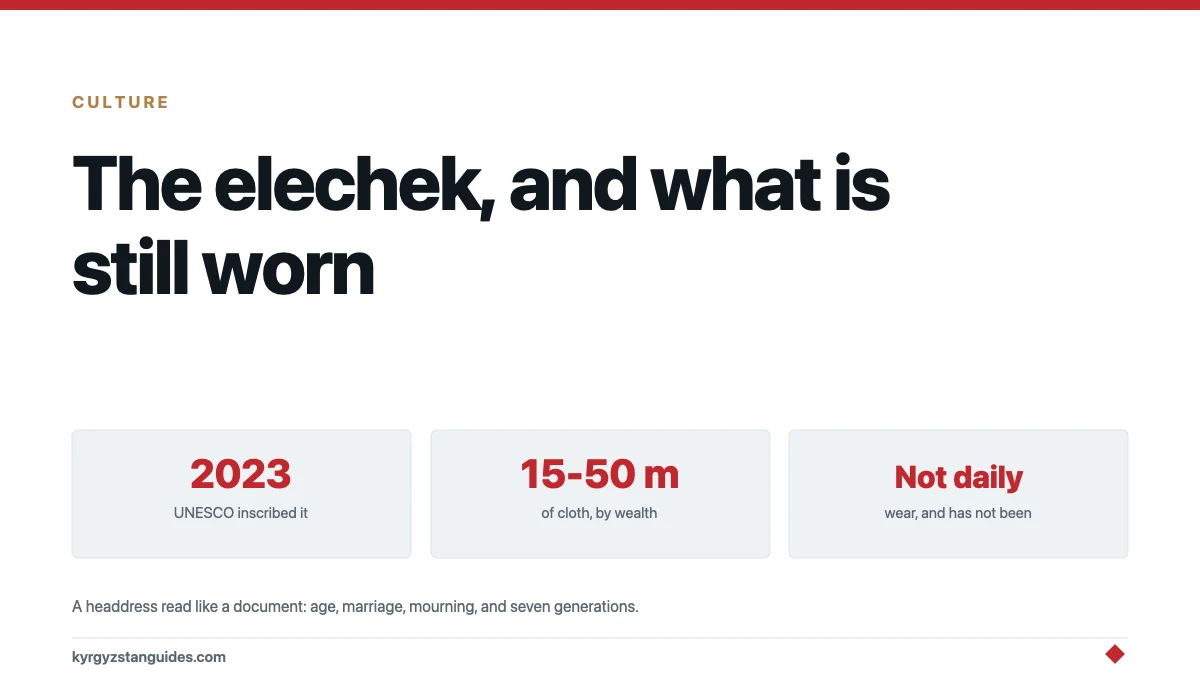
The elechek is a white cloth turban wound over a cap, and it was read the way you would read a document. How it was wound told you a woman's age. Whether she wore one at all told you she was married. A black-shrouded version told you she was grieving.
UNESCO inscribed it in 2023. It is also not daily wear and has not been for well over a century, and any page that suggests you will see it walking down Chuy Avenue is selling you something.
What UNESCO actually listed
The element is "Elechek, Kyrgyz female headwear: traditional knowledge and rituals", on the Representative List of the Intangible Cultural Heritage of Humanity. Inscribed in 2023 at the 18th session of the committee in Kasane, Botswana, 5 to 9 December, under decision 18.COM 8.b.38, nomination file 01985. Kyrgyzstan submitted it alone.
Do not confuse this with ak-kalpak craftsmanship, which is the men's white felt hat and was inscribed in 2019. They are separate listings four years apart.
UNESCO's own description is worth quoting for what it is careful about: a married woman "may wear the elechek at significant occasions". That is not the language of a living daily custom, and the nomination itself notes that transmission now runs partly through workshops and online video lessons. This is a documented revival, not an unbroken practice.
How it is built and wound
The elechek is not one piece of cloth. The named parts include the bash kep, the head cap underneath; the eek algych, the chin-piece; lower and upper wraps, astynky tartma and üstünkü tartma; plus a small amulet, tumarcha.
Underneath sits the kep takyya, a white under-cap that protects the hair and stops the layers slipping. In Talas, Issyk-Kul and Naryn it had no ear flaps, and the connecting strips at chin and nape were sewn onto the elechek itself instead. Around the outside runs the kyrgak, a wide ribbon that is both structural and decorative.
It is wound back to front. For festive wear, two or three women worked on it together: one winding, one smoothing, one securing each layer with needle stitches — no knots — and special pins.
How much cloth? Sources do not agree and we are not going to pretend they do. One master craftswoman gives 30 to 50 metres for wealthy women and about 20 metres today, and points out that it was historically measured in arm-spans and hand-spans rather than metres, so no exact historical figure survives. Other sources give 15 to 30 metres, up to 30 to 40 for the wealthy. An academic account says festive versions took 20 to 30 arm-spans. Take 15 to 50 metres as the honest range, depending on wealth and occasion.
One detail that is specific rather than decorative: if the elechek is wound so that the edges of seven layers show, it is said to honour the jeti ata, the seven forefathers of the patriline, and to draw their support.
It changed with age, and you could see it
In the north, three winding styles were graded by age.
Under about twenty, for a young bride, the front was folded into a pleat three or four times and worn with the chin-piece, often with a crane or eagle-owl feather at the side or back, and silver edging, beads or embroidered ribbon.
Over about thirty, the pleat moved to the back, the forehead was drawn flat, and a decorated "tail" was brought out.
At fifty and older, the chin-piece and tail were worn together, with a kerchief thrown over so the fold fell behind.
North and south still differ. One source names four winding traditions — northern, north-western, southern and Ferghana — and the southern form differs in shape from the northern. The headdress also carried different names by region: ileki in the north, and kelek in the south, specifically in the Alai valley and among Kyrgyz in the Murghab district of Tajikistan.
The fabric was always white: fine muslin, or white calico for wealthier families. The volume grew with age and with wealth.
Girls went bare-headed until marriage. A mother wound her daughter's first elechek at the wedding, before the bride left for her husband's family, and after that it was worn continuously except while sleeping — indoors, during housework, all of it.
The shökülö, which is the one you will photograph
The shökülö is the conical cap of a newly married woman, 25 to 30 centimetres tall. Originally white felt, later quilted over a wool core, covered in red velvet, with ear flaps of otter and marten fur. The forehead was set with pearls, mother-of-pearl, gilded pierced plates and embroidery, with owl feathers at the crown and a veil.
It was worn as the girl left her parents' house. On arrival, senior women replaced it with a kerchief. That swap is the whole social meaning of the object.
The beldemchi
The beldemchi is a wrap skirt, open at the front, gathered onto a wide belt. The name comes from bel, waist. The old dictionary carries a second, historical sense that is easy to miss: a battle garment, a metal cuirass covering the waist and part of the ribs, which turns up in lines of the Manas epic.
Two types are documented.
The first is wide and falls below the knee, made of several slightly angled panels gathered onto a belt of thin felt, lined and padded with wool, reported at anywhere from 14 to 20 centimetres wide across the sources. Fabrics were black lustrous lampuk, Central Asian patterned silks, striped bekasab, or wool, sometimes hand-woven. Herders' wives had sheepskin versions for winter. This type belongs to Issyk-Kul, the Tian-Shan and the Talas valley.
The second is shorter and narrower, open at the front and barely gathered, in patterned Uzbek half-silk or velvet, sometimes alternating black velvet with red wool stripes. It belongs to the ichkilik grouping — Osh oblast, the Pamir, Karategin.
Decoration is tambour-stitch embroidery in multicoloured silk, red-dominant with white, green, yellow and blue, matching the aesthetic of wall carpets. Formal pieces are edged with otter fur at the hem and front openings.
The rule that governs it: the beldemchi was not worn before marriage. One account is more specific, saying it came after the first child, when a young wife's parents brought her a cradle and a beldemchi together; an academic source says simply "married women". Cut, ornament and colour could indicate clan, means and how many children she had.
It was also practical. It kept a woman warm riding, working outdoors or in a cold yurt, without restricting movement.
The jewellery, with what the words mean
Söykö — large cone-shaped earring-pendants falling onto the neck and chest. The word is also a rite: söykö sal, to hang the söykö, is attaching it to a girl as the sign that matchmaking has succeeded, performed by the groom's mother at the first visit of his parents. It is the Kyrgyz engagement token.
Bilerik — bracelet, from bilek, forearm. Open or closed, twisted or flat with a widened centre, in gold, silver, brass or horn. The same word means the dark transverse rings on a horse's legs.
Chach uchtuk — literally the hair-end piece, hung at the braid tips. Related are the chachpak, long velvet strips rolled into tubes that sheathe the braids, with pendants; lighter silver for girls, heavier for older women.
Plus shakek, a finger ring, and tumar, an amulet worn at the chest.
For girls there was a sequence of caps before marriage: the takyya topu at ten to twelve, velvet with a gathered crown and ear flaps, and the ükülüü tebetey, the owl-feathered tebetey, at sixteen to eighteen.
The summary the language itself gives: girls wore the cap, married women put on the kerchief, the jooluk. The blessing said over a bride translates as "may the white kerchief never fall from your head."
So what do women actually wear today
The jooluk, for married and older women, and ordinary international clothing otherwise. Use of the elechek fell away sharply by the end of the nineteenth century.
You will see the elechek and shökülö at weddings and blessings, at the seeing-off of a bride, at national holidays and heritage events, and in staged folklore and museum demonstrations. Not on the street.
Where to see it properly:
The National Historical Museum of the Kyrgyz Republic, Chuy Avenue 112 on Ala-Too Square, Tuesday to Sunday 09:00 to 18:00 with the ticket office closing at 17:30. Closed Mondays and on the last Friday of each month. Tours in Kyrgyz and Russian are included in the ticket; prices are not published online.
The Kyrgyz National Museum of Fine Arts, Abdrakhmanov 196, holds around 18,000 items with a strong applied and decorative arts collection — felt, embroidery, jewellery. We could not find an official site, so check hours before going.
A 2018 exhibition at the Frunze House-Museum in Bishkek documented thirteen types of elechek, with elder women demonstrating the winding. The foundation behind it also supplied the media for the UNESCO nomination, so it is the main institutional actor here.
The densest concentration of traditional dress is at the ethno-village in Kyrchyn gorge during the World Nomad Games. Note the timing: the sixth edition ran from 31 August to 6 September 2026 and has finished. See our World Nomad Games guide for the cycle, and felt hats and the kalpak for the men's side of the same story.
FAQ
Is the elechek UNESCO-listed?
Yes. "Elechek, Kyrgyz female headwear: traditional knowledge and rituals" was inscribed on the Representative List of the Intangible Cultural Heritage of Humanity in 2023, at the committee's 18th session in Botswana, under nomination file 01985. It is a separate listing from ak-kalpak craftsmanship, the men's felt hat, which was inscribed in 2019.
How long is the cloth in an elechek?
Sources disagree. Figures range from 15 to 50 metres depending on wealth and occasion, with around 20 metres cited for versions made today. It was historically measured in arm-spans rather than metres, so no exact historical figure survives.
Do Kyrgyz women still wear the elechek?
Not in daily life. Its use declined sharply by the end of the nineteenth century, and UNESCO's own text says a married woman "may wear the elechek at significant occasions". You will see it at weddings, bride send-offs, national holidays, heritage events and museum demonstrations.
What is a beldemchi?
A wrap skirt, open at the front and gathered onto a wide padded belt, worn by married women over a dress or a short jacket. Two regional types are documented: a wide, below-knee version from Issyk-Kul, the Tian-Shan and Talas, and a shorter, narrower one from Osh, the Pamir and Karategin.
What is a shökülö?
The tall conical cap of a newly married woman, 25 to 30 centimetres high, in red velvet over felt, with otter and marten fur flaps, pearls and mother-of-pearl at the forehead, owl feathers at the crown and a veil. It was worn as the bride left her parents' house and replaced with a kerchief on arrival at her husband's.
Where can I see traditional Kyrgyz women's dress?
The National Historical Museum on Ala-Too Square at Chuy Avenue 112, open Tuesday to Sunday and closed on the last Friday of each month, and the National Museum of Fine Arts on Abdrakhmanov. For dress in use rather than in a case, the ethno-village at the World Nomad Games is the densest concentration, though the 2026 edition has already taken place.