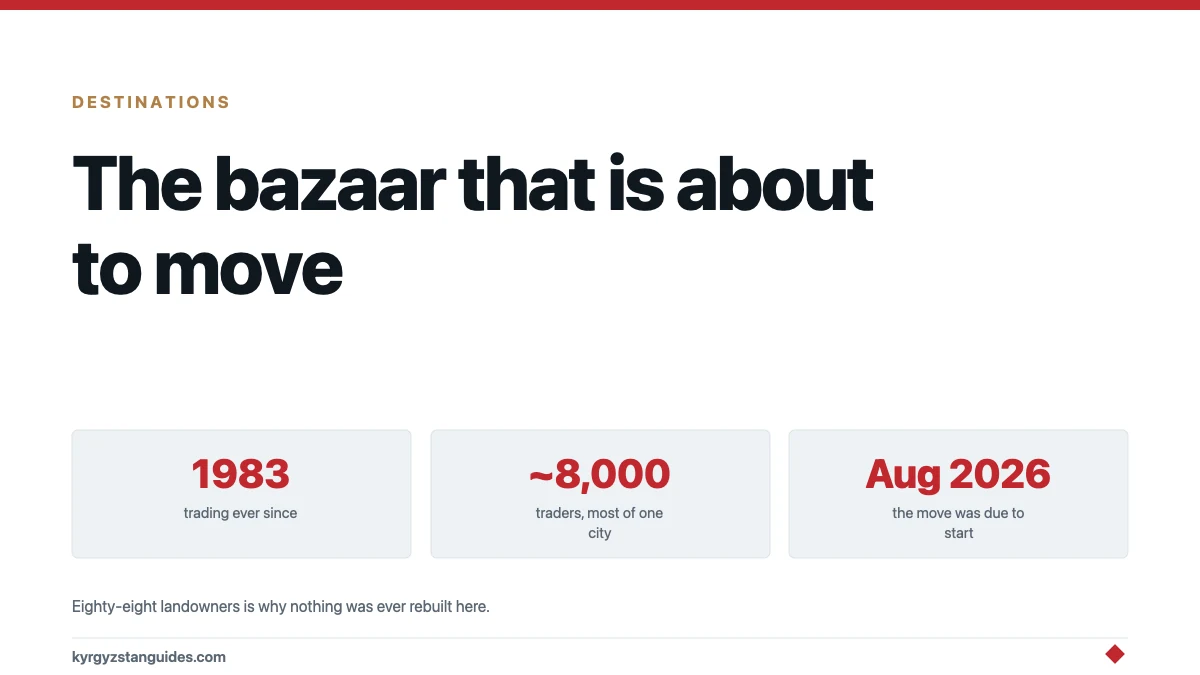
Every guide to Bishkek mentions Osh Bazaar twice: once as the place to buy things, and once as the place where your wallet will be stolen. Almost none of them tell you that the market has been trading since 1983, that it is run across eighty-eight separate landholdings, or that it was supposed to shut and move out of the city in August 2026.
First, the name. Osh Bazaar is in central Bishkek. It is not in, and not named for being in, the city of Osh six hundred kilometres south.
The scale of it
The market has operated since 1983, making it about forty years old when it was last surveyed properly. The original footprint is five hectares with a trading area of 17,000 square metres.
Traders: roughly 6,000 officially registered and around 8,000 in practice, including about a thousand unregistered street vendors. That is a working population the size of a small town, inside one market.
Goods run food and non-food side by side, which is unusual and is part of why it feels chaotic: potatoes and vegetables, fruit, meat, groceries, clothing, household goods, sweets, sewing threads and haberdashery, cleaning products. You can buy a kilo of apricots and a set of curtains within thirty metres of each other.
One thing I cannot tell you is opening hours. No official or news source states them, and I am not going to invent a figure for something so easy to get wrong. Go mid-morning and you will not be early or late.
Why it was never rebuilt: eighty-eight landowners
The single most useful fact about Osh Bazaar explains everything else about it. The land is fragmented among eighty-eight separate landowners, with plots valued from around $30,000 a hectare. That fragmentation, not neglect, is the main obstacle to redevelopment. Nobody can rebuild a market they only own a slice of.
It also has no cultural heritage or monument status and appears on no protected-objects register, so there is nothing legally preventing its removal either.
The fires
The market burns with some regularity. The best-documented event is the fire of 30 January 2018, which started at 09:48 in a building whose ground floor held the Seytek clothing mini-market and whose first floor held the administration. It was localised by 12:30. Two people were treated for mild carbon monoxide poisoning and five emergency brigades attended. The area burned was about 3,500 square metres, with losses estimated in the millions of som. The emergencies minister said a short circuit was the likely cause; eyewitnesses blamed heaters.
It was not a one-off. One Kyrgyz outlet's topic index for fires at this market carries thirty-nine articles, including February 2020 and April 2019.
A correction worth making, because it circulates: there was no 2023 fire at Osh Bazaar that I could verify in English or Russian. The documented major fires cluster in 2018, 2019 and 2020. Large Bishkek market fires in 2025 and 2026 happened at other markets — Aziz in December 2025 and Madina in August 2026 — not this one.
It is supposed to be moving
The plan is relocation, not reconstruction. Traders are to move to a purpose-built market beyond Prigorodnoye village, with the move scheduled to begin 1 August 2026. The old site is promised a park, and a hospital on the adjacent Kyyal territory.
The new market is large: 155,000 square metres, seven blocks — two single-storey and five two-storey — five entrances, a 400-space underground car park and 6,000 surface spaces.
As of 26 June 2026 the old market was still trading, the move had slipped from May to the end of August, and traders reported having received no formal closure notices. Clothing sellers pointed out they need three months' warning to manage seasonal stock. No plan has been announced to preserve any part of the old market, including its entrance arch.
So if you are reading this before a trip: check whether it is still there. A market that has been trading in the same place for over forty years is in the process of being switched off, and the date keeps moving.
Money changing here, and why it is the bigger risk
The pickpocket warning gets all the attention. The quieter problem at any Bishkek bazaar is the currency exchange, and this is one where the law is clear and travellers routinely get it wrong.
Exchange bureaus are licensed by the National Bank, which publishes names, licence numbers and suspensions, and enforces against them — in the second quarter of 2026 alone it issued 382 prescriptions, revoked twenty licences, suspended twenty-six and fined thirty-six bureaus.
Bazaars are also where the state’s attempts to tax the informal economy meet the most resistance. Exchanging cash with an unlicensed individual is not a grey area, it is an offence, and it is prosecuted. In June 2026 six people in Bishkek were fined 17,500 som each for changing foreign currency without a licence. If someone approaches you near the market with a better rate than the windows are showing, the transaction itself is illegal, and you are the one holding unfamiliar banknotes afterwards.
Use a bureau with a posted rate and a visible licence, count the notes at the window before you step away, and do not let anyone recount them for you. Our guide to money in Kyrgyzstan covers cards, ATMs and where the rates are actually best.
What it is actually like, and what is being lost
It is worth saying what a market of eight thousand traders feels like, because the safety framing makes people approach it as a hazard rather than a place. It is the main food market for a large part of the capital. It is where people buy potatoes in twenty-kilo sacks, and where the seasonal fruit arrives first and cheapest.
The layout is not designed so much as accumulated, which is the consequence of eighty-eight owners: food and clothing rows abut each other, passages narrow without warning, and the logic is historical rather than planned. That is exactly what will not survive the move to a purpose-built site with seven blocks and numbered pitches.
And nothing is being kept. No plan has been announced to preserve any part of the old market, including its entrance arch. A market that has run continuously on the same ground since 1983 is due to be replaced by a park, with a hospital next door.
If you are in Bishkek before the move completes, that is a reason to go rather than a reason to avoid it — with your bag in front of you.
The pickpockets, properly sourced
This one is not travel-blog folklore. The UK Foreign Office names the market explicitly in its advice: be careful when using currency exchange offices and visiting the bazaars in Bishkek, particularly Osh Bazaar, where pickpockets target tourists. It also warns about street crime including bag-snatching and mugging, and about thieves using distraction techniques.
That is an unusually specific naming in a national travel advisory, and it is worth taking at face value. The practical response is the boring one: nothing in back pockets, bag in front and closed, no phone out while walking, and change money at a licensed bureau rather than at the market. Our guide to scams in Kyrgyzstan covers the rest, including why unlicensed street exchange is itself illegal.
FAQ
Where is Osh Bazaar?
In central Bishkek. Despite the name it is not in the city of Osh. It has been trading on the same site since 1983, across about five hectares with a 17,000 square metre trading area.
Is Osh Bazaar safe?
The UK Foreign Office names it specifically, warning that pickpockets there target tourists, alongside bag-snatching, mugging and distraction techniques. Keep nothing in back pockets, carry your bag closed and in front, and change money at a licensed bureau instead.
Is Osh Bazaar closing?
That is the plan. Traders are to relocate to a new 155,000 square metre market beyond Prigorodnoye, with the move scheduled to start on 1 August 2026. As of late June 2026 it had slipped to the end of August and traders had received no formal notices. Check before you go.
How many traders work at Osh Bazaar?
Around 6,000 are officially registered and about 8,000 trade in practice, including roughly a thousand unregistered street vendors.
Why has Osh Bazaar never been rebuilt?
The land is split between eighty-eight separate owners, which is the main obstacle to any redevelopment. The market also holds no heritage or monument status.
Was there a fire at Osh Bazaar?
Several. The best-documented was on 30 January 2018, burning about 3,500 square metres with two people treated for carbon monoxide poisoning. There were further fires in 2019 and 2020. Claims of a 2023 fire could not be verified from any source.
The same pattern of unmarked, unprotected Soviet-era work runs through the city itself: see Bishkek’s Soviet mosaics, eleven catalogued panels and one that was destroyed in 2025 while still on the register.