Picture your first hour in Bishkek: you land, you need a taxi, a SIM, and dinner, and none of it runs on the card in your wallet the way it does at home. Money in Kyrgyzstan works on its own logic, and getting it right early saves a lot of small headaches later.
The essentials: the currency is the Kyrgyz som (KGS), trading around 87–89 to the US dollar. Cards work at city ATMs and larger hotels but this is a cash-first economy, so withdraw som from reputable bank ATMs — Optima, Demir, or KICB — carry US dollars in clean notes to change, and take plenty of cash into the mountains, where nothing electronic works. We put this together for travelers heading in, drawing on research rather than our own wallet on the ground, so verify rates locally.
The som, briefly
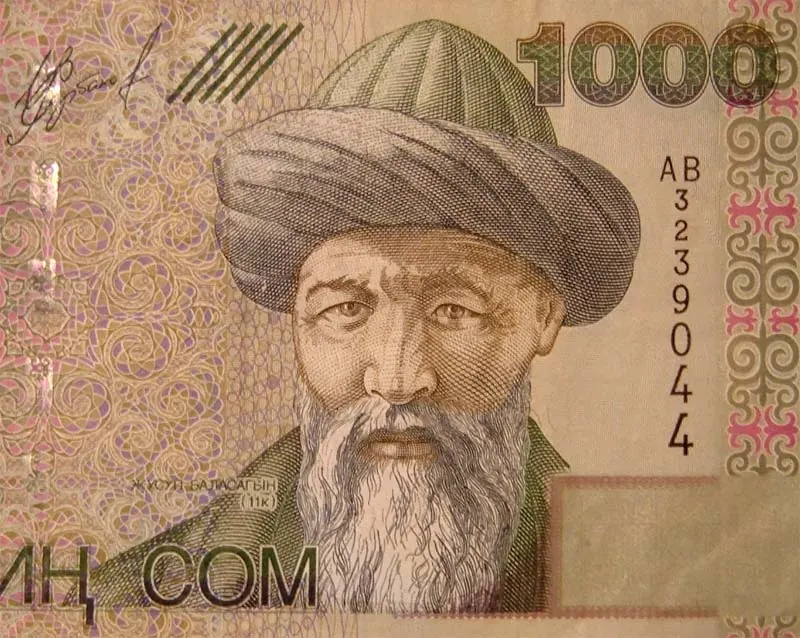
The Kyrgyz som comes in notes and small coins, and prices in shops and canteens are almost always quoted in it. The rate against the dollar is fairly stable in the high-80s, and the som sits close to parity with the Indian rupee, which makes mental math easy for Indian travelers — a price in som is roughly the same number in rupees. Do not expect to use dollars or any other currency directly; you will occasionally see dollar prices at agencies, but everyday spending is in som. For what those everyday prices actually are, our Kyrgyzstan travel budget guide has the numbers.
ATMs: which banks to trust
ATMs are the simplest way to get som, and in cities they're plentiful. Stick to machines attached to established banks, which are reliable and dispense clean notes at a fair rate. The names to look for are:
- Optima Bank — widely available, foreign-card friendly.
- Demir Bank — another dependable option in Bishkek and larger towns.
- KICB (Kyrgyz Investment and Credit Bank) — well regarded and used to international cards.
Most take Visa and Mastercard; withdrawal limits per transaction can be modest, and a local fee may apply, so pull larger amounts less often to save on charges. When a machine offers to bill you in your home currency rather than som, decline — that “dynamic currency conversion” almost always gives a worse rate. Withdraw what you'll need before leaving the cities, because ATMs thin out fast beyond Bishkek, Osh, and Karakol, and become non-existent in rural areas.
Where cards are accepted
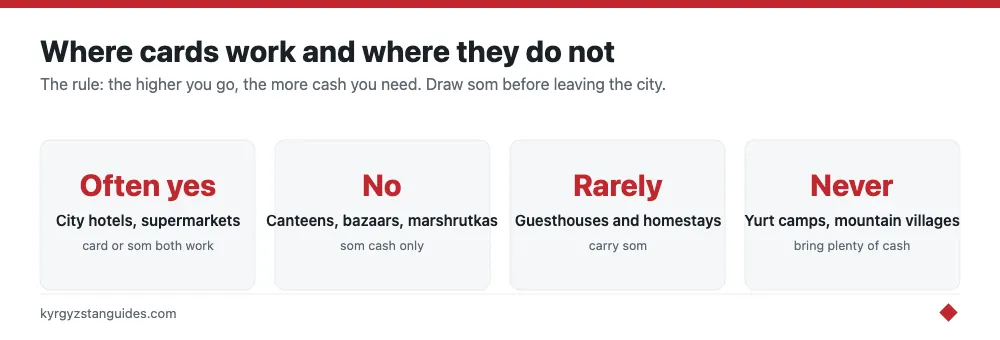
Card acceptance is improving in the cities but remains the exception, not the rule. Larger hotels, some mid-range and upmarket restaurants, supermarkets, and travel agencies in Bishkek will take Visa or Mastercard. Step outside that bracket — local canteens, bazaars, marshrutkas, guesthouses, homestays, and anything in a small town — and it's cash only. Treat your card as a way to top up som at ATMs, not as a payment method you can rely on day to day.
| Where | Cards? | Bring |
|---|---|---|
| City hotels, agencies, supermarkets | Often yes | Card or som |
| Local canteens, bazaars, marshrutkas | No | Som cash |
| Guesthouses and homestays | Rarely | Som cash |
| Yurt camps and mountain villages | Never | Plenty of som cash |
Changing dollars the right way
Bringing US dollars as backup cash is smart, but there are rules. Exchange offices give good rates on clean, newer, high-denomination bills — and they're fussy about condition. Torn, marked, or older-series notes are often refused outright or changed at a poor rate; reported cutoff years vary, so the newer your notes, the better. Bring crisp $50 and $100 bills, keep them flat and undamaged, and you will change them easily at the exchange booths that dot the cities. Avoid changing money on the street; use a proper office or bank.
Between ATM withdrawals and a dollar reserve, you have two independent ways to get som, which is exactly the redundancy you want in a cash economy. If one card is swallowed or a network is down, the dollars keep you moving.
Cash to carry on treks
This is the part that catches people out. The moment you leave the paved towns for a trek, a yurt stay, or a mountain village, there are no ATMs and no card terminals — only cash. Guides, horse hire, yurt camps, and village shops all want som in hand, and running short means an expensive, time-wasting trip back to the nearest town.
Before any multi-day trip into the mountains, withdraw enough som in the last city to cover the whole excursion plus a comfortable buffer — account for accommodation, food, guides, horses, and small extras, then add a bit for the unexpected. Carry it in small and mid-size notes; change for a large note can be hard to find in a village. It's better to come back with leftover som you spend later than to be stranded a valley away from the nearest bank. Our Kyrgyzstan trekking guide covers what those mountain days cost, and the Kyrgyzstan packing list flags carrying a secure way to stash that cash.
The pointer to leave you with: sort your money in the city, every time. Draw som from an Optima, Demir, or KICB ATM, keep a reserve of clean dollars, and load up on cash before you head for the hills — do that, and money becomes the one thing you never have to worry about for the rest of the trip.
Which cards work, and the one that stopped
Visa and Mastercard are the working networks, though the official sources are not identical on Mastercard. The UK Foreign Office says Visa is accepted in most places but Mastercard is sometimes not accepted; the US Commerce Department guide says both are commonly accepted. Take the more cautious version and carry a Visa if you have one.
UnionPay works at ATMs of RSK Bank, Zalker Bank and KICB, per UnionPay’s own cardholder information.
Mir is finished here, in practice. The timeline is worth having if you are arriving from Russia: registered with the National Bank in 2017, Kyrgyz banks began withdrawing in autumn 2022, and the national processing centre stopped handling Mir on 3 April 2024. The last recorded volume was the second quarter of 2024; from the third quarter onward it is zero. The stated reason is sanctions risk — the US sanctioned Russia’s Mir operator on 23 February 2024 and the processing centre announced it would stop to minimise secondary-sanctions exposure. The registration remains formally valid, which means nothing operationally.
On RuPay, be careful how you read this: India’s NPCI International does not list Kyrgyzstan among its acceptance countries and no agreement with the Kyrgyz system could be found. That is no evidence of acceptance, which is not quite the same as a confirmed no. Do not rely on it.
The cash limit that catches tourists
There are two separate rules here and travellers routinely confuse them.
The first is the EAEU declaration threshold: cash or traveller’s cheques totalling more than the equivalent of $10,000 must be declared when entering or leaving the customs territory. That is a declaration requirement, not a cap.
The second is a Kyrgyz export cap, and it is stricter. Since 16 January 2023 a temporary Cabinet ban prohibits taking more than $5,000 in cash out of Kyrgyzstan if you are a non-resident or foreign citizen, against $10,000 for residents and citizens, with residents exceeding their limit paying 10% of the excess. It is in force until a further Cabinet decision.
It is enforced. In December 2023 the border service stopped a traveller at the Dostuk crossing carrying $103,200 and restated the rule. I could not find a repeal or a 2025-26 restatement, so treat it as live and check before travelling with a large sum.
Cash, ATMs and the rate
The national bank’s official rate on 22 September 2026 was 87.4495 som to the US dollar and 100.3920 to the euro.
ATMs are widely available in the main cities and usually dispense both som and US dollars. Per-transaction withdrawal limits are often around 10,000 som. The national card network reports more than 3,500 ATMs and over 127,400 card terminals nationally, alongside 3.5 million domestic Elkart cards.
On cash to bring: US dollars are the most easily exchanged, and older-series notes are often refused or charged extra. Bring clean, recent, unfolded notes.
Exchange bureaus are licensed by the National Bank, which publishes the register and enforces against it — in the second quarter of 2026 alone it issued 382 prescriptions, revoked 20 licences and suspended 26. Use a licensed window, not a man on the street, which is itself an offence.
One modern note: the national QR standard ELQR is now interoperable internationally, with cross-border QR payments launched with Alipay+ in June 2026. That is for Kyrgyz cardholders paying abroad, not for you paying here.
Frequently Asked Questions
What currency is used in Kyrgyzstan?
The Kyrgyz som (KGS), which trades at roughly 87–89 to the US dollar and sits close to parity with the Indian rupee. Everyday prices are quoted in som, and you shouldn't expect to pay directly in dollars or other currencies.
Do ATMs and cards work in Kyrgyzstan?
City ATMs from banks like Optima, Demir, and KICB reliably dispense som on Visa and Mastercard, and larger hotels and agencies accept cards. But this is a cash-first economy: canteens, bazaars, marshrutkas, guesthouses, and anything rural are cash only.
How much cash should I carry on a trek?
Enough som to cover the entire trip plus a buffer, because there are no ATMs or card terminals in the mountains. Withdraw for accommodation, food, guides, and horses in the last city, carry small and mid-size notes, and add extra for the unexpected.
How much cash can I take out of Kyrgyzstan?
Two separate rules get confused. The EAEU declaration threshold requires declaring more than the equivalent of $10,000 — that is a declaration, not a cap. Separately, since 16 January 2023 a Cabinet ban prohibits non-residents and foreign citizens taking more than $5,000 in cash out of the country. It is enforced: in December 2023 the border service stopped a traveller at Dostuk carrying $103,200.
Does a Mir card work in Kyrgyzstan?
No, in practice. Kyrgyz banks began withdrawing from Mir in autumn 2022 and the national processing centre stopped handling it on 3 April 2024, citing secondary-sanctions risk after the US sanctioned Russia's Mir operator on 23 February 2024. Recorded volume was zero from the third quarter of 2024 onward.
Does RuPay work in Kyrgyzstan?
Do not rely on it. India's NPCI International does not list Kyrgyzstan among its acceptance countries and no agreement with the Kyrgyz system could be found. That is absence of evidence rather than a confirmed no, which is exactly why it is not something to plan around.
What condition do US dollar notes need to be in?
Clean, recent and unfolded. Older-series notes are often refused or changed at a worse rate (reported cutoff years vary), and torn or marked bills are often refused outright. Bring crisp $50 and $100 bills, and use a licensed exchange bureau — the National Bank issued 382 prescriptions, revoked 20 licences and suspended 26 in the second quarter of 2026 alone.