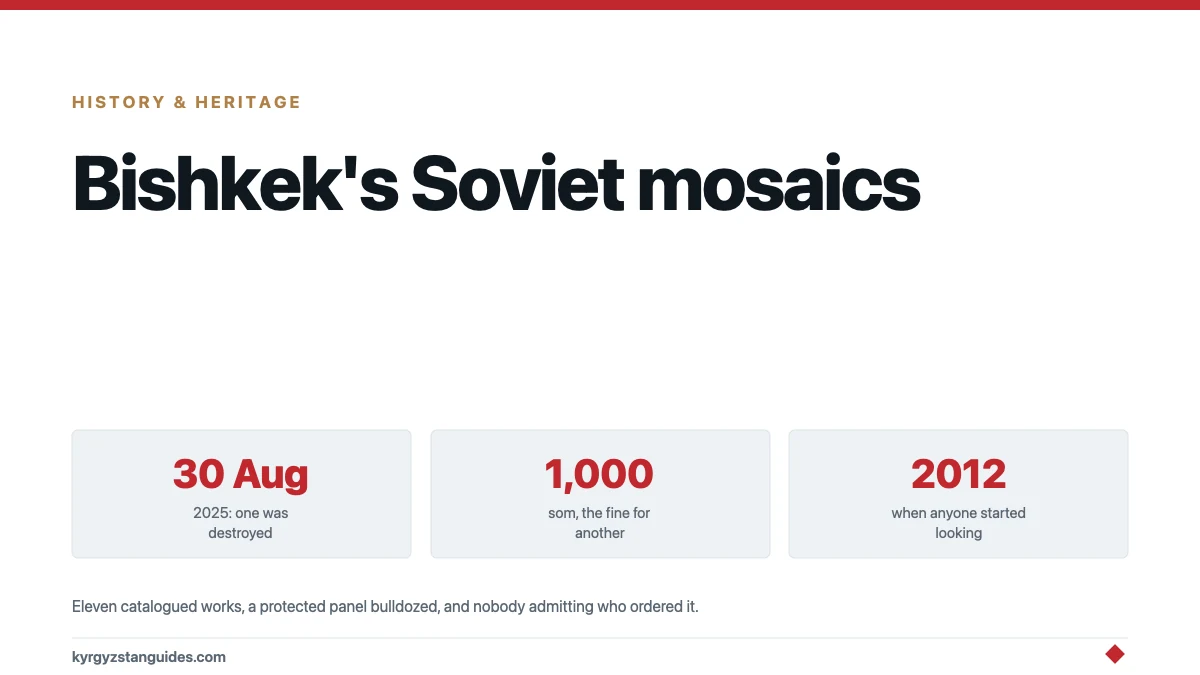
On 30 August 2025, a mosaic panel that had been on Kyrgyzstan's register of protected monuments since 20 August 2002 was destroyed during roadworks on Chyngyz Aitmatov Avenue. More than a year later, the mayor's office and the presidential property department were still pointing at each other, and nobody had established who gave the order.
That panel was called Vstrecha gostey, "Meeting of Guests", and it was the first smalt mosaic made in Kyrgyzstan. Everything else in this guide is still standing, most of it unmarked, and a fair amount of it behind locked gates.
Where to actually see them
Eleven works are properly catalogued with artist, year, technique and address. These are the ones you can walk to.
| Work | Artist | Year | Where |
|---|---|---|---|
| Lenin Is With Us | Lidiya Ilyina | 1978 | Molodaya Gvardiya Blvd at Toktogul St |
| Labour | M. Bochkarev, A. Usubaliev | 1966 | Isanov St 94, at Chuy Ave |
| To You, Motherland, Our Labour! | Theodor Herzen | 1984 | Jibek Jolu Ave near Togolok Moldo St |
| Solemn Procession | A. Kamensky, A. Bekdzhanyan | 1978 | The Southern Gates of the city |
| Radio and Modernity | Aleksandr Voronin | 1966 | The state TV and radio building |
| Flourish, Kyrgyzia | Zh. Moldakhmatov | 1985 | Abdrakhmanov St, Yug-2 district |
| Path of Enlightenment | Satar Aitiev | 1978 | Kyrgyz National University, lab block |
| Sport, Sport | Momunbek Akmatkulov | — | Kolbaev St, Olympic reserve school |
Three more exist and you probably cannot get to them: Weaver Women by Sagynbek Ishenov, 1970, and Herzen's athletes panel of the same year, both on the closed territory of the former worsted-cloth combine, and Herzen's Women of 1985, which is indoors.
Not all of these are the same kind of object
This matters if you are going to look at them properly, because "Soviet mosaic" flattens three quite different techniques.
Smalt is the classic: opaque coloured glass, cut into small tesserae, set in mortar. Herzen's textile panel on Jibek Jolu is the showpiece. Its colour scheme is deliberately dense and woven-looking, because the building behind it was a garment factory, and the effect is that the wall reads as cloth. For Path of Enlightenment at the university, the smalt was imported from the Baltic republics.
Pebble and ceramic is the other Bishkek signature, and it is more interesting than it sounds. Labour, at Isanov 94, is made of river pebble and ceramic rather than glass, so its colour comes from stone rather than pigment, and the surface is rough where a smalt wall is flat. Three figures: a worker, a peasant woman, a scientist. It is from 1966 and it has survived better than almost anything else.
Stone relief is what you get at the Southern Gates. Solemn Procession is built from Armenian tuff and travertine, not glass at all. It has a good origin story: the artists proposed a purely decorative panel, officials insisted it depict achievements in science, culture and agriculture, and the compromise was to show people who stand for those fields rather than the fields themselves.
The two best stories are about what people did to them
Flourish, Kyrgyzia covers the entire end wall of a residential block in Yug-2, in blue, white and red: women weaving carpets and baking bread. Advertisers wanted to hang a banner across it. The residents of the building fought them off and won. It is still there.
Cosmos and Scientific-Technical Progress, by the same artist who made the sports panel, did not do as well. The building on Suyumbaev Street became a karaoke club, and the new owners painted the mosaic over in brown — a work that was on the state-protected list. The loss was noticed when the artistic director of a local arts organisation went to photograph it and could not find the wall, then recognised its texture under the paint.
A media campaign and a prosecutor's order forced the owner to wash it off. The fine was 1,000 som. And the washing did not restore it: only the stones came clean, the joints are still full of paint, and holes have since been drilled through it for air conditioners.
That is the realistic ceiling on enforcement here. A protected monument, a successful public campaign, a prosecutor involved, and the penalty was roughly the price of a taxi across town.
The panel that was destroyed
Meeting of Guests stood on a purpose-built free-standing wall by the old Frunze airport, on what is now Chyngyz Aitmatov Avenue. Smalt and ceramic, 1964. Kyrgyz people in national dress welcoming arriving visitors from different countries, which is why most people called it Friendship of Peoples rather than its actual title.
An art historian quoted by the Kyrgyz press puts its significance plainly: it is where smalt mosaic art in Kyrgyzstan began.
The sequence is worth setting out because it explains how these losses happen. The mayor had issued an instruction that the mosaic be restored. The avenue was then reconstructed under the presidential property department rather than the municipality. The panel came down on 30 August 2025. The city said it had taken no decision to dismantle it. The Ministry of Culture said it had issued no demolition permit and referred the matter to law enforcement. Activists pointed out that monuments here are normally struck off the register before they are demolished, and this one had not been.
Nobody has been named. The material was never accounted for.
One note on the record: sources disagree on the artist's first name, giving both Andrey and Aleksey Mikhalev. We are not resolving that.
Why nobody knows any of this
Until about 2012, essentially no one was documenting Bishkek's mosaics. The work that exists was started by a local arts organisation whose participants describe rebuilding the information almost from nothing — archive searches, interviews, collecting residents' recollections of individual walls. They produced a map and ran walking tours, and they were candid that they were the first people in the region to take it seriously.
There is still no photobook, no museum exhibition, and no published list of which mosaics hold protected status. We tried to read the state register directly. Both the culture ministry's page and the justice ministry's legal database serve JavaScript shells rather than documents, so the register's actual contents are not publicly readable in any practical sense. The only mosaic we can confirm was on it is the one that got destroyed.
The amateur mosaics, which are the underrated ones
Here is the part most guides skip. The panels above went through an approval chain: commissions, artistic councils, professional monumentalists.
The end-wall mosaics in the housing estates mostly did not. Academic work on Bishkek's Soviet architecture argues these were designed at the construction stage by the builders themselves, bypassing the approval process entirely. The result is closer to free creation by the construction industry than to state art: fairy-tale and children's subjects, extravagant technique, and in places mosaics made of broken crockery.
The fifth microdistrict is where to look. There are sportswomen, a mosaic aksakal, and a figure of Hottabych, the genie from a Soviet children's book. Almost all of the authors are anonymous. The sportswomen panel has lost its upper portion, covered over when a flat owner insulated his apartment.
You will not find these in any list. They are on the blank ends of apartment blocks and you have to walk around and look up.
What else has gone since 2021
The mosaics are part of a broader pattern. Reporting on the 2021–2026 period records an ornamental mosaic roughly 200 metres long removed from the Molodaya Gvardiya underpass in October 2025 during road widening, a mosaic lost from a railway bridge, and a bas-relief taken off the front of the Russian Drama Theatre.
A 2021 study of Bishkek's heritage register found 270 protected buildings in the city, 74 of republican and 196 of local significance. Of the local-significance objects, 14 had been demolished, six replaced by high-rises, ten could not be located at all, six were abandoned, and 28 had been removed from the register. Things get de-listed and then demolished: a 1930s printing house de-listed in 2015 and partly demolished in 2019, a hippodrome de-listed in 2020, a restaurant de-listed in 2016 and demolished in 2017.
If you want to see the mosaics, the honest advice is not to assume they will be there next year. See also our guides to Soviet sanatoriums and to Bishkek's Osh Bazaar for the city as it is rather than as it is marketed.
FAQ
Where can I see Soviet mosaics in Bishkek?
The most accessible are Labour at Isanov Street 94 on the corner of Chuy Avenue, Lenin Is With Us on Molodaya Gvardiya Boulevard at Toktogul Street, Theodor Herzen's textile panel on Jibek Jolu near Togolok Moldo Street, and Flourish, Kyrgyzia on an apartment block in the Yug-2 district. Solemn Procession stands at the city's Southern Gates.
What happened to the Meeting of Guests mosaic?
It was destroyed on 30 August 2025 during reconstruction of Chyngyz Aitmatov Avenue, despite having been on the state register of protected monuments since 20 August 2002 and despite a mayoral instruction to restore it. The city said it took no decision to demolish it, the culture ministry said it issued no permit and referred the matter to law enforcement, and no one has been identified as responsible.
Are Bishkek's mosaics protected by law?
Some are, under Kyrgyzstan's heritage law, which has republican and local tiers. In practice the protection is weak: when one protected mosaic was painted over, the owner was fined 1,000 som and made to wash it off, and the original surface could not be recovered. The register itself is not readable online, so which mosaics are listed is not public in any usable form.
Who were the main mosaic artists in Frunze?
Theodor Herzen, who has at least three works in the city and is better known for his 200-plus linocuts illustrating the Manas epic; Lidiya Ilyina; Aleksey Kamensky; Aleksandr Voronin; Satar Aitiev; Mikhail Bochkarev with Altymysh Usubaliev; Sagynbek Ishenov; Momunbek Akmatkulov; and Zhyldyzbek Moldakhmatov.
Are the mosaics made of glass?
Not all of them. Three techniques are in use across the city: smalt, which is opaque coloured glass, and is what most people picture; pebble and ceramic mosaic, used in Labour and Radio and Modernity, where the colour comes from river stone; and stone relief in Armenian tuff and travertine at the Southern Gates, which contains no glass at all.
Is there a guidebook or map of Bishkek's mosaics?
No published photobook or museum exhibition exists. A local arts organisation began documenting them from around 2012, built a map and ran walking tours, and a current heritage project publishes pages on individual works in Russian and Kyrgyz. Before that, essentially nothing had been recorded.
For the buildings themselves, with their architects and dates, see our Soviet architecture walk through Bishkek.