Kyrgyzstan sits on the Central Asian Flyway, one of the nine recognised global flyways, which carries at least 279 populations of 182 migratory waterbird species — 29 of them globally threatened or near-threatened.
What makes the Kyrgyz section distinctive is altitude. This is where the flyway crosses the Tien Shan. The Ramsar documentation for Son-Kul describes birds arriving there from the Himalayas; Chatyr-Kul's describes the lake as a passage on the way south across the Asian continent. These are birds that have just crossed, or are about to cross, some of the highest ground on the route.
Three lakes carry almost all of it, and all three are Ramsar sites.
Chatyr-Kul: the moulting lake
Ramsar site since 8 November 2005. 3,530 metres. 16,100 hectares. Up near the Torugart Pass, inside the Karatal-Japyryk reserve.
Chatyr-Kul is completely fishless, and that is the point. With no fish stripping the invertebrates and plankton, the food base is undepleted, and the birds have it to themselves.
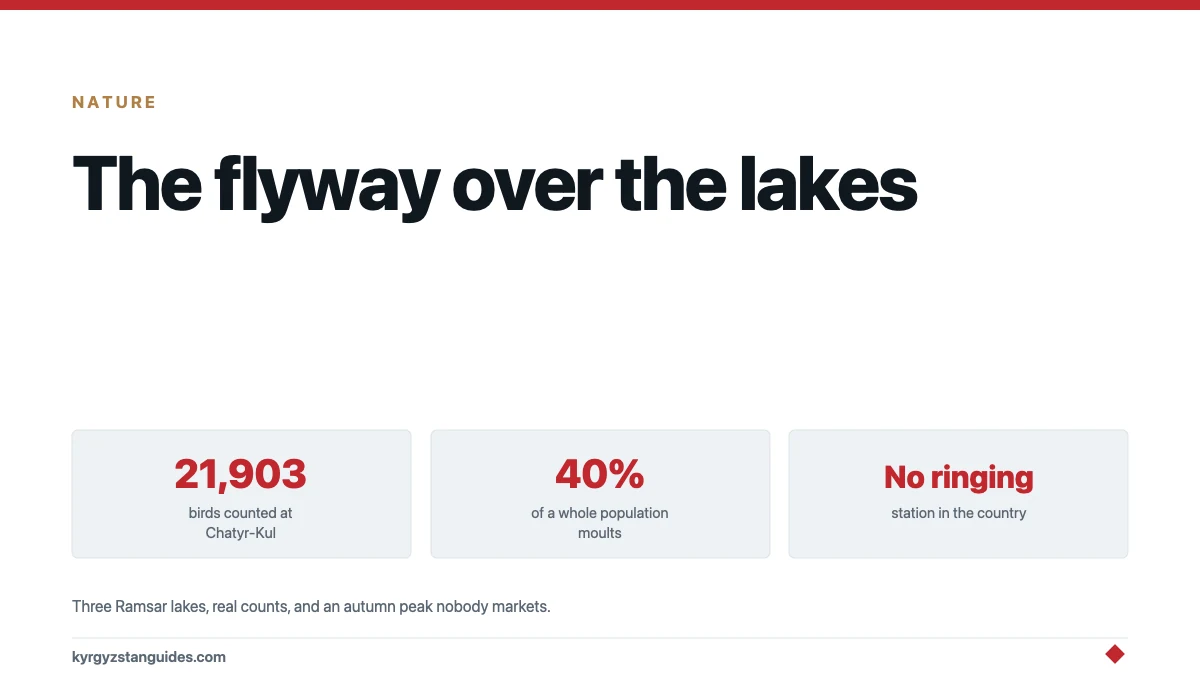
The numbers are the most striking on this list. A 2004 expedition recorded 52 species and an estimated 21,903 individuals. The lake qualifies under the Ramsar criterion for supporting more than 20,000 waterbirds during moulting and breeding.
The headline species is the ruddy shelduck. Between 5,000 and 10,000 are present, and around 40 per cent of the entire Central Asian population moults here — one count put the total at 17,800, about 35.6 per cent of the population. For context, the threshold for international significance is 500 birds.
It also holds more than 500 individuals each of five dabbling duck species and more than 1,000 each of four diving ducks, plus an important breeding colony of bar-headed geese, the birds that cross the Himalaya.
In winter it freezes over completely. This is a summer and passage site, not a wintering one.
Son-Kul: the stopover
Ramsar site since 23 January 2011. About 3,026 metres. 36,869 hectares, of which nearly 28,000 are water.
Seventy species of wader are recorded. Over a thousand ducks breed, feed or rest here, and the site documentation describes it as a point for stopovers and rest during moulting and after migration.
The counts by species:
| Species | Numbers |
|---|---|
| Northern pintail | over 2,000 |
| Common pochard | over 1,500 |
| Teal | over 1,000 |
| Garganey | over 500 |
| Mallard | over 500 |
| Shoveler | over 100 |
| Wigeon | 100–150 |
| Tufted duck | 100–150 |
| Gadwall | 50–100 |
A flock of goosanders moults at the outflow at the eastern end. Black stork, demoiselle crane, bar-headed goose, ferruginous duck, whooper swan and Eurasian spoonbill all occur, with golden eagle, Barbary falcon and Himalayan griffon in the mountains around.
One warning embedded in the official sheet: two whitefish species were introduced to the lake, grey loach and naked osman came with them accidentally, and the zooplankton shifted from large forms to small ones, with a corresponding decrease in the number of waterbird species. The stocking damaged the food web the birds depend on.
Issyk-Kul: the wintering lake
Ramsar site since 12 November 2002. 1,608 metres. 626,438 hectares — the whole lake and its reserve.
Issyk-Kul is saline and does not freeze, which is why it holds the country's great winter concentration rather than a passage one.
267 bird species are recorded, 18 of them on the Kyrgyz Red Data Book. Three appear under the strictest Ramsar criterion: white-headed duck (Endangered), Dalmatian pelican (Vulnerable) and slender-billed curlew (Critically Endangered).
About fifty waterfowl species pass through in spring and autumn. The wintering total runs 35,000 to 70,000 birds.
The long series is unusually good. Systematic counts began in 1948, after surveys in 1944–46, and the decadal picture is a decline and partial recovery:
| Decade | Wintering birds |
|---|---|
| 1940s | about 100,000 |
| 1960s | about 60,000 |
| 1970s | 50,000 |
| 1980s | 35,000–45,000 |
| 1990s | about 65,000 |
| 2000s | 46,000–60,000 |
Annual abundances within that: coot 25,000–30,000; red-crested pochard 15,000–20,000; grebes across five species 6,000–10,000; swans about 2,500. Coot counts in the monitoring tables reached 87,000 in one year.
Wintering specialities worth the trip: Dalmatian pelican, greater flamingo, whooper swan, Bewick's swan, white-tailed eagle, pygmy cormorant.
When to go
Here is where we have to be straight with you.
Autumn is documented. Chatyr-Kul's sheet states it plainly: movement begins in the second half of August, and September to October is the high point of migration. That is the one dated peak in the official record.
Winter is the spectacle. December to February on Issyk-Kul, tens of thousands of birds on open water ringed by snow, in a country where almost nobody visits in winter.
Spring is undocumented. The official material says only that about fifty species pass through "in the spring and fall". No source we could reach gives dated spring peaks for any of the three lakes. Pages that confidently tell you late March to early May are not working from anything we could find. Spring passage certainly happens; when it peaks is not published.
Why the altitude matters
Most flyway writing treats a stopover as a stopover. Here it is worth thinking about what the birds are doing either side of it.
Bar-headed geese breed at Chatyr-Kul and cross the highest mountains on earth on migration. The ducks moulting there are flightless for a stretch of weeks while they replace their flight feathers, which is why a fishless lake at 3,530 metres with no predatory fish and few people is worth 40 per cent of a population's moult. It is not a stop on the way to somewhere better. It is the safest place available.
Son-Kul, a thousand metres lower, works as the rest and refuelling site rather than the moulting one. Issyk-Kul, lower again and never frozen, is where the ones that do not continue south spend the winter.
Read the three together and you have a vertical system rather than three separate lakes: moult high, refuel mid, winter low.
Getting the timing right
Two practical consequences fall out of that.
If you want the moulting concentrations at Chatyr-Kul, you want midsummer, and you want the border permit arranged weeks ahead. By the time autumn passage begins in late August the moulting birds have finished.
If you want autumn passage, September and October, you are in the one window the official documentation actually dates — and also the window when the high lakes are still reachable and the weather has stopped being reliably good.
If you want the winter concentration, you want a lake shore in January, warm clothes and low expectations of company.
Two honest gaps
There is no bird ringing station in Kyrgyzstan that we could find, and no ringing recovery dataset. Every number in this article comes from visual counts. If you read a claim about ringed birds here, ask where it comes from.
The Important Bird Area network could not be verified. Kyrgyzstan is said to have eleven IBAs, including all three of these lakes, but the international database serves its content through scripts that returned empty pages to us, so the codes, areas and criteria are unconfirmed.
Practical notes
Chatyr-Kul sits in a border zone near the Chinese frontier and needs a permit, arranged in advance. Son-Kul is reachable from June to September; outside that the passes close. Issyk-Kul is accessible year-round, and the western bays hold the winter concentrations.
For the general species picture see birdwatching in Kyrgyzstan, and for what is under the water and why it matters, fishing rules and Chatyr-Kul.
FAQ
Which flyway crosses Kyrgyzstan?
The Central Asian Flyway, one of nine recognised global flyways, covering at least 279 populations of 182 migratory waterbird species including 29 globally threatened or near-threatened ones. The Kyrgyz section is the high-altitude part, where birds cross the Tien Shan to and from the Himalayas.
When is bird migration in Kyrgyzstan?
Autumn passage is the documented one: movement starts in the second half of August and peaks from September to October, according to the official site documentation for Chatyr-Kul. Spring passage happens but no dated peak is published for any Kyrgyz site. Winter, December to February, is when Issyk-Kul holds its 35,000 to 70,000 birds.
Where is the best place to see migrating birds in Kyrgyzstan?
Chatyr-Kul for moulting concentrations, where around 40 per cent of the Central Asian ruddy shelduck population gathers and a 2004 survey counted nearly 22,000 birds. Son-Kul for passage waterfowl. Issyk-Kul for the winter concentration, since the lake is saline and does not freeze.
How many bird species are there at Issyk-Kul?
267 species are recorded at the Issyk-Kul Ramsar site, of which 18 are on the Kyrgyz Red Data Book. Three globally threatened species are listed under the site's Ramsar criteria: white-headed duck, Dalmatian pelican and slender-billed curlew.
Are Kyrgyzstan's lakes protected as wetlands?
Yes. Kyrgyzstan has three Ramsar sites and they are exactly these three lakes: Issyk-Kul, designated 12 November 2002; Chatyr-Kul, 8 November 2005; and Son-Kul, 23 January 2011. Issyk-Kul and Chatyr-Kul also sit inside state nature reserves.
Do I need a permit to visit Chatyr-Kul?
Yes. Chatyr-Kul lies in the border zone near the Torugart Pass on the Chinese frontier, and a border permit must be arranged in advance. Son-Kul needs no permit but is only reachable roughly June to September.