There is a moratorium on Issyk-Kul right now, and most pages have not caught up with it.
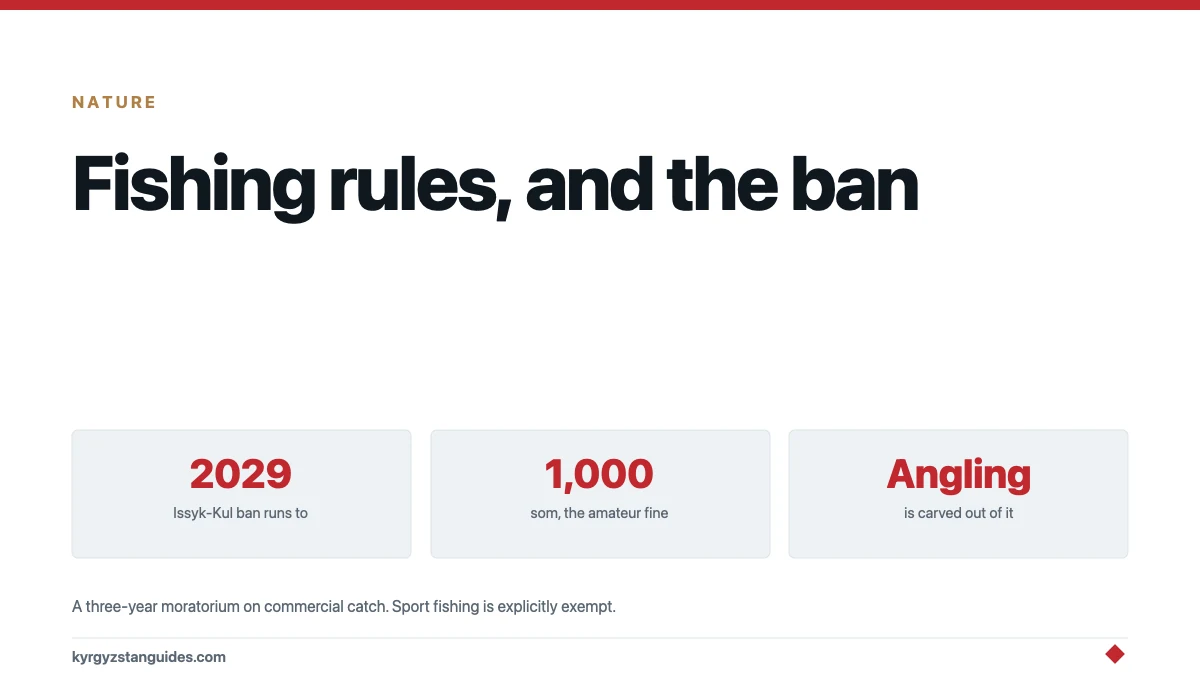
A presidential decree signed on 17 July 2026 imposed a three-year ban running 21 July 2026 to 21 July 2029 on the commercial catch, transport, storage, sale, purchase and export of all fish species in Lake Issyk-Kul and Lake Son-Kul.
The part that matters to a visitor is the exception list. Four things are carved out, and the first one is organised amateur and sport fishing. The others are approved restocking work, scientific research and monitoring, and annual clearance of weed fish species.
So: you can still fish Issyk-Kul with a rod. You cannot buy its fish commercially, and neither can the restaurant serving you.
Why the ban exists
The stated reason is that commercial stocks have declined and recovery in Issyk-Kul "has not yet reached a stable level" at which commercial catch could resume without threatening the ecosystem.
This is a continuation rather than a first attempt. The 2026 decree was framed as extending an existing moratorium, and a three-year ban across several Kyrgyz water bodies dates from 2025.
The lake holds 28 fish species, seven of them endemic. Two are on the Red Data Book of the Kyrgyz Republic: the Issyk-Kul marinka and the Issyk-Kul scaleless osman. Taking either is not a fishing offence. It is a criminal one — see below.
The closed seasons
Spawning bans are announced annually rather than fixed in statute, so treat the 2025 pattern as a guide and check the current year's announcement before you travel.
| Closure | Dates in 2025 | Species |
|---|---|---|
| Nationwide | 1 May – 1 July | Carp, pike, catfish and others |
| River osman | 5 June – 15 July | Diptychus and Schizothorax |
| Amu Darya trout | 15 October – 15 December | Salmo trutta oxianus |
The nationwide May-to-July closure is the one that catches summer visitors, because it covers the start of the travel season.
The paperwork
Kyrgyzstan has a formal fishing permit, the рыболовный билет or fishing card, established under the aquaculture and fisheries law of 17 March 2021.
We could not establish what it costs, where a foreigner obtains one, or how long it is valid. The state licensing portal that lists it refused connection every time we tried, and the actual Fishing Rules document sits on the justice ministry's legal database, which returns an access error to every method we attempted.
That is an honest gap and we would rather say so than guess. If you intend to fish here, arrange it through a local operator or a guesthouse that runs trips, and let them handle the permit. That is what most visitors do anyway.
What is banned outright
Two categories of gear are named in the Code on Offences and again in the Criminal Code: synthetic fishing nets and electro-fishing equipment.
The Criminal Code's longer list adds explosives, chemicals, gases, electric current, and the use of motor vehicles, boats or aircraft as methods of mass destruction.
Leaving prohibited gear in a water body is treated as water pollution in its own right.
The fines, in actual som
Kyrgyz law states penalties in "calculation indices". One index is 100 som, so the conversions are straightforward.
Administrative:
| Offence | Fine |
|---|---|
| Breaking amateur fishing rules | Warning, or 1,000 som |
| Breaking commercial fishing rules | 10,000 som |
| Using synthetic nets or electro-fishing gear | 5,500 som |
| Importing, making or selling that gear | 10,000 som, or 28,000 for a company |
Criminal, where the damage passes a threshold or the location is protected:
Illegal taking of fish causing significant damage, or taking fish at spawning grounds or on the routes to them, carries a fine of 50,000 to 100,000 som or up to two years' imprisonment.
Doing it with nets, electricity, explosives or chemicals, with large damage, carries 100,000 to 200,000 som or two to five years.
And doing it in a state reserve, or against a Red Data Book species, carries five to seven years.
The damage thresholds are set at 10,000 som for "significant", 100,000 for "large" and 1,000,000 for "especially large".
The bit that should make you careful
Read those last two together. The Issyk-Kul State Nature Reserve is a zapovednik. So is Karatal-Japyryk, which contains Chatyr-Kul.
Fishing inside a reserve, or catching a marinka or an osman anywhere, moves you straight past the fines and into the five-to-seven-year band. A visitor is overwhelmingly unlikely to be prosecuted at that level, but the exposure is real and it is worth knowing which waters are which before you cast.
The practical rule: fish where a local operator takes you, not where it looks quiet.
Who enforces it
Two bodies share the job, which is worth knowing because it explains why answers differ depending on who you ask.
The Ministry of Natural Resources, Ecology and Technical Supervision runs the ecological inspectors and wardens who actually stop people on the water. The Department of the Fishing Industry Complex, under the Ministry of Agriculture, handles the fishery itself — stocking, quotas, the commercial side.
The spawning-ban announcements come from the environment ministry. The moratorium's exception list came from the agriculture ministry's draft. Neither publishes a consolidated, current, plain-language summary of what an ordinary person may do, which is the gap this article exists to fill and also the reason parts of it are marked unverified.
A note on the fish you will be served
Issyk-Kul trout appears on menus all round the lake. Under the moratorium, commercially caught Issyk-Kul fish should not be reaching those kitchens at all until at least 2029.
What is legitimately available is farmed fish — aquaculture is a separate sector and is not covered by the ban — and fish from other water bodies. We are not going to tell you that every plate of lake trout on the north shore is illegal, because we cannot know that. But if a restaurant assures you the fish was caught in the lake that morning, that claim and the decree cannot both be true.
Ask whether it is farmed. Most places will tell you straightforwardly, and farmed Issyk-Kul trout is good.
What is actually in the water
Issyk-Kul's 28 species include introduced ones that now dominate the fishery. Son-Kul's Ramsar documentation records an unintended consequence of stocking there: two whitefish species were introduced, grey loach and naked osman arrived accidentally with them, and the zooplankton community shifted from large forms to small ones, with a corresponding decrease in the number of waterbird species.
That is worth knowing if you are wondering why a moratorium on a lake that looks full of fish is a reasonable idea. The stocking history here has form.
For what the lakes support above the waterline, see bird migration over Kyrgyzstan, and for the lake itself, Issyk-Kul fish.
FAQ
Can I fish in Issyk-Kul?
Amateur and sport fishing is explicitly exempted from the moratorium that runs from 21 July 2026 to 21 July 2029, so yes, with the right permit and outside the closed season. What the moratorium bans is the commercial catch, transport, sale, purchase and export of fish from Issyk-Kul and Son-Kul.
When is fishing closed in Kyrgyzstan?
The closures are announced each year. In 2025 the nationwide spawning ban ran 1 May to 1 July, with separate closures for river osman from 5 June to 15 July and for Amu Darya trout from 15 October to 15 December. Check the current year's announcement rather than assuming these dates repeat.
Do I need a licence to fish in Kyrgyzstan?
There is a formal fishing card established under the 2021 fisheries law, but we could not confirm its cost, where a foreigner obtains one, or its validity — the government licensing portal and the legal database both refused access. Arrange fishing through a local operator or guesthouse and let them handle the permit.
What is the fine for illegal fishing in Kyrgyzstan?
Breaking amateur fishing rules carries a warning or 1,000 som; using synthetic nets or electro-fishing gear carries 5,500 som; commercial breaches carry 10,000 som. Criminal liability starts once damage exceeds 10,000 som, and fishing in a state reserve or taking a Red Data Book species carries five to seven years' imprisonment.
Which fish are protected in Kyrgyzstan?
The Issyk-Kul marinka and the Issyk-Kul scaleless osman are both on the Red Data Book of the Kyrgyz Republic. Taking a Red Data Book species falls under the most serious criminal provision, with a five to seven year sentence, regardless of the value involved.
Is electro-fishing illegal in Kyrgyzstan?
Yes, explicitly. Both electro-fishing systems and synthetic fishing nets are banned by name, with a 5,500 som fine for using them and 10,000 som for importing, making or selling them. The Criminal Code separately lists electric current among methods of mass destruction of fish.