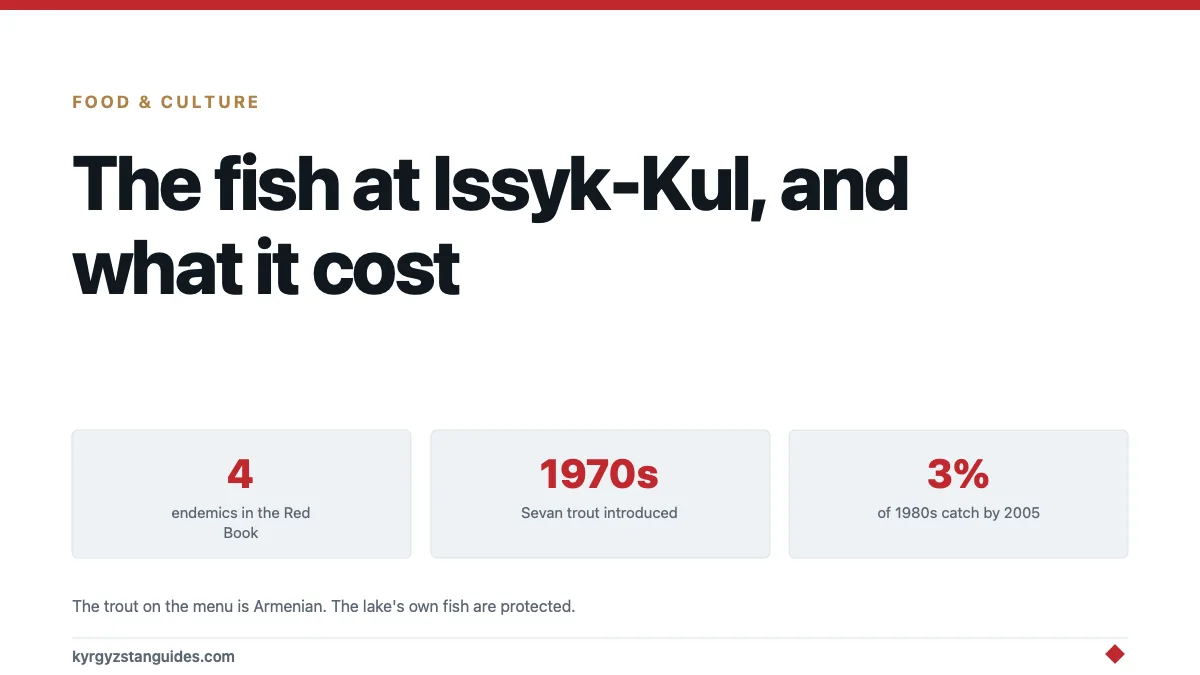
Order fish at a restaurant on the Issyk-Kul shore and you'll probably be served trout. That trout is not from here. It is Sevan trout, native to a lake in Armenia, introduced in the 1970s. And along with pikeperch stocked two decades earlier, it's a principal reason the lake's own fish have collapsed. Catches across Kyrgyzstan had fallen to around 3% of 1980s levels by 2005.
This is one of the clearer examples anywhere of a fishery being engineered into ruin with good intentions, and nobody mentions it on the menu.
What lived here before
Issyk-Kul is an ancient, deep, slightly saline endorheic lake (no outflow, isolated for a very long time) which is exactly the setting that produces species found nowhere else.
Four of its commercially fished endemics are now listed in Kyrgyzstan's Red Book:
| Species | Local name |
|---|---|
| Leuciscus schmidti | Chebak |
| Leuciscus bergi | Chebachok |
| Schizothorax issykkuli | Marinka |
| Diptychus dybowskii | Naked osman |
These are not glamorous fish. They are small, bony, and adapted to a cold oligotrophic lake with not much food in it, which is why they were abundant and why they couldn't withstand what came next.
Our Issyk-Kul guide covers the lake itself, which is the second-largest alpine lake in the world and the thing the whole country's tourism rests on.
What was put in
Soviet fisheries policy took the view that a lake with small bony endemics was a lake underperforming, and set about fixing it.
Pikeperch and bream, introduced in 1954–56. Pikeperch is a predator.
Sevan trout, introduced in the 1970s, from Lake Sevan in Armenia. Also a predator, and one with its own tragic history. It was later driven to near-extinction in its native lake.
The logic was straightforward: stock bigger, faster-growing, more marketable fish and the fishery improves. For a while, by the metrics being used, it did. Sevan trout is now assessed as Endangered on the IUCN Red List in its own native range, the transplanted Issyk-Kul population outlived the original.
The FAO's technical study of fish species introductions in the Kyrgyz Republic documents what followed in detail. Chebachok populations fell by roughly 80% from the mid-1990s. The endemics were being eaten by the introductions and outcompeted by them, in a closed system they couldn't leave.
Then the fishery collapsed anyway
This is the part that makes it a genuine cautionary tale rather than just a conservation loss.
Catches of everything declined. Endemics and introductions alike. The causes stacked: overfishing after the Soviet collapse removed both enforcement and alternative livelihoods, heavy predation from the introduced species, and the end of hatchery restocking when the money ran out.
By 2005 the national catch was around 3% of what it had been in the 1980s.
A moratorium ran from 2008 to 2013. Research since has found that the endemic populations didn't sufficiently recover, and that the ban on whitefish and trout produced no real improvement in stocks. A closed system that has been rearranged does not simply revert when you stop fishing it.
Why the lake can't simply bounce back
It's worth understanding the mechanism, because "stop fishing and it recovers" is the intuition most people bring to this and it's wrong here.
Issyk-Kul is endorheic. No river runs out of it. Nothing flushes, nothing migrates in from a connected system, and there's no upstream population waiting to recolonise. Whatever is in the lake is all there's.
It's also oligotrophic: cold, deep, nutrient-poor. Fish grow slowly in water like that. Slow growth means late maturity, and late maturity means a population needs many uninterrupted years to rebuild — far more than a five-year moratorium provides.
And the predators don't leave when the fishing stops. A moratorium removes human pressure and leaves pikeperch and trout doing exactly what they were doing before, to a prey population that is now much smaller. That is the plain reason the 2008–2013 ban produced so little: it addressed one of three problems.
The Convention on Biological Diversity's country profile for Kyrgyzstan records introduced species as a standing pressure on native freshwater fauna, not a historical episode.
There is a broader point here for anyone who likes mountains. The interventions that damaged this lake were competent, well-funded and scientifically argued at the time. They weren't vandalism. They were a confident answer to the question "how do we make this more productive," asked without a good answer to "what are we trading away."
So should you eat the fish?
An honest answer rather than a comfortable one.
Trout served on the Issyk-Kul shore today is increasingly farmed rather than caught, and farmed trout is a different proposition — it isn't taking pressure off wild endemics, whatever else you think of aquaculture. Fish farms operate around the lake and along rivers, including in Chychkan gorge on the Bishkek–Osh road.
What to do in practice:
Ask whether it's farmed or from the lake. People generally know and will tell you.
Don't seek out endemic species. If chebak or marinka is offered, that's a Red Book fish.
Understand that "fresh from the lake" is a selling point, not a reassurance. It means the opposite of what it sounds like.
Farmed trout is the lower-impact choice, which is an odd sentence to write and still the honest one. Trout farms operate near Karakol and along the southern shore, and the fish they sell isn't coming out of a Red Book population.
We are not going to tell you not to eat fish in a country where a restaurant meal is somebody's income. We are going to say that the trout is Armenian, the lake's own fish are in the Red Book, and you should know that before you order.
Why this belongs in a travel guide
Because Issyk-Kul is sold to visitors as pristine, and the word is doing a lot of work.
The lake is beautiful, it's enormous, and the water is clean enough to swim in. It is also a heavily modified ecosystem in which the dominant fish were flown in from Armenia and Europe within living memory, and in which several native species are heading out.
That pattern repeats across this country in ways our other pieces cover: the glaciers feeding the rivers are retreating, the native horse was bred out by a Soviet improvement programme, the argali are hunted against quotas that outrun the herds. None of it is visible from a beach.
Knowing it does not spoil the view. It just means you are looking at the actual place rather than the brochure.
The moratorium, in force since July 2026
A presidential decree signed on 17 July 2026 imposed a three-year ban, running 21 July 2026 to 21 July 2029, on the commercial catch, transport, storage, sale, purchase and export of all fish species in Issyk-Kul and Son-Kul.
The stated reason is the one described above: stocks have declined and recovery "has not yet reached a stable level" at which commercial catch could resume without threatening the ecosystem. It is an extension rather than a first attempt — a three-year moratorium across several Kyrgyz water bodies dates from 2025.
Four things are exempted: organised amateur and sport fishing, approved restocking work, scientific research and monitoring, and annual clearance of weed fish species.
So angling is still legal with the right permit and outside the closed season. What is not legal is the commercial chain — and that has a consequence at the table. If a restaurant tells you the fish on your plate was caught in the lake that morning, that claim and the decree cannot both be true. Ask whether it is farmed; aquaculture is a separate sector and is not covered by the ban.
What taking the wrong fish costs
The lake's Ramsar documentation records 28 fish species, seven of them endemic.
The penalties are steeper than most visitors would guess. Breaking amateur fishing rules carries a warning or 1,000 som. Using synthetic nets or electro-fishing gear carries 5,500 som. But taking a Red Data Book species, or fishing inside a state reserve — and the Issyk-Kul State Nature Reserve is one — falls under a criminal provision carrying five to seven years' imprisonment, whatever the value involved.
Given that several of the lake's endemics are Red Book listed, that is not a theoretical distinction. The full rules are in our guide to fishing in Kyrgyzstan.
FAQ
What fish live in Issyk-Kul?
Four commercially fished endemics — chebak, chebachok, marinka and naked osman — all now in Kyrgyzstan's Red Book, alongside introduced pikeperch, bream and Sevan trout.
Is the trout at Issyk-Kul local?
Not originally. Sevan trout was introduced from Armenia in the 1970s. Much of what's served today is farmed rather than caught from the lake, which is worth asking about before you order.
Why did Issyk-Kul's fish stocks collapse?
A combination: introduced predators eating and outcompeting the endemics, heavy overfishing after the Soviet collapse, and the end of hatchery restocking. National catches fell to around 3% of 1980s levels by 2005.
Was there a fishing ban on Issyk-Kul?
Yes, a moratorium from 2008 to 2013. Research since indicates endemic populations didn't sufficiently recover and that the ban on whitefish and trout produced no meaningful improvement.
Can you fish in Issyk-Kul as a visitor?
Regulations change and endemic species are protected. If you want to fish, arrange it through a licensed local operator who knows the current rules rather than improvising from the shore.
Should I avoid eating fish in Kyrgyzstan?
Not necessarily. Ask whether it's farmed, and don't order endemic species like chebak or marinka. The point is to know what you're eating rather than to abstain.
Before you fish anywhere here, read the fishing rules: a three-year moratorium on commercial catch in Issyk-Kul and Son-Kul runs to July 2029, and two Red Book species carry criminal liability.