The traditional Kyrgyz horse stands 130 to 142 centimetres at the shoulder — small, shaggy, unimpressive to look at, and capable of carrying a grown adult over a 3,500-metre pass on grass it found itself. By 1979 it had disappeared from the country's official livestock statistics, replaced by a Soviet-designed breed that was faster, bigger, and worse at nearly everything the mountains actually demand.
Everything in this culture runs on the horse. It's worth knowing which horse.
What the old one was
Small, and that's the point rather than a limitation.
A mountain horse doesn't need size. It needs to be sure-footed on scree, to keep condition on poor grazing, to tolerate cold, and to work at altitude without fuss. The traditional Kyrgyz horse did all of that, and did it eating what was on the hillside rather than what was brought to it.
That combination is what made a nomadic life possible here at all. Our guide to Kyrgyz nomadic culture covers the wider system, the seasonal move between winter village and summer jailoo, and the horse is what carried it.
Mares also produced the milk. A herding economy in which the animal moves you, carries your house, feeds you and represents your savings is a very different relationship from horse-keeping as a hobby.
The replacement
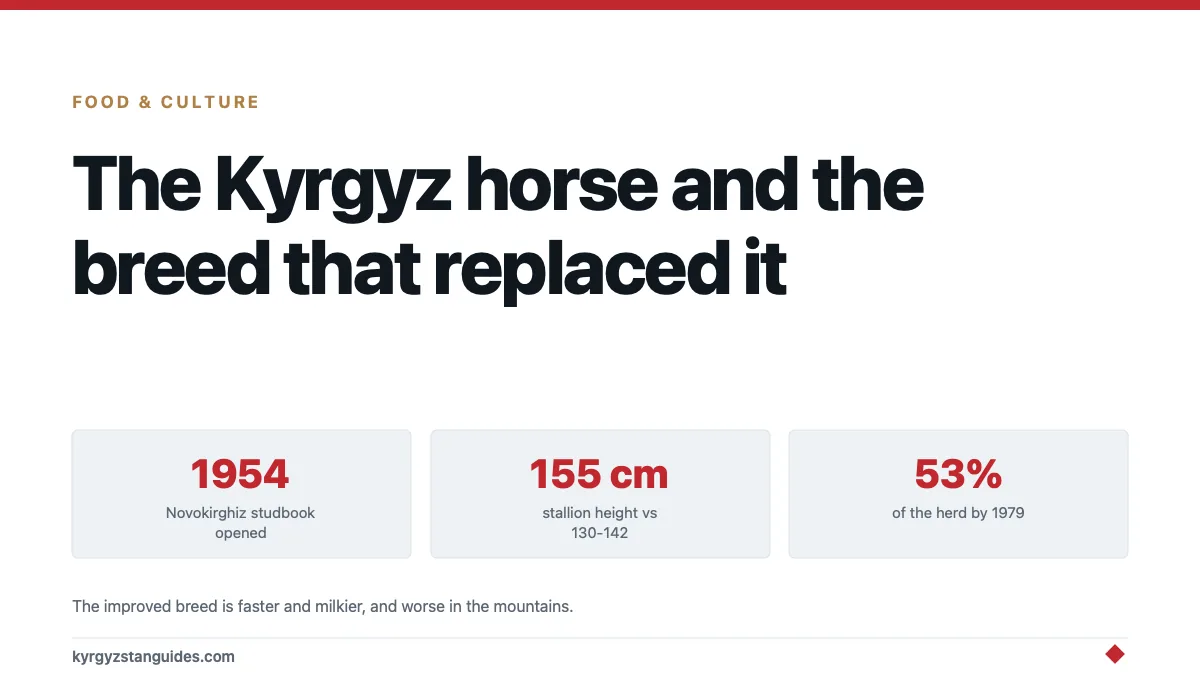
In the mid-twentieth century Soviet breeders set out to improve the native stock by crossing it with Thoroughbred, Don and Anglo-Don horses. The result was registered as the Novokirghiz, with a studbook established in 1954. Private projects are now trying to work backwards from it: Novastan has reported on one that has grown from a single stallion and five mares to more than eighty horses, and needs 500 with documented pedigrees before the state will recognise it as a breed at all.
It's a bigger animal: stallions around 155 centimetres and 455 kilos, mares around 151 and 445. It comes in three types (original, saddle and heavy) and it's genuinely better at some things. Faster over short distances. More useful in harness and for agricultural work. Higher milk yield, with mares giving up to 20 kilos a day, which matters for kymyz production.
The trade-offs were the problem. The Novokirghiz is more expensive to feed, slightly less capable on mountain terrain, and more prone to disease.
Read that again with the geography in mind. A country that is 94% mountains replaced a horse adapted to mountains with one that is less good in them and costs more to keep.
By 1979, 53% of the national herd was Novokirghiz and the traditional Kyrgyz horse had dropped out of the official figures entirely.
Why it happened
Not stupidity. A different set of goals.
Soviet agricultural planning valued measurable output, meat weight, milk yield, speed, draught power, and a native breed optimised for surviving on a bad slope scores badly on all of those. The improvement programme did exactly what it was designed to do.
What it didn't weigh was the thing the old horse was actually for, which was being cheap to keep in a place where nothing is cheap to keep.
Breeders have complained that Kyrgyzstan is allowing its indigenous horses to die out, and the argument has had more traction recently as interest in native livestock genetics has grown, the same argument being made about heritage crops, and about the apricot varieties of Batken.
Wealth on four legs
Worth understanding because it explains behaviour you'll otherwise misread.
Livestock here is not a hobby and it isn't sentiment. It's capital. A family's herd is its savings account, its pension, its insurance against a bad year and the thing it'll sell to pay for a wedding or a funeral: both of which, as our wedding and funeral guides set out, cost a very great deal.
Horses sit at the top of that hierarchy. They are worth more than sheep, they carry more prestige, and giving one is a serious act.
Which is why a herder will treat a horse as a valuable working asset rather than as a pet, and why the relationship can look unsentimental to a visitor from a country where horses are leisure animals. It is not indifference. It is the difference between an animal that earns and an animal that costs.
It also explains the anxiety underneath the breeding argument. A herd that needs bought feed through the winter is a herd that can bankrupt you in a bad year. The old horse didn't need it.
What you'll actually ride
If you take a horse trek here. And you should. You'll most likely be on a Novokirghiz or a cross.
That is fine. These are working animals, they know the ground, and the horses used by CBT operators and herders have spent their lives doing exactly this. Our horse trekking guide covers what a multi-day ride involves.
What to expect: a horse that has been handled but not schooled the way a Western riding-school horse is, tack that's functional rather than smart, and an animal that knows the route better than you do. Kyrgyz horses are generally calm and sensible on bad ground, which is the quality that matters.
Do not expect a horse that responds to leg aids you learned in an arena. Expect one that follows the horse in front and objects to being asked to do otherwise.
The horse in everything else
You cannot separate the animal from the culture here, and once you notice it you see it constantly.
Kok-boru, the national sport, is horseback and violent and the single clearest expression of what these animals were bred for.
Kymyz, fermented mare's milk, drunk through the summer and central to hospitality.
Meat. Horse is eaten here, and chuchuk, horse sausage, is a prestige food at celebrations. Beshbarmak in its ceremonial form is horse meat.
Weddings, where livestock is part of what moves between families.
The Manas epic, in which Manas's horse Ak-Kula is a named character.
Transport that still works. Get above a road and horses aren't nostalgia; they're how things get moved.
Seeing them properly
Song-Kul and the jailoos in summer, where herds are loose on open pasture. Our Song-Kul guide covers the season.
Suusamyr, which in July is essentially a horse basin.
Kok-boru matches, at Nooruz and Independence Day especially, as our Nooruz guide notes.
At Chabysh, the horse festival held around the south shore of Issyk-Kul, which exists partly to promote native breeds.
That last one is worth seeking out if the breeding question interests you. It is where the argument about what a Kyrgyz horse should be gets made in public, by people who keep them.
FAQ
What is the Kyrgyz horse breed?
A traditional small mountain horse, 130–142 cm at the shoulder, bred for sure-footedness, hardiness and the ability to keep condition on poor grazing at altitude rather than for size or speed.
What is a Novokirghiz?
A breed developed in the mid-twentieth century by crossing the native Kyrgyz horse with Thoroughbred, Don and Anglo-Don blood, with a studbook from 1954. Larger and faster, but more expensive to feed and less adept in the mountains.
What happened to the original Kyrgyz horse?
It was largely bred out. By 1979 the Novokirghiz made up 53% of the national herd and the traditional Kyrgyz horse had disappeared from official statistics. Breeders have since argued that the indigenous animal is being allowed to die out.
What horse will I ride on a trek in Kyrgyzstan?
Most likely a Novokirghiz or a cross. They're working animals that know the terrain, generally calm on bad ground, and handled rather than schooled — don't expect arena-trained responses.
Do Kyrgyz people eat horse?
Yes. Horse meat is eaten and chuchuk, horse sausage, is a prestige dish at celebrations. Ceremonial beshbarmak is made with horse rather than mutton.
Where can I see Kyrgyz horses?
On the summer jailoos, Song-Kul and Suusamyr especially, where herds run loose. Kok-boru matches at Nooruz and Independence Day, and the At Chabysh festival on Issyk-Kul's south shore, which promotes native breeds.