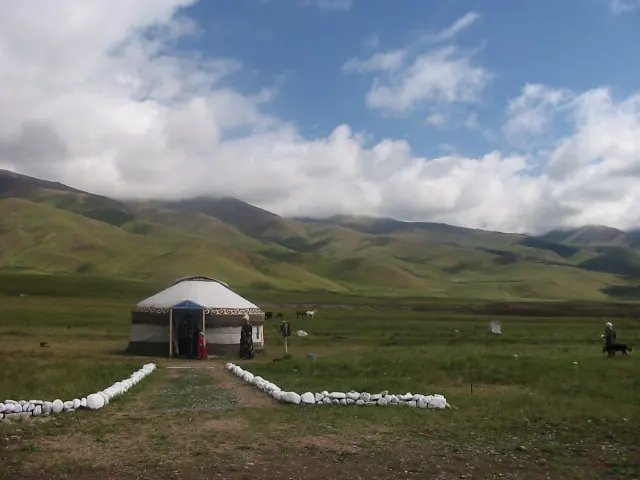
What is the flat, treeless, yurt-dotted plateau you suddenly find yourself crossing a couple of hours out of Bishkek on the road south? That is Suusamyr — a broad high-altitude valley at around 2,000–2,200 meters, ringed by the Kyrgyz and Suusamyr-Too ranges, and one of the country’s great summer pastures.
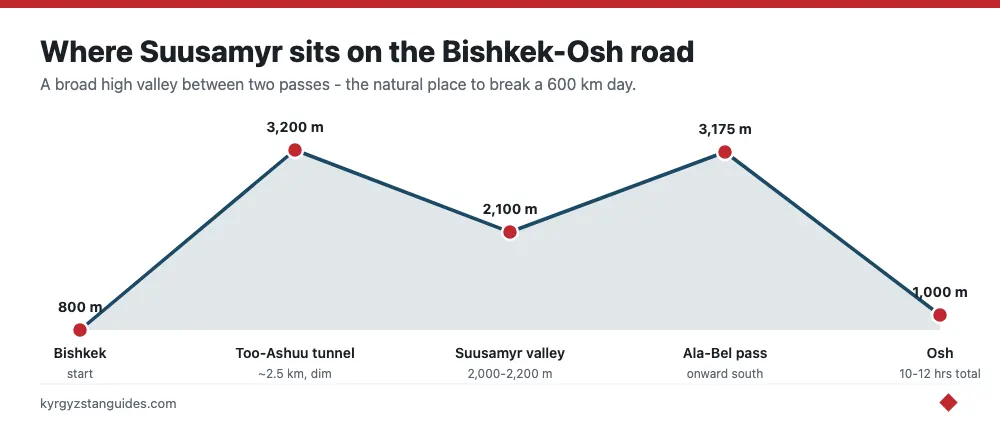
For most travelers Suusamyr is a stop, not a destination: you cross it on the long haul between Bishkek and Osh, over the Töö-Ashuu pass — the old road tops out at 3,586 meters, while the Soviet tunnel that replaced it sits at roughly 3,125 to 3,150 meters — and through that tunnel, and then down again toward Toktogul and the south. But the valley is worth more than a photo from a moving car. In summer it is classic jailoo country (nomad families, herds, kymyz (fermented mare’s milk) sold from the roadside) and it has become a spot for paragliding and horse riding. This guide is about what Suusamyr actually offers, how to break your journey here, and the honest limits of stopping.
What Suusamyr is
The Suusamyr Valley is a high intermontane basin drained by the Suusamyr River, used for centuries as summer grazing. Because it sits so high, it's a summer place: from roughly June to September the grass is green, families move their herds up, and yurts appear across the plain. In winter it empties out, cold and wind-scoured, though the surrounding passes see backcountry skiers. The valley is crossed by the M41 Bishkek–Osh highway, which is what puts it on nearly every southern traveler’s route, and its position between two passes gives it a genuine end-of-the-world openness. Big sky, long horizons, no trees.
That openness is exactly why it draws paragliders. The steady thermals and wide flat landing ground have made Suusamyr one of Kyrgyzstan’s paragliding spots, with tandem flights sometimes offered in season. It isn't a fixed, always-on operation the way a European flight center would be: availability depends on operators, weather, and the season — but if the conditions and a pilot line up, floating over a valley full of yurts is a rare thing.
Jailoo life and horse riding
The real substance of Suusamyr in summer is nomadic pasture culture. This is one of the more accessible places to see a working jailoo up close because the highway runs right through it: you don't need a multi-day trek to reach herders’ summer camps. Roadside families sell kymyz and sometimes qurut (dried yogurt balls); a few offer yurt stays and horse rides. Riding here is about the landscape rather than technical trails: hours across open pasture with mountains on every side. Rates are informal, usually a few hundred KGS an hour, negotiated on the spot.
If this style of travel, riding between summer camps, staying in yurts, living briefly at the herders’ pace, is what you came to Kyrgyzstan for, Suusamyr is a taste rather than the main course. The country’s dedicated horse-trekking regions run deeper and longer; our horse trekking guide covers where to go for a real multi-day ride, and the nomadic culture guide explains the jailoo system you're looking at.
Breaking the Bishkek–Osh journey here
The Bishkek–Osh road is a long day — 600-plus km, 10–12 hours by shared taxi or marshrutka if you go straight through, more with stops. Suusamyr sits a few hours in from the Bishkek end, past Töö-Ashuu, which makes it a logical first break: stretch, eat, buy kymyz if you are brave, and photograph the plateau. A few simple roadside cafes and guesthouses cluster near the highway, so it's possible to overnight here and split the journey, which some travelers do to avoid the full marathon in one sitting. If you're weighing whether to fly or drive the south, our getting around Kyrgyzstan guide compares the options and their real costs.
Shared taxis and marshrutkas along the M41 will drop and pick up here, but seats fill in Bishkek or Osh, so if you break your trip you may spend time flagging down passing vehicles with space. Build in flexibility. Where you're ultimately headed shapes the calculus: Suusamyr is the northern gateway to the whole southern journey toward Osh and the Fergana Valley.
The passes and the road itself
You can't talk about Suusamyr without the road that reaches it. From the Bishkek side you climb to the Töö-Ashuu pass and pass through a roughly 2.5 km tunnel near 3,200 meters, old, dim, sometimes poorly ventilated, and occasionally the scene of delays. On the far side the road drops onto the plateau in a series of switchbacks with long views. It's a spectacular drive and a serious one: high altitude, changeable weather, and mountain gradients. In winter and shoulder seasons snow can close or slow the passes with little warning.
A word of caution before you stop
Suusamyr is high, exposed, and weather-driven, and that's the thing to respect. The valley sits above 2,000 meters and the passes on either side climb well past 3,000, so an overnight here means cold nights even in summer and a real, if usually mild, chance of feeling the altitude — pace yourself, hydrate, and don't treat kymyz as a substitute for water. Facilities are basic and thin on the ground; there is no town, no reliable ATM, and patchy signal, so carry cash and enough food and warm layers to be self-sufficient. Most importantly, the whole experience hinges on the M41 staying open: check pass and weather conditions before you commit to breaking your journey here, especially outside high summer, because a closed Töö-Ashuu tunnel can strand you on the wrong side with few comfortable places to wait. Come prepared and Suusamyr is one of the finest stops on the southern road — arrive unprepared and it's a cold, empty plateau a long way from help.
The pass, and why it closes
Suusamyr is reached over Töö-Ashuu from the north and left over Ala-Bel to the south, and both are on the emergency ministry's standing list of avalanche-prone sections. The bulletins name them by kilometre: 121 to 138 on the Bishkek–Osh road for Töö-Ashuu, and 198 to 255 for Ala-Bel and the Chychkan gorge beyond it. The standing instruction on those stretches is to keep at least 500 metres between vehicles.
In January 2025 an avalanche at kilometre 132 on Töö-Ashuu caught six cars and a minibus, and four people were pulled out of one buried vehicle. In February 2026 the ministry carried out controlled releases at kilometres 132, 133 and 136. Truck restrictions come and go through the winter without much notice.
None of that makes a summer crossing risky. It does mean that if you are planning to stop in Suusamyr between November and April, the valley is not the variable — the two passes either side of it are.
Breaking the journey here rather than driving through
The argument for stopping is simple arithmetic. Bishkek to Osh is around 670 kilometres of mountain road, and the crash that most often kills people on it is a tired driver crossing the centre line. Suusamyr sits at roughly the point where a morning start from Bishkek has used up the good hours.
The argument against is that facilities are thin. This is jailoo country, not a resort strip: yurt stays and roadside kymyz rather than hotels, and almost all of it seasonal. Arrive in October and you may find the valley emptying out.
If you are driving yourself, read the note on night travel before deciding to push through to Toktogul in the dark.
Frequently Asked Questions
Where is the Suusamyr Valley?
It is a high mountain valley in northern Kyrgyzstan, crossed by the M41 Bishkek–Osh highway a few hours south of Bishkek, beyond the Töö-Ashuu pass and tunnel. It sits at roughly 2,000–2,200 meters between the Kyrgyz and Suusamyr-Too ranges.
What is there to do in Suusamyr?
In summer, mainly jailoo experiences: seeing nomad herders’ camps, buying kymyz, horse riding across the pasture, and yurt stays. Suusamyr is also known for paragliding when operators and conditions align. In winter the surrounding passes attract backcountry skiers, but the valley itself largely empties out.
Is Suusamyr worth stopping for on the way to Osh?
Yes, as a break rather than a base. It is a natural place to stretch, eat, and take in the plateau, and some travelers overnight here to split the long Bishkek–Osh drive. Just check pass and weather conditions first, carry cash and warm layers, and treat it as a wild, high, thinly serviced stop.
How high is the Töö-Ashuu pass?
The old road over the top reaches 3,586 metres. The Soviet tunnel that replaced it sits lower, at roughly 3,125 to 3,150 metres — the Ministry of Transport's own pages give both figures. Suusamyr valley itself lies at about 2,000 to 2,200 metres.
Is there anywhere to stay or get cash in Suusamyr?
A few simple roadside cafes and guesthouses cluster near the highway, and in summer some herding families offer yurt stays. There is no town, no reliable ATM and only patchy signal, so carry cash, food and warm layers. Almost all of it is seasonal: arrive in October and you may find the valley emptying out.
Is the road through Suusamyr dangerous?
The valley floor is easy. The passes either side are the hazard: Töö-Ashuu and Ala-Bel both appear in the emergency ministry's avalanche bulletins, which instruct drivers to keep at least 500 metres between vehicles on the marked sections. In winter, truck restrictions and short closures are routine.
From Suusamyr a road also branches west over the Otmok pass to Talas. For Talas itself — its bean economy, and the fact that the cheap road to it runs through Kazakhstan — see Talas town.
On the drive up to Töö-Ashuu, Kara-Balta is the last real town you pass — a place that grew around a uranium combine and an oil refinery, both of which have since stopped. More in the Kara-Balta guide.
Suusamyr is also on a slower route to Song-Kul: instead of the two-day jeep from Kochkor, you can walk in, seven days on foot from Kyzyl-Oi through the Suusamyr valley.