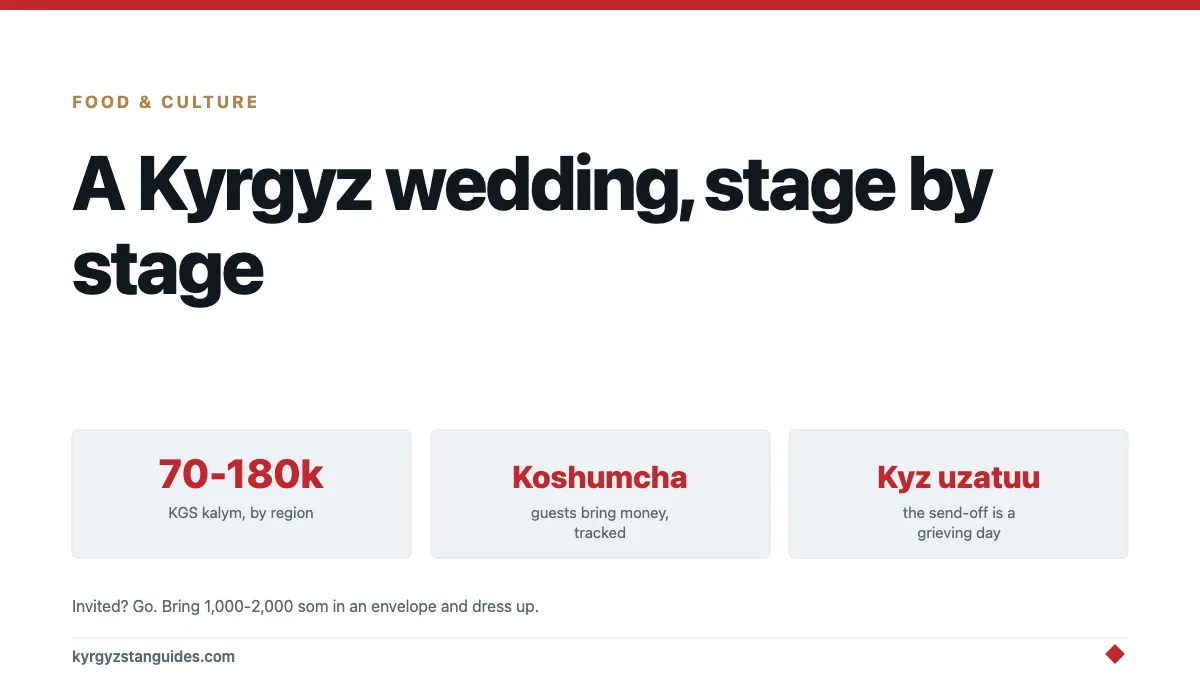
A Kyrgyz wedding isn't an event, it's a sequence that can run for months, engagement visits, earrings, a bride price negotiated between families, a send-off that is openly a grieving occasion, and finally a feast that might seat several hundred people. Travellers get invited to the last part more often than they expect, usually at a day's notice.
If that happens to you, here's what you're walking into.
The sequence
Kuda tushuu — the groom's family visits the bride's house. ICHCAP's record of Kyrgyz wedding ritual sets out the full sequence, of which this is the opening move. This is the formal approach, and it's between families rather than between the couple.
Soiko saluu, the bride is given a pair of gold earrings by the groom's family. That's the moment the engagement becomes official. Earrings, specifically; it's not a ring culture.
Kalym — the bride price, paid by the groom's family in money or livestock. More on this below, because it's the part outsiders ask about and the part that gets flattened in the telling.
Sep, the bride's family's side of the exchange, the goods and furnishings she brings to the new household. Kalym travels one way and sep the other, which is the bit usually left out when kalym gets described as a purchase.
Nike kyiuu: the Islamic marriage ceremony.
Kyz uzatuu — the send-off from her parents' house. This is the emotionally heavy one, and it isn't a happy occasion in the way a Western engagement party is. A daughter is leaving to live with another family. People cry, and that is the expected register.
Bet achach: the bride's arrival at the groom's family, with songs about her, small gifts of money and sweets, and a white scarf as blessing. In more traditional households she sits behind a curtain, the koshogo, for a few days while visitors come to see her.
Toi — the feast. Hundreds of guests, and the part you'll be invited to. If there's music, there may be an aitysh. Improvised verse contests turn up at large weddings.
What kalym actually is
Money or livestock, from the groom's family to the bride's, and the amounts are real. Published figures by region run roughly:
| Region | Typical kalym |
|---|---|
| Talas | 160,000–180,000 KGS |
| Naryn | 100,000–130,000 KGS |
| Osh, Jalal-Abad | 100,000–130,000 KGS |
| Batken | 90,000–100,000 KGS |
| Chuy | 80,000–100,000 KGS |
| Issyk-Kul | 70,000–100,000 KGS |
At roughly 88 som to the dollar, that's somewhere between $800 and $2,000 — against a country where a guesthouse night runs $15 and a month of decent mobile data is $6. It is a large sum here.
Two things worth understanding rather than judging. It isn't a one-way transfer: sep goes back the other way, and in many families the totals aren't far apart. And it's widely argued about inside Kyrgyzstan, by people who think it's an obligation on young families that has inflated well past what anyone can afford.
Why a toi can bankrupt a family
The feast is the expensive part, not the kalym. A large toi runs into millions of soms.
The mechanism that makes that survivable is koshumcha, guests bring money, and the amounts are tracked. If you give a relative 5,000 som at their toi, they bring at least 5,000 to yours. It's a reciprocal credit system running across a whole extended family over decades, and it's how a household with an ordinary income puts on a feast for four hundred people.
It also means the guest list has a logic beyond affection. Inviting someone is partly an investment.
Our guide to toi and Kyrgyz celebrations covers where weddings sit among the other occasions that organise life here.
If you get invited
You probably will, if you stay in a homestay for more than a couple of nights in summer. Weddings cluster in the warm months. Which is also when you are most likely to be in a village at all, as our yurt stay guide and the homestay network both funnel visitors into family households. The invitation is usually genuine rather than polite.
Go. It's the single best window into the culture you'll get, and refusing is a bigger deal than accepting.
Bring money, in an envelope. This is koshumcha and it's the expected form. As a foreign guest with no reciprocal obligation, something in the range of 1,000–2,000 som is appropriate and nobody will scrutinise it. Hand it to whoever is receiving guests, not to the couple.
Dress up. Smarter than you think. A Kyrgyz toi is a well-dressed occasion and the walking clothes you've been in for a week are not it.
Expect a lot of food and a long sitting. Beshbarmak, plov, boorsok, salads that arrived two hours before you did and are still there. Our beshbarmak guide explains the ceremonial version you're likely to meet.
Expect to be introduced, repeatedly. A foreigner at a family toi is an event within an event. Accept it with good humour.
Toasts matter. If you're asked to say something, stand, keep it short, wish the couple well, thank the hosts. Nobody expects eloquence in Kyrgyz.
On alcohol: it varies enormously by family and region. Some tois are dry, some emphatically are not. Follow the table you're sitting at rather than assuming either way.
The part that's genuinely contested
Bride kidnapping, ala kachuu, belongs in any honest account of marriage in Kyrgyzstan, and it isn't a wedding custom in the sense the others are.
It is illegal. It still happens, mostly rurally, and it ranges from a staged consensual elopement that both families are in on to abduction and coerced marriage. Kyrgyz activists, journalists and women's organisations have campaigned on it for years, and it's a subject of real and ongoing argument inside the country rather than an exotic detail for visitors.
Mentioning it here because a page describing Kyrgyz marriage that leaves it out isn't telling you the truth. It isn't something a traveller will encounter at a toi, and it isn't a reason to think differently about the family that invites you.
One practice that gets described to visitors as a wedding custom is not one in law. Ala-kachuu, abduction for marriage, carries five to seven years’ imprisonment under the current Criminal Code and is prosecuted as a grave offence without the victim’s complaint.
FAQ
What is kalym in Kyrgyzstan?
Kalym is the bride price paid by the groom's family to the bride's, in money or livestock. Published regional figures run from about 70,000 som on Issyk-Kul to 160,000–180,000 in Talas. The bride's family sends goods the other way, called sep.
What are the stages of a Kyrgyz wedding?
Kuda tushuu (the families' formal visit), soiko saluu (gold earrings marking engagement), kalym and sep (the exchange between families), nike kyiuu (the religious ceremony), kyz uzatuu (the send-off from her parents), bet achach (arrival at the groom's family), and finally the toi, the feast.
Can tourists attend a Kyrgyz wedding?
Yes, and invitations are common if you're staying in homestays during summer. They're generally genuine. Going is far better received than declining.
What should I bring to a Kyrgyz wedding?
Money in an envelope: this is koshumcha, the reciprocal contribution guests make towards the cost. As a foreign guest, 1,000–2,000 som is appropriate. Give it to whoever is receiving guests rather than to the couple.
Why is kyz uzatuu so sad?
Because it marks a daughter leaving her parents' household to live with her husband's family. Crying is the expected response, not a sign anything is wrong. It's the emotional counterweight to the celebration that follows.
What is koshumcha?
The money guests contribute at a toi, tracked and reciprocated. Give 5,000 som at a relative's wedding and they'll bring at least that to yours. It's what allows ordinary families to host feasts for hundreds of guests.