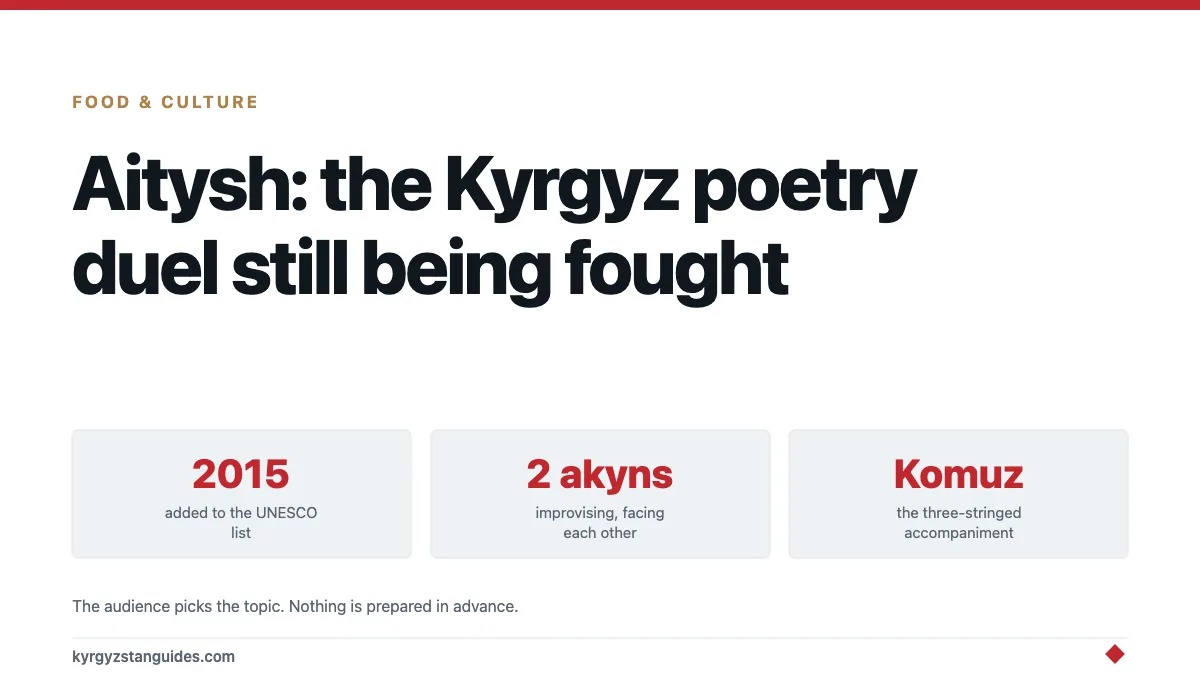
Two people sit facing each other with komuz in hand, the audience shouts a topic at them, and they argue in improvised verse until one of them runs out of wit. That is aitysh, it's a live competitive art rather than a museum piece, and UNESCO added it to the Representative List of Intangible Cultural Heritage in 2015.
Travellers almost never see one, mostly because nobody tells them it exists.
What actually happens
Strip away the folklore framing and aitysh is a rap battle with a three-stringed lute, which is the comparison that makes it click for most people and is not as flippant as it sounds. The mechanics are close to identical: two performers, alternating turns, improvised on the spot, judged on wit and timing, with an audience that reacts in real time and decides who won.
The performers are called akyns. They sit opposite one another and build a dialogue in verse on subjects the audience picks, which means an aitysh can swing from mockery of a rival's appearance to a serious argument about corruption or migration inside the same exchange. UNESCO's own description of the form notes that it alternates between humorous ripostes and philosophical reflection, and that's exactly the texture: a joke, a jab, then something that lands harder than you expected.
The accompaniment is the komuz in Kyrgyzstan and the dombra in Kazakhstan, where the same art is called aitys. It is a shared tradition, jointly inscribed by both countries, and the two national scenes pay close attention to each other.
Judging is on musical skill, rhythm, originality, resourcefulness, wisdom and wit. Not on being right.
Why it survived when most oral traditions didn't
Because it never stopped being useful.
An akyn isn't reciting a fixed text. There is a fixed text tradition in Kyrgyz culture (the Manas epic, half a million lines of it, carried by specialists who train for decades) and our guide to the Epic of Manas covers that side. Aitysh is the opposite discipline. Nothing is memorised. The verse is made while you watch, about whatever the room just named.
That makes it a commentary medium. Under the Soviet system it carried what could be said obliquely. Since independence it has carried politics fairly directly, and akyns are known figures with reputations. Aitysh was traditionally performed by men; women compete now, and use the form to put arguments in public that are harder to make elsewhere.
A tradition that's genuinely doing a job doesn't need protecting in the way a dying one does. It needs an audience, and it has one.
Kyrgyzstan isn't alone in this
A small detour, because it changes how you see the thing.
Competitive improvised verse is not a Central Asian oddity. It turns up independently across the world, the Basque bertsolaritza, Sardinian and Sicilian duelling poets, Welsh and Gaelic traditions, freestyle battles in half a dozen hip-hop scenes. The American folklore organisation City Lore runs a project documenting poetry duels precisely because the pattern recurs in so many unconnected cultures.
The shared ingredients are always the same: a form tight enough that breaking it is audible, an audience close enough to react instantly, and a rule that you cannot prepare. Where those three exist, people seem to invent this.
Which is a useful thing to carry into the room. You aren't watching an exotic local custom. You're watching one branch of something humans keep doing, performed here at a standard that has kept it alive for centuries.
The modern competition circuit
Aitysh today runs on organised contests with prize money, regional heats and national finals, televised and clipped onto social media the way any competitive format is now.
That has done two things. It has made akyns into recognisable public figures with followings rather than village performers, and it has pulled younger competitors in: the format rewards speed and nerve, which is a young person's game. Kazakhstan's aitys scene runs on the same circuit logic, and cross-border contests between Kyrgyz and Kazakh akyns are a fixture.
It has also made the form more visible than it was thirty years ago, which is not what most people assume happens to a traditional art under modern media.
Where you might actually encounter it
Honestly: not reliably, and not on a schedule you can book.
The places aitysh turns up are national holidays, regional festivals, weddings and large celebrations, and televised competitions. The single best bet for a visitor is Nooruz on 21 March, when celebrations happen nationwide and the programme in Bishkek and the regional centres usually includes performances. Independence Day on 31 August is the other likely window.
Beyond those, it comes down to asking. A CBT office, a guesthouse owner, or a university student who speaks English will know whether something is on locally in a way no website will tell you. Our festivals calendar sets out the fixed dates worth planning around.
There is also the option nobody thinks of: television. Aitysh contests are broadcast, and an evening in a guesthouse with the set on will show you the form even if you cannot follow the words. You will still see the timing, the laughter arriving a beat after a line, the audience reaction that tells you a point landed.
Will you understand any of it?
No. Let's be straightforward about that.
Aitysh is dense, fast, idiomatic Kyrgyz, full of references to people and events you have no context for. Even fluent Russian speakers who don't have Kyrgyz miss most of it. A translator can give you the gist of a topic but can't keep up with improvised verse in real time.
What you can follow is everything except the words — and with this particular art form, that's a surprisingly large share of it. Who is on the front foot. When someone lands a hit. The pause before a reply that means the other akyn is in trouble. The crowd noise doing the work a scoreboard would do.
Is it worth going out of your way for if you understand nothing? If you have any interest in oral culture, live competition, or how a society argues with itself, yes. If you want a show with costumes and a narrative, no, and the World Nomad Games or a kok-boru match will give you far more to look at.
How this fits with the rest of Kyrgyz music
The komuz is the thread. It accompanies aitysh, it carries its own instrumental repertoire, and it's the instrument you'll be offered in every souvenir shop — our komuz guide covers buying one and what separates a real instrument from a wall decoration.
Around it sits a wider tradition: the manaschi reciting epic, the kyiak with its horsehair strings, and jailoo evenings where someone plays because someone always does. Aitysh is the competitive, verbal, public end of the same culture.
FAQ
What is aitysh?
Aitysh is a Kyrgyz improvised poetry contest. Two akyns sit facing each other, accompanied by komuz, and trade verses on topics chosen by the audience. UNESCO inscribed it on the Representative List of Intangible Cultural Heritage in 2015, jointly with Kazakhstan, where it's called aitys.
Is aitysh the same as the Epic of Manas?
No, and they're near-opposites. Manas is a fixed epic carried by trained reciters called manaschi. Aitysh is improvised on the spot about whatever the audience names. Both are oral traditions; only one is memorised.
Where can tourists see aitysh in Kyrgyzstan?
There's no regular public venue. Your best chances are Nooruz on 21 March, Independence Day on 31 August, regional festivals and large weddings. Ask locally: a CBT office or guesthouse will know what's on. Contests are also televised.
Do women perform aitysh?
Yes. The tradition was historically male, but women compete today and use the form to raise arguments and perspectives that are harder to voice in other public settings.
What instrument is used in aitysh?
The komuz, a three-stringed fretless lute, in Kyrgyzstan. In Kazakhstan the equivalent contest uses the dombra. The instrument marks rhythm and fills the gaps while the performer composes the next line.
Can I follow aitysh without speaking Kyrgyz?
Not the words — it's fast, idiomatic and full of local reference. You can follow the contest itself: who's winning, when a line lands, how the crowd reacts. Take a Kyrgyz speaker if you can, and accept you're getting the shape rather than the content.