Count the lines and the Epic of Manas stops sounding like folklore and starts sounding impossible. The fullest recorded versions run to around half a million lines of verse, roughly twenty times the length of Homer’s Odyssey and, by most reckonings, longer than the Iliad and the Odyssey put together several times over. The Epic of Manas is the Kyrgyz national epic, widely called the longest epic poem in the world, and it survives above all as a living oral performance carried in the memory of trained bards rather than as a text on a shelf.
No single poem fixed on a page sits behind that number. Manas is a three-generation saga, a warrior code, a genealogy and a national origin story rolled into one, and for most Kyrgyz people it's the clearest single answer to the question of who they are. Here is what the epic actually contains, who keeps it alive, where you can stand inside its story, and why the name Manas is on the airport, the university and the main square of the capital.
What exactly is the Epic of Manas?
Manas is a trilogy that follows three generations of one family. The first and largest part tells the life of Manas himself; the second follows his son Semetey; the third his grandson Seytek. Across those parts the story tracks the Kyrgyz from scattered, defeated clans to a united people back in their own land.
The number at the centre of it all is forty. Kyrgyz self-understanding folds together forty tribes, and the epic dramatises their gathering into one people under Manas; his personal guard, the kyrk choro, is forty strong, and the traditional link between the name Kyrgyz and the idea of forty clans feeds the epic’s theme of unity out of fragmentation. Read as literal history it is unreliable; read as a charter for how a scattered people becomes a nation, it's remarkably coherent.
Because the whole epic is so vast, it's never performed from start to finish. A bard chooses episodes to suit the occasion, and the same performer can stretch or compress a scene depending on the audience and the hour. That is why two recordings of the same passage can differ so much: what you're hearing is a tradition being re-made in real time rather than a script being read aloud.
There is no single authorised text either. Every great reciter carried his own version, so the epic exists as a family of tellings rather than one fixed manuscript, and the two most influential twentieth-century versions, recorded from the bards Sagymbay Orozbakov and Sayakbay Karalaev, differ in length, emphasis and detail. That is why even the total line count is genuinely disputed: it depends on which recorded version you count. None of this is a flaw in the record. Manas was built to be performed, not read, and it kept absorbing the concerns of each era that sang it.
Manas the hero: the story in brief
Manas is born to Jakyp at a low point for the Kyrgyz, who have been pushed from their homeland and scattered among more powerful neighbours. Marked out from childhood, he grows into the leader who reunites the forty tribes, and the number forty runs through the epic like a signature, echoed in his band of forty companions, the kyrk choro.
Around him stands a cast the epic returns to again and again: his shrewd, capable wife Kanykey; Almambet, a noble outsider who becomes his closest comrade in arms; and his warhorse Ak-Kula. The narrative moves through feuds, migrations and campaigns against Kalmyk and Oirat armies and other rivals, building toward a great campaign far to the east. Manas is eventually wounded and dies. The epic then hands the struggle to Semetey and Seytek, so the story becomes one of a people outlasting the death of even its greatest hero.
One of the epic’s great set pieces is that eastern campaign, a vast expedition against a powerful enemy, but the saga’s emotional weight comes from its people rather than its battles. Almambet, who abandons his own to stand with Manas, embodies the theme of chosen loyalty, while Kanykey emerges as a strategist and healer who outlives her husband and shapes the next generation. Betrayal, blood-brotherhood, a warrior’s death and the grief of those left behind are handled with a seriousness that has kept the epic alive as literature, well beyond its role as patriotic symbol.
The manaschi: bards who carry an epic in memory
A reciter of Manas is called a manaschi, and the tradition asks something extraordinary of them: to hold tens or hundreds of thousands of lines in memory and deliver them from within, without a book. A manaschi performs unaccompanied, a rapid, rhythmic, half-chanted torrent of verse driven with the hands and the whole upper body. This sets them apart from the akyn, the improvising poet who sings to the plucked komuz; the manaschi needs no instrument.
By long custom, real manaschi do not simply decide to learn the epic. Many describe being called to it in a dream, often by Manas or one of his forty companions, and only then taking up the tradition. Within it they improvise, so no two performances match line for line, yet the great figures stay recognisable. Sayakbay Karalaev, the towering manaschi of the Soviet era, was recorded reciting on the order of half a million lines.
Becoming a manaschi is treated as a vocation rather than a career. A gifted child might absorb thousands of lines simply by listening, then serve a kind of apprenticeship to an older bard, and only the strongest are recognised as full manaschi; lesser reciters are sometimes called chala, or half, manaschi. In performance the good ones are hypnotic, the verse pouring out fast and loud, the reciter sweating and gesturing as if watching the battles happen in front of them, so that audiences who do not follow every word still feel the momentum. This oral art is the beating heart of Kyrgyz nomadic culture, and you're as likely to meet it at a festival or a yurt-camp evening as in any theatre.
Manas Ordo: the shrine near Talas
The physical centre of the Manas world is Manas Ordo, a complex set in the Talas valley in the country’s northwest, a short drive from the town of Talas. Its centrepiece is the Gumbez, a domed fourteenth-century mausoleum that local tradition holds to be the tomb of Manas.
There is a twist that Kyrgyz storytellers enjoy. The building’s inscription names a noblewoman rather than a warrior, and the legend explains this away beautifully: Kanykey is said to have disguised her husband’s tomb, dedicating it to a woman so that enemies wouldn't find and desecrate it. Around the mausoleum sit a museum, monuments and a hill traditionally described as Manas’s lookout, and the site hosts gatherings and commemorations through the year. Talas is genuinely out of the way, usually reached by a long road that dips through Kazakh territory or crosses high passes, so most travelers treat Manas Ordo as a dedicated pilgrimage rather than a casual stop.
Why Manas is the heart of Kyrgyz identity
Through Tsarist rule, the Soviet decades and independence since 1991, Manas has stayed the fixed point of Kyrgyz self-understanding. It works as a shared genealogy and an ethical charter as much as an adventure story, and a set of guiding principles often called the seven precepts of Manas, covering unity, generosity, national pride and friendship among peoples, has been promoted as a national code.
The epic also survived pressure. Under Soviet rule Manas was at times treated with suspicion as feudal and nationalist, and some scholars who worked on it paid a heavy price, yet the tradition never broke. In the independence era the writer Chingiz Aitmatov and others helped return Manas to the centre of cultural life, and today it functions as the common inheritance of Kyrgyz from every region and clan, a shared story in a country where local and tribal identities still run strong.
The epic is taught in schools, quoted by politicians and woven into public life, and in 1995 the country staged a vast jubilee marking a symbolic thousand years of Manas. To be Kyrgyz, in the story the nation tells about itself, is to be an inheritor of Manas.
UNESCO recognition, and a quiet dispute
In 2013 UNESCO inscribed the Kyrgyz epic trilogy of Manas, Semetey and Seytek on the Representative List of the Intangible Cultural Heritage of Humanity, formal recognition of the manaschi tradition as world heritage. The listing celebrates the living art of performance rather than any single frozen text, which suits an epic that has never stood still.
There is a sensitive backstory. A few years earlier, Manas had been inscribed by China as heritage of the sizeable Kyrgyz minority living in Xinjiang, where the epic is also sung. That move was felt keenly across the border in Kyrgyzstan, where Manas is treated as the core of national identity, and it sharpened the sense that the epic needed recognition rooted in its homeland.
Where travelers actually encounter Manas
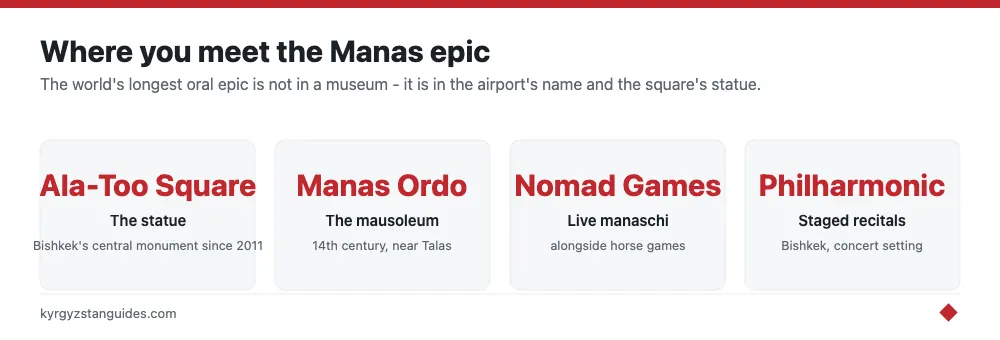
You do not need to reach Talas to meet the epic. Manas’s name and image are stitched through daily life, starting the moment you land, and a handful of places let you see the epic rather than just hear about it.
| Where | What you encounter |
|---|---|
| Ala-Too Square, Bishkek | The towering statue of Manas on horseback, the capital’s central monument since 2011 |
| Manas International Airport | The country’s main gateway, named after the hero the moment you arrive |
| Manas Ordo, near Talas | The fourteenth-century mausoleum, museum and monuments at the epic’s spiritual home |
| World Nomad Games and festivals | Live manaschi performances alongside horse games and eagle hunters |
| National Philharmonic, Bishkek | Staged recitals where you can hear the chanted verse in a concert setting |
If you are shaping a trip around the culture rather than the peaks, pairing a manaschi performance at the World Nomad Games with a day among the monuments and museums of Bishkek gets you closer to Manas than any summary can, without the long haul out to Talas.
Manas is the largest of the Kyrgyz epics but far from the only one. Between sixteen and twenty others survive, and they are performed differently — sung by akyns with an instrument rather than narrated solo. See our guide to Kyrgyzstan’s small epics for Er-Töshtük, Kojojash and the rest.
Frequently Asked Questions
Is the Epic of Manas really the longest in the world?
By most counts, yes. The fullest recorded versions run to roughly half a million lines, far longer than the Iliad, the Odyssey or the Mahabharata. Because each bard’s telling differs, there is no single official length, but Manas is routinely cited as the longest epic poem known.
Can I watch a manaschi perform as a tourist?
Yes. Performances happen at cultural festivals, the World Nomad Games, the National Philharmonic in Bishkek and some yurt-camp evenings. A full recitation can run for hours or days, so what visitors usually see is a vivid extract rather than the entire epic.
How do I get to Manas Ordo?
Manas Ordo sits near the town of Talas in the northwest. Talas is remote, reached by a long road that passes through Kazakh territory or over high mountain passes, so most travelers go by shared car or organised trip and treat it as a dedicated day out.
Was Manas a real historical person?
There is no firm proof that Manas existed as a single historical figure. Scholars see the epic as a layered tradition that gathered real events, places and anxieties over centuries. Whether or not one man inspired it, Manas is culturally very real to Kyrgyz people today.
What is the Manas statue in Bishkek?
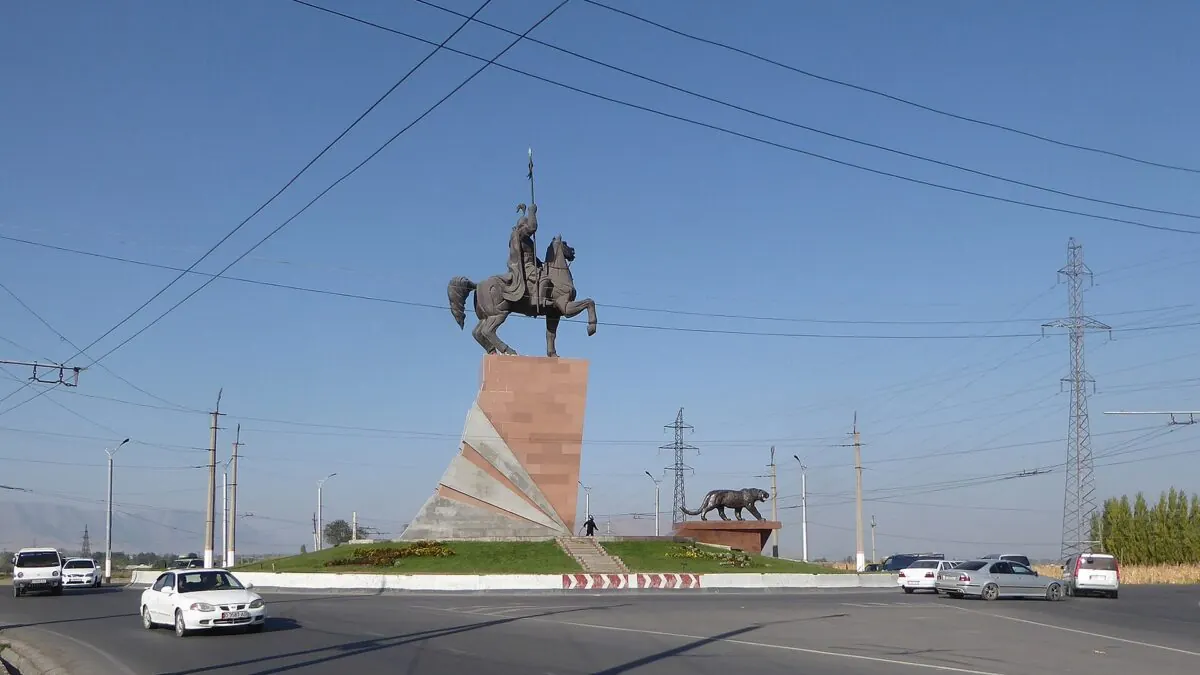
It is the large equestrian monument to Manas on Ala-Too Square, the capital’s main plaza, installed in 2011. Manas is shown mounted and armed, and the statue is the city’s central landmark and a natural first stop for anyone following the epic.
Who were the most famous Manas reciters?
The two most influential twentieth-century versions were recorded from the bards Sagymbay Orozbakov and Sayakbay Karalaev, and they differ in length, emphasis and detail. That is the nature of the tradition: there is no single authorised text — every great manaschi carried his own version, choosing and stretching episodes to suit the occasion.