You'll spend a lot of hours in a marshrutka with the radio on, and after the first day you will start recognising songs.
Kyrgyz music isn't one thing. It's a traditional instrumental and epic tradition that never broke, a Soviet-trained classical and conservatory layer, a Russian-language rock scene, a large and confident Kyrgyz-language pop industry, and (genuinely) a pagan metal band.
Here is enough to know what you're hearing and what to look for.
The traditional core
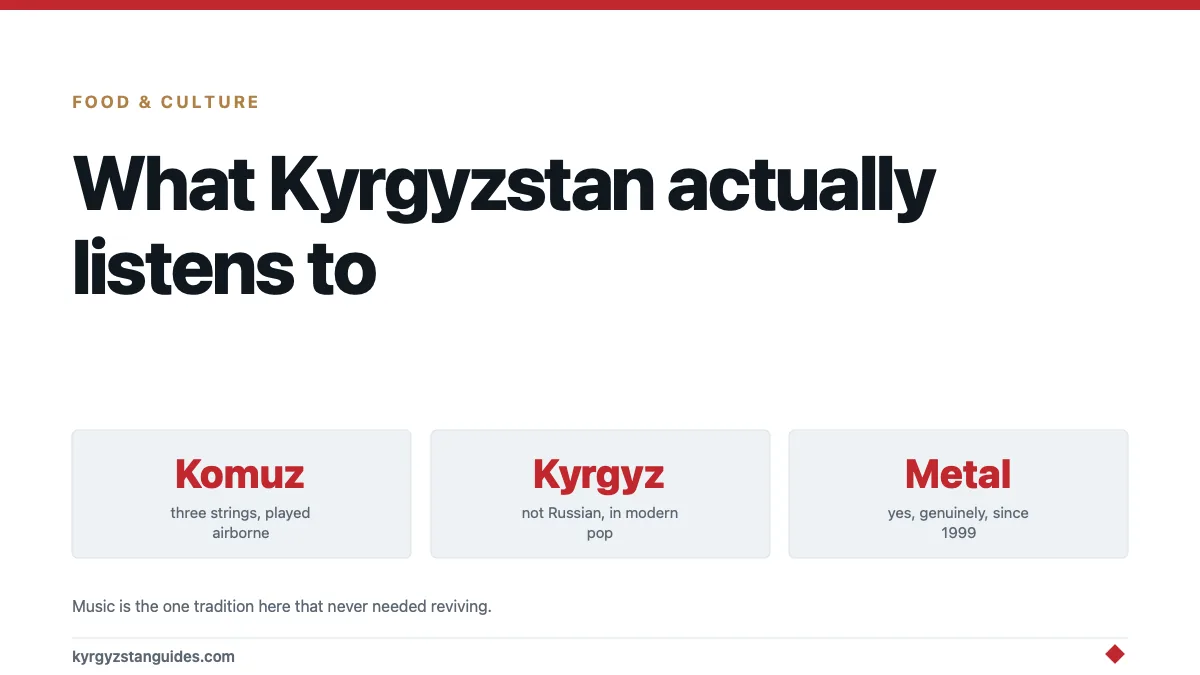
The komuz is the national instrument: a three-stringed fretless lute, played with extraordinary physical showmanship, instrument behind the back, over the head, spun mid-phrase — while the melody continues. Our komuz guide covers it properly.
The kyiak is the bowed two-stringed horsehair instrument, lower and rougher, used for laments.
The temir komuz is a jaw harp, small enough to carry in a pocket, and disproportionately expressive.
Manaschi. Epic recitation of Manas is technically not music, is performed without instruments, and is treated in this culture as the highest performing art there's.
Akyn and aitysh. Improvised sung poetry, including competitive duels between two performers. The aitysh tradition is a living contest form rather than a preserved one.
Modern interpreters of the traditional repertoire include the Kambarkan folk ensemble and Ordo Sakhna, an ethnographic folk theatre founded in 1999 that performs on authentic instruments and has toured widely.
Salamat Sadikova is the great traditional voice of the modern era, known for extraordinary breath control.
The pop industry
Much larger and more confident than visitors expect, and almost entirely invisible outside the country and its diaspora.
Dinara Akulova is widely described as the queen of Kyrgyz pop.
Mirbek Atabekov is the name to know for the crossover between traditional material and the chart. His 2015 hit Molmolum took a poem and turned it into a pop standard, and his reworkings of older love songs are the template a lot of the scene now follows.
What is interesting about Kyrgyz pop is the language. A great deal of it's in Kyrgyz, not Russian: which was not a given, and which tracks the broader shift covered in our piece on the language question. Eurasianet's writing on how Kyrgyz pop stars perform Kyrgyzness treats this as deliberate cultural work rather than a market accident.
Rock, metal and jazz
Gorod 312 is the biggest export: a Russian-language pop-rock band formed in Bishkek in 2001, named after the city's telephone code, with a substantial following across the former Soviet space.
Darkestrah is a Kyrgyz pagan metal band formed in Bishkek in 1999, blending folklore material with black metal. This is not a novelty act; they have a serious international reputation in that genre and they're probably the most unexpected thing on this list.
Jazz has a real Bishkek scene with roots in the Soviet conservatory system, and combinations of saxophone, double bass and drums with komuz are a recognised local form rather than a gimmick. Reporting on the city's jazz scene traced the same conservatory lineage.
What the Soviet period did to it
Complicated, and the answer is not simply "suppressed".
It built institutions. Conservatories, a philharmonic, state folk ensembles, music schools in provincial towns, notated arrangements of traditional material, and professional salaried musicians. A great many of the traditional performers who carried the repertoire into the 1990s were trained inside that system.
It also standardised it. Folk music was arranged for orchestra, tidied into concert programmes, and given the costumes and staging of a state ensemble. What had been a solo performer in a yurt became twenty people in matching outfits on a stage.
And it censored the epic. Manas was politically awkward, a nationalist epic in a state suspicious of nationalism, and manaschi worked under pressure for parts of the period.
The result is genuinely double-edged. Kyrgyzstan emerged from 1991 with a trained musical workforce, functioning venues and a documented repertoire, and with a version of its own tradition that had been shaped for a stage.
The revival since has largely been a move back toward the smaller, rougher, unamplified form — which is why an ensemble like Ordo Sakhna describes itself as ethnographic rather than simply folk.
Where to hear it live
The Philharmonic in Bishkek for orchestral and traditional ensemble performance.
Ordo Sakhna and Kambarkan perform for audiences including visitors; ask locally rather than assuming a schedule.
Restaurants and concert venues in Bishkek for the pop and rock scene. Our things to do in Bishkek guide covers the practical side.
The World Nomad Games for traditional performance at scale, including aitysh and komuz competition.
A toi. If you're invited to a wedding or celebration, there will be live music, an MC, and a great deal of dancing. This is where you'll actually hear what people like.
A yurt at night. Somebody in a herding family frequently plays. Asking is not rude and the answer is often yes.
What to listen to before you come
A short list, all findable on streaming services:
Salamat Sadikova for the traditional voice.
Ordo Sakhna for instrumental ensemble work.
Mirbek Atabekov, Molmolum, for the modern crossover.
Gorod 312 for the Russian-language rock end.
Darkestrah if you want the strangest thing this country produces.
Any recording of a manaschi, for perhaps five minutes, to understand what the recitation actually sounds like. It isn't comfortable listening and it isn't meant to be. UNESCO holds the Manas trilogy on its intangible heritage list, and the accompanying material includes recordings.
Why it's worth bothering with
Because music is the one part of Kyrgyz culture that never had to be revived.
The yurt is mostly a summer structure now. The native horse was bred out and is being bred back. Crafts are on UNESCO's urgent safeguarding list.
The komuz was never in danger. Children still learn it. Manas is still recited. Aitysh is still a competitive sport with an audience and a prize.
That continuity is why a Kyrgyz pop singer can take a nineteenth-century poem and chart with it, and why nobody here finds that an unusual thing to do.
FAQ
What is the national instrument of Kyrgyzstan?
The komuz, a three-stringed fretless lute, played with a strong element of physical showmanship alongside the music.
What kind of music is popular in Kyrgyzstan?
A large domestic pop industry singing largely in Kyrgyz, alongside Russian-language rock, a traditional instrumental and epic tradition, and a Bishkek jazz scene.
Who are the best-known Kyrgyz musicians?
Salamat Sadikova in the traditional repertoire, Dinara Akulova and Mirbek Atabekov in pop, Gorod 312 in rock, and the ensembles Ordo Sakhna and Kambarkan.
Is there a metal scene in Kyrgyzstan?
Yes. Darkestrah, formed in Bishkek in 1999, is a pagan metal band that blends Kyrgyz folklore with black metal and has an international following.
Where can I hear live traditional music?
At the Bishkek Philharmonic, through ensembles such as Ordo Sakhna and Kambarkan, at the World Nomad Games, and informally at celebrations and in yurt camps.
What is a manaschi?
A reciter of the Manas epic, performing hundreds of thousands of lines from memory without instruments. It's regarded as the highest performing art in Kyrgyz culture.