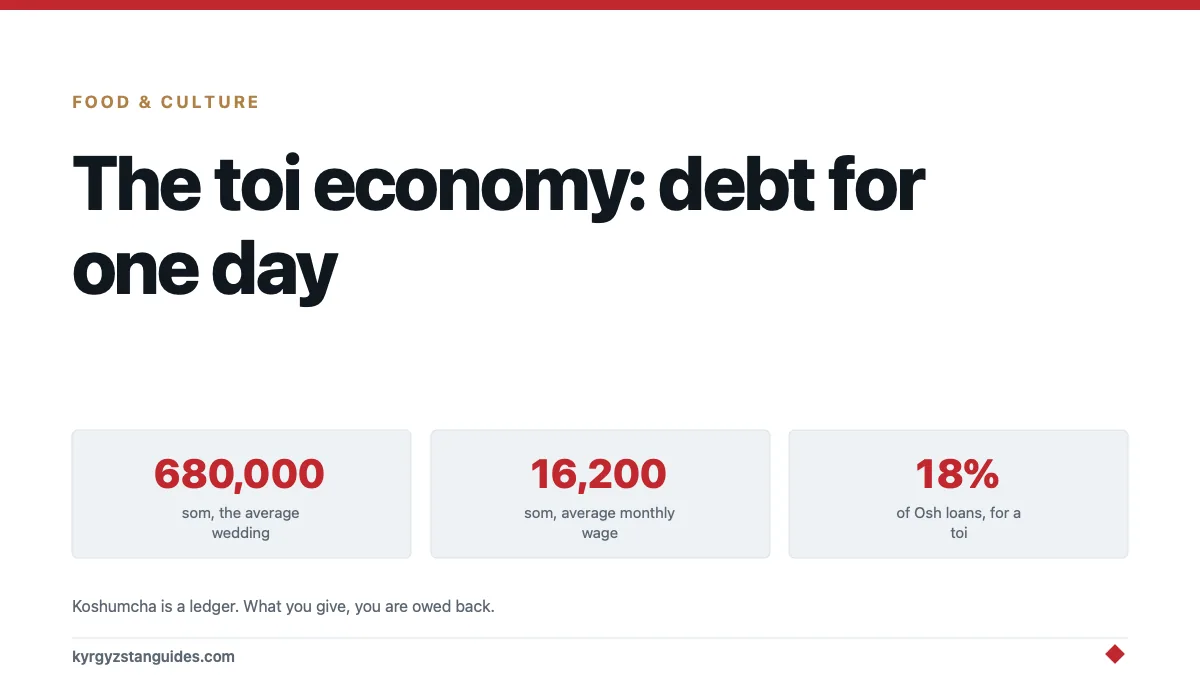
A Kyrgyz wedding feast, a toi, costs on average around 680,000 som, roughly $9,900.
The average monthly salary when that figure was calculated was about 16,200 som, around $230.
That is forty-two months of an average wage, spent on one day.
It sits alongside the other two: a pension that arrives on a fixed date and a wage that often arrives in cash. This is the single most consequential economic fact about ordinary Kyrgyz life, it's discussed constantly here, and it appears in no travel guide.
The scale of it
National spending on toi-ash, celebrations and memorial feasts together, rose from 40 billion som in 2008 to 140 billion som in 2018. That is a 250% increase in ten years, far outpacing incomes.
Five per cent of all loans taken out in the country are to fund a toi. In Osh that figure reaches eighteen per cent.
Read the Osh number again. Nearly one loan in five in Kyrgyzstan's second city is borrowed to pay for a celebration.
Saferworld's reporting on the pressure to host documents how households end up here, and it isn't through extravagance in any ordinary sense.
Why it happens
It isn't vanity, or not mainly. It's obligation, and the mechanism is specific.
A toi is not optional. Weddings, the kiz uzatuu bride send-off, circumcisions, a child's first steps, the fortieth day after a death, the anniversary of a death, the müçöl years — each has an expected gathering. Our guides to wedding and funeral customs cover the individual events.
The guest list is not yours. It's the extended family's, the village's and the workplace's. Excluding people is a lasting insult.
Refusing to host reads as failure. In a society where standing is communal, an inadequate toi is a public statement about a family, and the judgement falls hardest on those least able to pay.
It's partly a savings system. This is the part outsiders miss entirely.
Koshumcha
Guests don't arrive empty-handed. They bring koshumcha, a contribution, in cash or in kind, recorded by the host family.
That record matters, because the obligation reverses. When the guest's own family holds a toi, the host is expected to contribute at least as much. Over decades this becomes a running ledger of mutual obligation across an entire network of families. AKIpress has described how the system works in practice.
Understood properly it's a form of rotating credit — a way of concentrating a large amount of capital on a household at a moment when it needs it, in a place with no functioning consumer finance for most of the twentieth century.
The problem is inflation. As the expected scale rises, the amount you owe back rises with it, and a family can be locked into decades of escalating obligations from events held before the current costs existed.
The migration connection
This is where it joins up with the rest of the country.
A very large number of Kyrgyz citizens work in Russia, and a recurring pattern in the reporting is that people work abroad for months specifically to fund a family toi, then return abroad afterwards to pay off what they still borrowed.
A large share of that spending is meat, much of it horse. So the sequence runs: a family obligation generates a debt, the debt generates a migration, and the migration generates the remittances that keep the household solvent until the next obligation.
It's a closed loop, and it is one reason why a fifth of GDP arriving from abroad has not translated into visible accumulated wealth in villages.
Who this falls on hardest
Worth being precise, because "cultural pressure" is vague and the burden is not evenly distributed.
Poorer families. A wealthy household hosting 300 people is spending discretionary money. A household on an average wage doing the same is borrowing at microfinance rates.
Rural families more than urban. The obligation network is denser in a village, where the guest list is effectively everyone, and where opting out is visible to people you'll see every day for the rest of your life.
Women, disproportionately. The labour of a toi (the cooking, the serving, the preparation over days) falls on the women of the household, unpaid and largely unremarked. The bride send-off and the wedding both centre on a young woman whose family is often taking on the debt.
Young couples at the start. Beginning a marriage owing several years of income is a poor foundation, and it's a common one.
There is a generational argument going on about this inside Kyrgyzstan, conducted with some heat. Younger urban Kyrgyz increasingly say publicly that the system is indefensible. Older and more rural voices point out, not unreasonably, that mutual obligation is what held communities together through the 1990s when the state didn't.
Both are describing the same institution.
The law
In January 2025, Kyrgyz MPs proposed legislation to cap celebration spending, following a similar approach taken earlier in Tajikistan.
The proposed limits, as reported:
| Event | Limit |
|---|---|
| Wedding | 250 guests |
| Livestock slaughtered | One head of large cattle or one horse |
| Kiz uzatuu (bride send-off) | 100 guests |
| Combined wedding and kiz uzatuu | 350 guests |
Coverage of the proposal framed the argument made by its sponsors: that tradition has become a platform for displays of wealth and social competition.
The counter-argument is not trivial. A state capping how many people you may feed at your own daughter's wedding is a serious intrusion, and enforcement in a country of villages is close to unimaginable. Whether legislation can shift something this deeply social is the open question, and Tajikistan's experience is mixed.
What this means for a visitor
You may well be invited to one. If you are staying in a village and a toi is happening, you will probably be asked. Go.
Bring koshumcha. Cash in an envelope is normal and correct. Ask your host what's appropriate. In a village, a modest amount is genuinely fine and the gesture matters more than the sum.
Expect scale. Hundreds of people, enormous quantities of food, long speeches, and a structure to the seating. Our tea and bread customs guide covers the table.
Do not comment on the cost. However well meant, "this must have been expensive" lands badly.
Eat. Refusing food at a toi is much harder than refusing it at a homestay dinner, and the same rules apply.
Understand what you are seeing. A family may have borrowed heavily, or a relative may have worked a year in Moscow, for the meal in front of you. That is not a reason to be uncomfortable. It's a reason to take it seriously.
FAQ
What is a toi in Kyrgyzstan?
A celebration or feast marking a life event — a wedding, a bride send-off, a circumcision, a memorial. Toi-ash refers to celebrations and memorial feasts collectively.
How much does a Kyrgyz wedding cost?
Around 680,000 som, roughly $9,900, against an average monthly salary of about 16,200 som at the time that figure was calculated.
Why do Kyrgyz families borrow for weddings?
Because hosting is a social obligation rather than a choice, and the expected scale has risen far faster than incomes. Five per cent of loans nationally, and eighteen per cent in Osh, are taken out for celebrations.
What is koshumcha?
The contribution guests bring to a toi, in cash or kind, which the host records. The obligation reverses when the guest's own family hosts, creating a long-running network of mutual debt.
Is Kyrgyzstan regulating wedding spending?
Legislation was proposed in January 2025 capping weddings at 250 guests, bride send-offs at 100, and limiting livestock slaughtered, following a similar approach in Tajikistan.
Should I attend a toi if invited?
Yes. Bring a cash contribution, ask your host what's appropriate, eat what you are given, and don't remark on the expense.