Somebody will ask what year you were born. Not your age, your year.
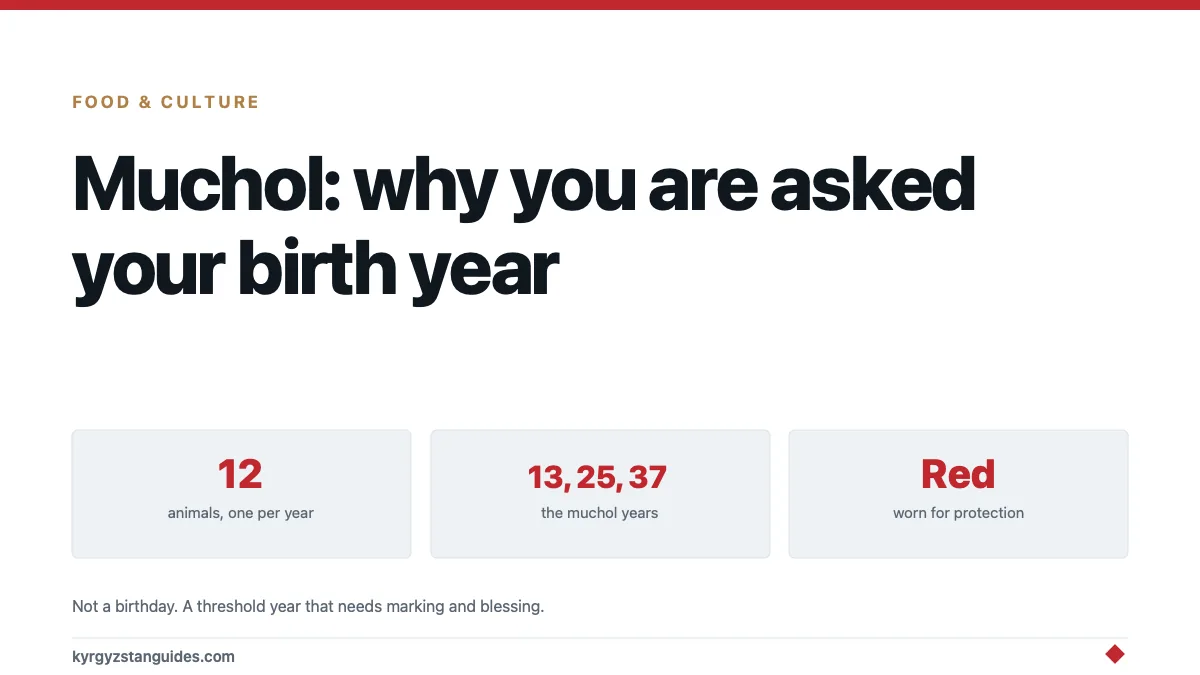
The answer they are looking for is an animal. Kyrgyz timekeeping runs on a twelve-year cycle called müçöl, each year named for an animal, and knowing which one you belong to tells a Kyrgyz person your age, your position in the cycle, and whether you're currently in a year that requires care.
It is one of the most commonly used pieces of traditional knowledge in the country and one of the least explained to visitors.
The twelve
The cycle is shared across the Turkic and East Asian world, and the Kyrgyz names are their own:
| Kyrgyz | Animal |
|---|---|
| Чычкан (Chychkan) | Mouse |
| Уй (Uy) | Cow |
| Барс (Bars) | Tiger / leopard |
| Коён (Koyon) | Rabbit |
| Улуу (Uluu) | Dragon |
| Жылан (Jylan) | Snake |
| Жылкы (Jylky) | Horse |
| Кой (Koy) | Sheep |
| Мечин (Mechin) | Monkey |
| Тоок (Took) | Chicken |
| Ит (It) | Dog |
| Доңуз (Donguz) | Pig |
Note bars. It is usually translated as tiger, but in a country with no tigers and a famous snow leopard, the word carries the local animal with it. And jylky isn't a generic horse — it's specifically the herd horse, the one from our piece on the Kyrgyz horse.
A month begins with the new moon; twelve months make a year; twelve years make a müçöl. The cycle appears in Kyrgyz folk poetry, in lullabies, and in the epic of Manas.
Your müçöl year
Here is the part that makes it more than a zodiac.
Every twelve years, the cycle returns to the animal you were born under. That is your müçöl, and it isn't straightforwardly good news.
The first is marked at 13. Twelve years plus the year in the womb, which is counted. After that it comes at 25, 37, 49, 61 and so on.
A müçöl year is understood as a threshold. The belief is that changes occur in the body and the mind, that a person is weakened during it, and that they need support, blessing and protection to pass through safely.
So it's marked. A sheep is slaughtered, relatives are invited, and the person wears red. In some practice a piece of a favourite dish is deliberately broken.
The red is the key element, and it's consistent: red cloth, a red shirt, a red shawl. At the first müçöl, at around twelve or thirteen, parents and relatives give blessings along with a red garment, marking the start of the transition out of childhood.
Some accounts describe the red item then being given away afterwards, carrying the year's ill luck with it. Descriptions of Kyrgyz life-cycle traditions record the same practice, with the red garment given at the first müçöl as a marker that childhood is ending.
Where it comes from
The twelve-animal cycle isn't Kyrgyz in origin and nobody here claims it is.
It is shared across an enormous area, China, Korea, Japan, Vietnam, Tibet, Mongolia and the Turkic world, and versions of it have been in use for well over two thousand years. Encyclopaedic accounts of the Chinese calendar trace the sexagenary system that underlies it, in which the twelve animals combine with five elements to produce a sixty-year cycle.
What the Turkic peoples did with it was make it a twelve-animal calendar in its own right, used for reckoning years directly rather than as one half of a compound system. Scholarship on the twelve-animal Turkic calendar traces its use across the steppe, in inscriptions and in manuscripts, long before any of these were modern nations.
For a traveller, the useful implication is a familiar one in Central Asia: things that look local turn out to be regional, and things that look imported turn out to have been here for a millennium. The Silk Road moved calendars as readily as it moved silk.
Why this is useful to know
Four practical reasons.
You'll be asked. "What year were you born?" is a normal opener, more so than asking an age directly. Knowing your animal is a genuinely useful party trick and an instant conversation.
It is how ages get compared. Two people establishing who's older will often do it through animals rather than numbers, especially in rural areas and among older people.
You may be invited to a müçöl celebration. If somebody in a guesthouse family is turning 49 or 61, there may well be an event. It's a family occasion with food and guests, closer in feel to the other life-cycle ceremonies than to a birthday party in the Western sense.
Red will make sense. If you notice someone wearing a conspicuous red item, or a child given a red shawl, this is likely why.
If you're invited to one:
Bring something. As at any Kyrgyz gathering. Sweets, fruit, tea.
Expect meat. A sheep may well have been slaughtered for it. Our tea and bread customs guide covers the table etiquette, which is the same here.
Don't call it a birthday. It's not one. It's a protection ritual that happens to be attached to an age.
How it fits with everything else
Kyrgyz practice layers several systems without much friction.
There is Islam, which arrived progressively from roughly the eighth century onward in the south and much later in the northern mountains. There is a substantial body of pre-Islamic belief about spirits, ancestors and protection that never went away. There is the Soviet secular century. And there is this calendar, shared with Central and East Asia and older than any of the above.
They coexist. A family will mark a müçöl with a sheep and a red shirt, observe Islamic funeral rites, celebrate Nooruz at the spring equinox, and see no contradiction in any of it, because there's not really one.
That layering is the thing to understand about Kyrgyz culture generally, and the müçöl is a small, legible, daily example of it.
FAQ
What is müçöl in Kyrgyz culture?
The twelve-year animal cycle used in traditional Kyrgyz timekeeping, and also the name for the year in which the cycle returns to the animal you were born under.
What are the twelve Kyrgyz year animals?
Chychkan (mouse), Uy (cow), Bars (tiger), Koyon (rabbit), Uluu (dragon), Jylan (snake), Jylky (horse), Koy (sheep), Mechin (monkey), Took (chicken), It (dog) and Donguz (pig).
At what ages does a müçöl year fall?
The first is marked at 13, counting the year before birth, then every twelve years after: 25, 37, 49, 61 and onward.
Why do Kyrgyz people wear red in a müçöl year?
A müçöl year is seen as a vulnerable threshold, and red is worn for protection. In some practice the red item is given away afterwards to carry off ill luck.
How is a müçöl year celebrated?
With a family gathering, often the slaughter of a sheep, blessings from relatives, and the wearing of red cloth. In some traditions a piece of a favourite dish is deliberately broken.
Why do people ask my birth year in Kyrgyzstan?
Because the year identifies your animal, which conveys your age and your position in the cycle. It is a normal and friendly question rather than a personal one.
The cradle feast that follows a birth, and the cradle itself, are covered in beshik toi.
The other great family celebration, and the most expensive one after a wedding, is sunnot toi.
The traditional year underneath all this starts at the equinox, not in January: see the Kyrgyz folk calendar.