The Kyrgyz traditional year begins at the spring equinox, not on 1 January. It has twelve months with names, and the naming splits the year cleanly in two.
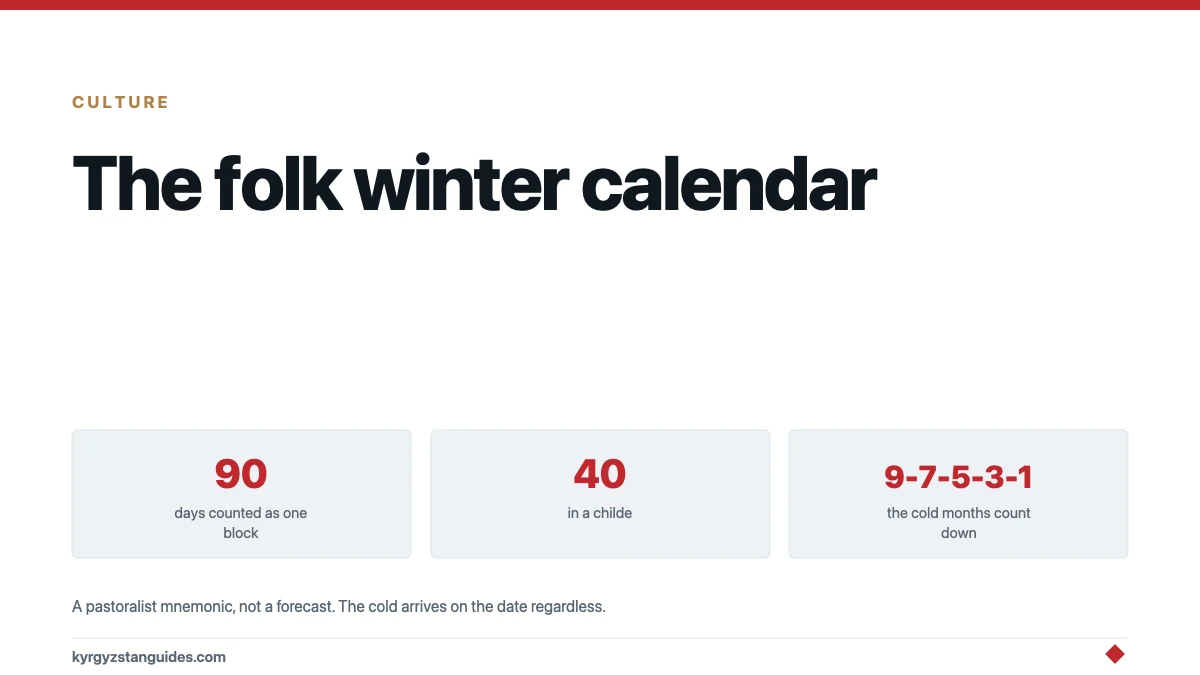
The warm half is named after animals and what they are doing. The cold half is counted backwards in odd numbers: nine, seven, five, three, one.
Before going further, one thing this article will keep saying: this is folklore and ethnography, not meteorology. It is a pastoralist mnemonic for a continental winter, built by people whose livestock survival depended on knowing what was coming. It is not a forecast, and the named cold spells arrive on their dates whether or not it is cold.
The twelve months
| Kyrgyz | Transliteration | Literal meaning |
|---|---|---|
| Жалган куран | Jalgan kuran | "False roe-buck" |
| Чын куран | Chyn kuran | "True roe-buck" — the real rut of the wild goats |
| Бугу | Bugu | "Red deer" — the hinds preparing to calve |
| Кулжа | Kulja | "Argali ram" |
| Теке | Teke | "Billy goat" — the longest, hottest days |
| Баш оона | Bash oona | "Head of the oona" — young she-goats first coming into heat |
| Аяк оона | Ayak oona | "Foot of the oona" — the end of the rut |
| Тогуздун айы | Toguzdun ayy | "Month of the nine" |
| Жетинин айы | Jetinin ayy | "Month of the seven" |
| Бештин айы | Beshtin ayy | "Month of the five" |
| Үчтүн айы | Üchtün ayy | "Month of the three" |
| Бирдин айы | Birdin ayy | "Month of the one" |
The animal months track a breeding cycle through the warm season, from the roe-buck in spring to the end of the goat rut in early autumn. Then the counting starts.
The month boundaries fall around the 18th, not the 1st, and the year's pivots are the two equinoxes and the two solstices. Teke, the hottest month, is given in one popular account as 18 to 24 June — the solstice. Üchtün ayy as 18 to 25 December — the other one.
What the numbers count
The descending nine-seven-five-three-one is conventionally explained as the changing angular distance between the Moon and Үркөр (Ürkör) at conjunction.
Үркөр is the Pleiades. This is worth stating flatly because it is regularly mistranslated as the Big Dipper in secondary writing. The Big Dipper is Жетиген (Jetigen, "the seven"). The Pole Star is Алтын казык (Altyn kazyk, "the golden stake").
That is what makes this system a calendar and an almanac at once: the months of the cold half are named for an observation you make by looking up.
The forty and the ninety
Чилде (childe) comes from Persian chilla, meaning forty. It is the block of forty days at the extremity of a season — кыш чилдеси, winter's forty, and жай чилдеси, summer's forty. The winter chilla is the forty coldest days; the summer chilla the forty hottest.
The ethnographer Fyodor Fielstrup, working among the Semirechye Kyrgyz in the 1920s, recorded кырк күн чилде, the forty-day chilla, running from January through mid-February and described as the coldest time of winter.
Токсон (togson) means ninety: December, January and February taken as one ninety-day block.
The named cold spells
Inside the ninety, individual cold waves have names and dates. These come from a Kyrgyz cultural organisation's account rather than from an academic source, and the spellings vary regionally — we flag that below.
| Spell | Meaning | Dates | Length |
|---|---|---|---|
| Кырдач Kyrdach | — | before 14 January | 6 days; the harshest, when livestock grow thin |
| Адынын алты уулу Adynyn alty uulu | "The six sons of Ady" | ends 19 January | 6 days |
| Жетинин жети уулу Jetinin jeti uulu | "The seven sons of the Seven" | 20–26 January | 7 days |
| Кантар Kantar | — | 27 January | 1 day, a turning point |
| Үт Üt | — | 28 January – 11 February | 15 days of heavy snow |
| Апкыт-сапкыт Apkyt-sapkyt | — | 12–17 February | 6 days, the last cold wave |
| — | end of the winter chilla | 18 February | — |
"The seven sons of the Seven" refers back to Jetigen, the Big Dipper. The same source aligns "the six sons of Ady" with the Russian Epiphany frosts, which fall at the same point in January.
Of Үт, the snow period, the saying is that it is good for the crops and bad for travel. That is the most practically useful line in the whole system, and it still holds.
There is also a folk gradation of frost by severity — iron frost in January, milder horn frost in February, milder still felt frost — the metaphor descending from metal through horn to felt as the cold relents. We could not reach the source page for this directly and it comes to us second-hand, so treat it as reported rather than documented.
How well it maps to the actual weather
Reasonably well, as a description. January genuinely is the coldest month in Bishkek, Naryn and Karakol, and mid-February genuinely is when the continental cold tends to break. The system encodes a real climatology.
But it is calendrical, not predictive. "The six sons of Ady" arrives on 14 January whether or not there is a cold snap. Nobody in the system is forecasting anything; they are naming a pattern that usually holds, so that a herder in a yurt knows roughly how much winter is left.
For what the weather actually does, see mountain weather in Kyrgyzstan. Kyrgyzhydromet issues the forecasts.
Where we have to be careful
Three things, stated openly.
The dates and spellings above rest on a single cultural-organisation source. The Cyrillic forms Adynyn alty uulu, Apkyt-sapkyt and Kyrdach in particular should be checked against a Kyrgyz print source before anyone relies on them. Who or what "Ады" is has no explanation in anything we found.
The two main sources disagree by about a month on mapping the traditional months onto Gregorian ones. Fielstrup's 1920s table puts Chyn kuran in March, Bugu in April, Teke in June. A popular modern account starts Chyn kuran on 18 March and puts Teke at 18–24 June. Both are given above; we are not picking one.
One claim in circulation is not supportable. A widely shared Kyrgyz account presents this calendar as originating with Ice Age mountain hunters and possibly being the oldest calendar in the world. There is no evidentiary basis for that. The month names and their solstice anchoring are the real, usable part; the Palaeolithic origin story is an assertion.
We also could not reach a dictionary entry for childe, togson or Ürkör — not Yudakhin, not the Academy's explanatory dictionary. Every gloss above comes from ethnographic or popular retelling.
Why it is still worth knowing
Two reasons, if you are travelling here.
The jailoo year still runs on this logic rather than on the Gregorian one — see the jailoo year. When a herder tells you when they move up and when they come down, the underlying calendar is this one.
And Nooruz on 21 March is the new year in this system, not a spring festival attached to an existing year. That is a different thing, and it is why it is the largest public celebration in the country. See Nooruz in Kyrgyzstan.
Kazakh neighbours run a parallel and better-documented system, with named spells like beskonak, "five guests", and the chill of the saiga calving. Kyrgyz equivalents are widely spoken of. We could not source them in Kyrgyz specifically, which is a fair summary of the state of the whole subject: the practice is alive and the documentation is thin.
FAQ
When does the Kyrgyz traditional year begin?
At the spring equinox, around 21 March, with the month Jalgan kuran, "false roe-buck". This is why Nooruz is the new year in this system rather than a spring festival added to an existing calendar, and why it is the country's largest public celebration.
What is a childe in Kyrgyz?
A block of forty days at the extremity of a season, from the Persian chilla meaning forty. Kysh childesi is winter's forty coldest days; jay childesi is summer's forty hottest. An ethnographer working in the 1920s recorded the forty-day winter chilla as running from January into mid-February.
What does Ürkör mean?
Ürkör is the Pleiades. It is central to the Kyrgyz folk calendar, because the cold-half months — nine, seven, five, three, one — are conventionally explained by the changing angular distance between the Moon and the Pleiades at conjunction. It is often mistranslated as the Big Dipper, which is Jetigen.
Why are Kyrgyz winter months named after numbers?
The warm half of the year is named for animals and their breeding cycle, and the cold half counts down: month of the nine, of the seven, of the five, of the three, of the one. The numbers are tied to an observation of the Moon against the Pleiades, which makes the system a calendar and an almanac at once.
Are the Kyrgyz cold spells a weather forecast?
No. They are calendrical, not predictive. Named spells such as "the six sons of Ady" or "the seven sons of the Seven" fall on fixed dates in January and February whether or not a cold snap arrives. The system encodes a real pattern — January is genuinely coldest, mid-February is genuinely when it breaks — but it forecasts nothing.
Is the Kyrgyz calendar the world's oldest?
No, and the claim should be treated with care. A popular Kyrgyz account presents it as originating with Ice Age mountain hunters, but no evidence supports that. What is documented is the set of month names, their solstice and equinox anchoring, and their recording by ethnographers in the 1920s.