The yurt you sleep in at Song-Kul is not there all year. Neither is the family, the horses or the sheep.
Kyrgyz pastoralism runs on a strict annual cycle between three or four different sets of pasture at different altitudes, and the timing is determined by grass and snow rather than by a calendar.
Knowing the cycle tells you when the country you came to see actually exists, which is more useful than any list of best months.
The pastures
Not one pasture but a set, used in sequence.
| Kyrgyz | Season | Where |
|---|---|---|
| Kyshtoo | Winter | Sheltered gorges and valley floors, near the village |
| Jazdoo | Spring | A little further out and higher |
| Jailoo | Summer | High alpine meadow, above the tree line |
| Kuzdoo | Autumn | Back through the spring ground |
The logic is grass. Snowmelt moves uphill through the season, and the fresh growth follows it. A herd that moves with the melt line eats new grass for months; a herd that stays still eats the same ground bare. Fieldwork on transhumance in the Kyrgyz Pamir documents the same pattern at the southern end of the country.
The Satoyama Initiative's case study of transhumance in northern Kyrgyzstan sets out the categories and the movement between them.
The year
March–April. Lambing and calving, at or near the winter camp. This is the hardest and busiest period of the year and the one nobody photographs. Snowmelt begins.
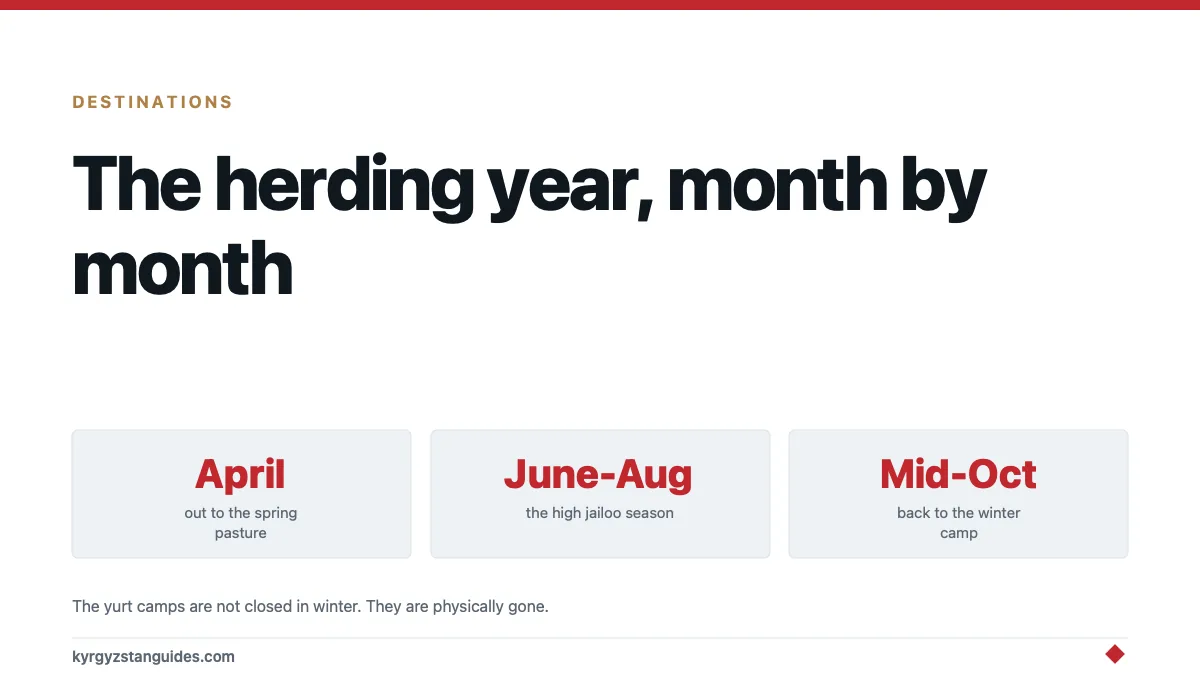
April–May. The move out to the spring pasture (jazdoo) a short distance from the village and modestly higher. Grass is thin but new.
Late May–June. The move up. Families, yurts, animals and possessions go to the early summer pasture, often in stages. Yurts go up. This is when the jailoo becomes inhabited.
June–mid-July. A relatively settled period on the early summer pasture. Milk production is at its peak, which is when kymyz and kurut are made in volume.
July–August. The high summer pasture above the tree line, sometimes with further moves within it. Maximum altitude, maximum grass, maximum daylight. This is the postcard, and it is about eight weeks long.
Late August–mid-October. A slow move back down across the autumn pasture, fattening animals on the regrowth before winter.
Mid-October. The rapid return to the winter camp. After this the high valleys are empty.
November–February. Winter at the kyshtoo: hand-feeding hay, sheltering animals, and the long wait.
What this means for timing a trip
Yurt camps exist roughly June to September. Outside that window the high camps aren't there. Not closed — physically absent, packed onto a truck.
Mid-June to late August is the real jailoo season. Song-Kul at 3,016 m is at the late end of that; it opens later and closes earlier than lower pastures.
Early June is a gamble and often the best one. Fewer people, flowers at their peak, and a real chance that a given pass or camp is not open yet.
September is superb and shortening. Herds coming down, autumn colour, clear air, and camps closing through the month.
The shoulder isn't a lesser version of summer. It's a different thing: movement rather than settlement, and you may find yourself sharing a road with a herd rather than visiting one.
Our best time to visit guide covers the broader seasonal picture.
What you're actually looking at
Two clarifications that change the experience.
This isn't nomadism. Kyrgyz pastoralism is transhumance — seasonal movement between fixed, known pastures, with a permanent village house at one end of it. Families have addresses. Children go to school. Nobody is wandering.
The distinction matters because "nomad" invites a fantasy of rootlessness, and the reality is the opposite: an extremely precise, inherited knowledge of which valley to be in during which weeks.
It is not unbroken tradition either. The collective farm system ran this movement as a managed operation with vehicles, veterinary support and planned rotation. When that collapsed in the 1990s, households resumed it privately — which is why the practice you see is both genuinely old and, in its current household form, quite recent.
UNESCO has inscribed transhumance as intangible cultural heritage, recognising the same practice across a wide range of countries.
Why the timing is getting harder
The cycle depends on snowmelt arriving when it always has. It increasingly doesn't.
Melt is earlier and faster. Warmer springs bring the melt line up sooner, which sounds convenient and is not: grass that grows early can be gone before the herd arrives, and a fast melt produces mudflows rather than a steady season of water.
Water on the high pasture is less reliable. Summer grazing at altitude depends on streams fed by snowfields and small glaciers, many of which are shrinking. A jailoo without water is not a jailoo.
Pasture near villages is degraded, which pushes households to arrive at the high ground earlier and stay longer, which degrades that too. Around 94% of Kyrgyz pasture has been degraded in at least one season, as our piece on yak herding sets out.
Pasture committees allocate, weather decides. The formal system assigns grazing rights; the informal reality is that everyone moves when the grass is ready, and if that's two weeks earlier than the allocation assumes, the allocation loses.
Herders will tell you this directly if you ask. They are the people with the longest continuous dataset on when the snow leaves these valleys, and they have noticed.
Staying on one
Go in the working season and expect work. A jailoo in July is a place of labour, not a resort. Milking happens early, animals are moved, children have jobs.
Offer to help, and accept being refused. Guests are guests here, and the offer is the point.
The animals set the schedule. Breakfast is after milking. Dinner is after the herd is in.
It's cold at night. At 3,000 m, in July, below freezing is ordinary. Our yurt stay guide covers what to bring.
The dogs are working. Livestock guardians, not pets. Keep away from the flock.
Ask about the year. Where they winter, when they came up, how the grass has been. It's the most reliable good conversation available in this country, and you will learn more about pasture pressure and the weather than any report would give you.
FAQ
What is a jailoo?
The high summer pasture above the tree line, used from roughly June to September. It is one of three or four seasonal pastures Kyrgyz herding families move between through the year.
When do Kyrgyz herders move to the summer pastures?
The move begins in spring, around April to the spring pasture, with the ascent to the high jailoo from late May or June and the return beginning in late August.
When do yurt camps operate in Kyrgyzstan?
Roughly June to September, with the highest camps such as Song-Kul opening later and closing earlier. Outside that window the yurts are physically packed away.
Is Kyrgyz herding nomadic?
Not strictly. It is transhumance, seasonal movement between known fixed pastures, with a permanent village house for winter. Families have addresses and children attend school.
What is a kyshtoo?
The winter camp, in a sheltered gorge or valley near the village, where animals are hand-fed through the cold months.
What is the best month to see jailoo life?
Mid-June to late August is the working season. Early June is quieter with better flowers but less certain access; September offers the descent, autumn colour and closing camps.
The traditional year underneath all this starts at the equinox, not in January: see the Kyrgyz folk calendar.