Above about 3,000 metres, the animal doing the work changes. Sheep thin out, horses stop making economic sense, and the herds you see become yaks — shaggy, slow, indifferent to weather that would kill a cow.
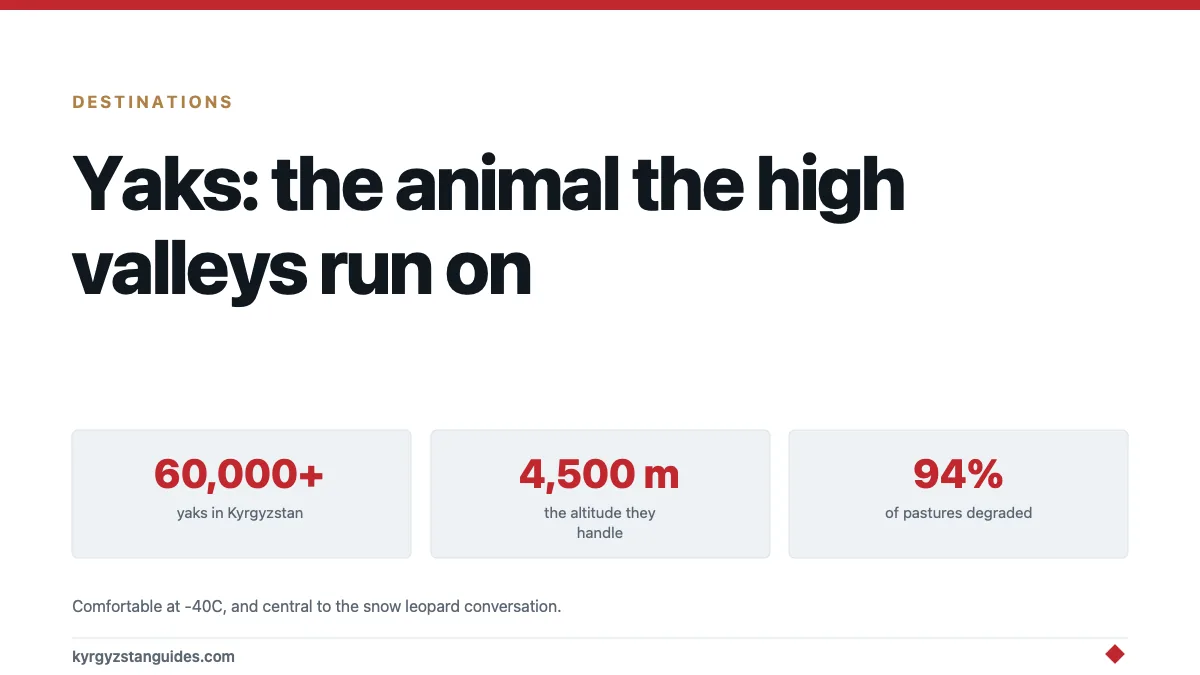
Kyrgyzstan has more than 60,000 of them, roughly double the number in the late 1990s. Most visitors photograph one from a car window and never ask what it's doing there.
The answer is more interesting than "it's cold." The yak is the reason the highest valleys in this country are inhabited at all, and it's quietly at the centre of both the climate conversation and the snow leopard one.
What a yak actually does
A yak isn't a hairy cow, and treating it as one gets the economics wrong.
Bos grunniens, the grunting ox, because it does not moo, is adapted to altitude at the physiological level: larger lungs and heart relative to body size, more haemoglobin, a dense undercoat beneath the long outer hair, and few sweat glands. It's comfortable to around 4,500 metres, and it is genuinely uncomfortable below about 2,000.
What it gives a herding household:
| Product | Notes |
|---|---|
| Milk | Far higher fat content than cow's milk; made into butter, kurut and cheese |
| Meat | Lean, and the main cash product |
| Wool | Soft undercoat, increasingly sold for textiles |
| Dung | Fuel, in valleys where there are no trees |
| Transport | Pack animal on ground no vehicle reaches |
The crucial economic property is what it eats. A yak will hold condition on sparse, coarse high pasture that will not sustain cattle, and it'll do it without supplementary feed through a winter. That is the whole proposition: an animal that converts land nobody else can use into food and cash.
Where you'll see them
Anywhere high, and reliably in a few places.
Naryn region is the heartland. The Ak-Sai valley in the far south of the region runs at around 3,000 metres and is serious yak country. Our Naryn guide is the practical starting point for that whole area.
Around Song-Kul, mixed in with horse and sheep herds on the summer jailoo, though the lake sits low enough that horses still dominate.
The high passes on the Bishkek–Osh road, and on the way to Kel-Suu and Chatyr-Kul, where they appear on slopes with no obvious grazing on them at all.
Sarychat-Ertash and the high eastern valleys, where they overlap with wild ungulates and, consequently, with predators.
The snow leopard connection
This is where yak herding stops being a livestock story.
High pasture is also snow leopard habitat. A predator that takes a calf costs a household real money, and the historical response to that anywhere in the world is to kill the predator. Conservation groups working on snow leopards in the Tien Shan therefore spend a lot of their effort on herders rather than on cats.
NABU runs a sustainable yak husbandry programme in the Kyrgyz Tien Shan explicitly as part of its snow leopard work. The logic: if a herd is better managed, better protected at night and more profitable, a lost calf is a setback rather than a catastrophe, and the herder has less reason to shoot anything.
It is a more honest model than most conservation messaging, because it accepts that the herder's interests are legitimate and expensive rather than asking them to absorb the cost of living next to a protected species.
The white yaks of Kara-Saz
The best yak story in the country is a family one.
In Kara-Saz, the Akmatov family has spent fifteen years breeding white yaks (around a decade of it as deliberate selective breeding) and now runs a herd of roughly 300. The patriarch, Tashtanbek, is 88. Three generations work the animals at about 3,000 metres, where night temperatures reach -40°C.
They have applied to have the white yak registered as an official Kyrgyz breed, which would matter both for national heritage and for export. The commercial argument is the wool: white fibre is strong and takes dye, which coloured yak wool doesn't.
AFP covered the family and the detail that stays with you is the ordinariness of it, a long selective breeding programme, run by a family, on a mountain, without institutional support, at a temperature most of the world's livestock couldn't survive.
Why the government is pushing it
Climate, bluntly.
Bishkek promotes yak farming as the sustainable option because yaks handle cold, drought and poor pasture, and Kyrgyz rangeland is degrading. Overgrazing at mid-altitude is a serious problem here: an IFAD-supported remote-sensing assessment found that around 94% of Kyrgyz pastures, close to 70,000 km². Had been degraded in at least one season between the 2000–2004 and 2016–2020 periods, with winter grazing areas worst hit. An animal that thrives high up takes some pressure off the pasture lower down.
There is a caution worth stating. "Yaks are climate resilient" is true of the animal and not automatically true of the system. Doubling herd numbers on high pasture without managing rotation moves the overgrazing uphill rather than solving it, into exactly the fragile high meadows the snow leopards and argali depend on. Which is, again, why pasture committees and herd management keep appearing in every serious programme.
Practical notes
Yak meat turns up on menus in Naryn and the high valleys, usually just called meat. It is leaner and stronger-tasting than beef.
Yak milk products are excellent. The butter is very yellow and very rich; the kurut is harder than the sheep version. If you're already working through kymyz and the dairy line-up, yak dairy is the high-altitude end of it.
Don't walk into a herd. Yaks are calm and are not cattle. Bulls in particular should be given a wide margin, and a mother with a calf is exactly as unforgiving as any other large animal.
Yak wool is a real souvenir. Scarves and blankets, sold in Naryn, Kochkor and Bishkek. Check what you are buying, since "yak wool" is applied loosely.
FAQ
How many yaks are there in Kyrgyzstan?
More than 60,000, roughly double the number of the late 1990s after government support for the sector. Higher figures approaching 100,000 are sometimes quoted, so treat the total as an estimate.
Where can I see yaks in Kyrgyzstan?
Mainly in Naryn region, including the Ak-Sai valley, and around high pastures near Song-Kul, Chatyr-Kul and Sarychat-Ertash. They are typically found above 3,000 metres.
What are yaks used for?
Milk, meat, wool and dung for fuel, and as pack animals. The milk is very high in fat and is made into butter, cheese and kurut.
How high can yaks live?
Comfortably to around 4,500 metres. They are physiologically adapted to thin air and cold, and do poorly at low altitude and in heat.
What are white yaks?
A rare colour variant being selectively bred in Kara-Saz by the Akmatov family, now a herd of around 300. They have applied for recognition as an official Kyrgyz breed, partly because white wool takes dye.
Do yaks conflict with snow leopards?
They can, since high pasture is snow leopard habitat and calves are vulnerable. Conservation programmes therefore focus on better herd management and protection so that losses don't push herders into killing predators.