The two large wild herbivores you might see above the treeline in Kyrgyzstan are Siberian ibex and argali, and the argali (the Marco Polo sheep, with horns that spiral out past a metre) is the one people fly across the world for. Some of them come to photograph it. Rather more come to shoot it, and that's where this gets complicated.
Both animals are on the IUCN Red List. Kyrgyzstan is one of only two countries, with Tajikistan, where hunting Marco Polo sheep is still legal.
Telling them apart
Easy once you've seen both, and they mostly don't share ground.
Siberian ibex (Capra sibirica) is a goat. Stocky, dark brown, with heavy backward-sweeping horns that are ridged along the front edge. Lives on cliffs and broken rock, and behaves like it — you'll usually spot one already above you, on ground you'd need rope for.
Argali (Ovis ammon) is a sheep, and a very large one. Paler, longer-legged, built for open ground rather than cliffs. The Marco Polo subspecies carries the enormous outward-spiralling horns. Argali want broad high valleys and rolling plateau, not crags.
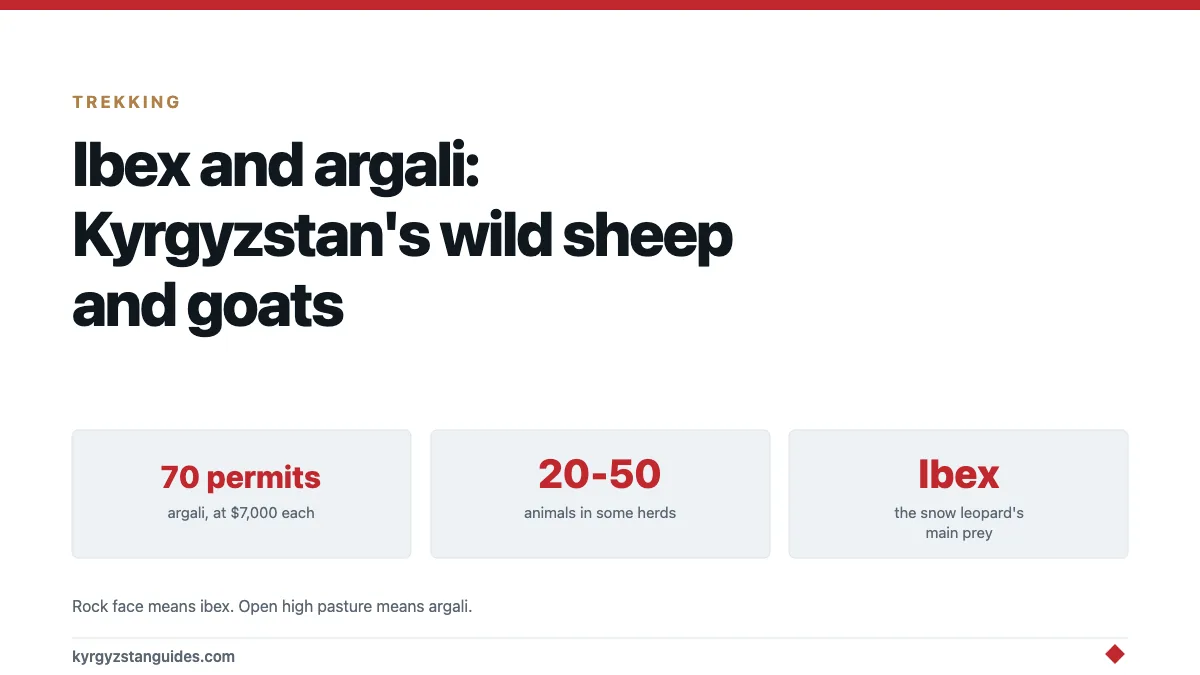
So the habitat tells you which you're looking at before the animal does. Rock face, ibex. Open sweep of high pasture, argali.
Where they're
Ibex are spread across the Tien Shan and the Pamir-Alay, and they're the realistic sighting for a walker. Anywhere with steep broken ground above roughly 3,000 metres is possible: the upper Ala-Archa valley, the ridges around Ala-Kul, the Terskey Ala-Too generally.
Argali are concentrated in the high open country of the south and east: the Pamir-Alay in the south, the At-Bashy syrts, the country around Chatyr-Kul and the Chinese border. Much of that's border-permit ground, which our entry fees and permits guide covers.
Both are hunted, wary, and good at seeing you first. Realistic sightings are at distance, through binoculars, of animals that have already clocked you.
The numbers that make this an argument
Kyrgyzstan sells trophy hunting permits, and the money is real. Recent reporting describes the government authorising sport hunting permits for 70 argali at $7,000 each, close to half a million dollars in a country where that's a meaningful sum.
The case for it is the standard conservation-economics one: hunting gives a wild animal a cash value, that value funds protection and gives communities a reason to tolerate wildlife, and a regulated quota is better than uncontrolled poaching.
The case against is arithmetic. Mongabay's reporting on trophy hunting here quotes local concern that more animals are being taken than the populations produce, with some argali herds estimated at 20 to 50 animals and not reproducing sustainably. A quota set above replacement isn't management, whatever it funds.
In 2017 a bill to ban hunting of argali, ibex and snow leopards through 2025 went before parliament and was narrowly rejected.
What the horns are for, and why they get so big
Worth a paragraph, because the horns are the whole reason these animals have the status they do.
Argali rams fight by charging each other head-on, and the horn is both the weapon and the crash structure. Bigger horns win more contests, so the trait runs away, which is how a sheep ends up carrying something that can exceed a metre on each side and weigh a serious fraction of its own skull. Rings along the horn mark annual growth, so an old ram carries a readable record of its own life.
Ibex do the same thing on cliffs rather than open ground, which is why their horns are shorter, heavier and swept back rather than out. You cannot rear up and clash on a ledge.
The unlucky consequence is that the same signal evolution built for other sheep is the one that makes a ram worth $7,000 to a foreign hunter, and it selects hardest against exactly the animals that have been breeding most successfully. National Geographic's account of a Marco Polo hunt is a useful read on what the trade actually looks like on the ground.
Why this matters for snow leopards
Because they eat these animals.
Ibex are the main prey of snow leopards across most of their range, and argali matter too. Reduce the prey base and the cats have two options, go hungry, or take livestock, which is how a snow leopard ends up shot by a herder protecting his income.
That's the connection that makes trophy hunting quotas more than an animal-welfare question. The question isn't just whether killing seventy argali is defensible on its own terms. It's what those herds hold up. Our guide to snow leopards in Kyrgyzstan covers the predator's side of the same ledger, and marmots make up the rest of the summer diet.
Seeing them without a rifle
Genuinely possible, and nobody markets it, so it takes some initiative.
Binoculars are the whole game. These are animals seen at 500 metres to a kilometre. Without glass you will walk past them all day.
Early and late. Both species feed at the edges of the day and lie up in the middle.
Scan skylines and shadow lines, not open slopes. A stationary ibex against rock is nearly invisible until it moves.
Sarychat-Ertash is the serious answer. A reserve with real populations of ibex, argali and snow leopards, requiring a border permit, a licensed operator and a ranger. Not cheap and not spontaneous. Our Sarychat-Ertash guide has the detail.
Or just walk high and pay attention. Plenty of trekkers see ibex without planning to.
What we'd say if asked
An opinion, labelled as one.
The conservation-hunting argument is not stupid and it works in some countries. Whether it is working here's a different question, and when the reported herd sizes and the reported quotas are put next to each other, they don't look compatible. That's not an animal-rights position; it's a sustainability one, and it's the position a number of Kyrgyz biologists have taken publicly.
We'd also note that the financial case rests on the money reaching conservation and communities, and that this is the part that's hardest to verify from outside.
FAQ
What is the difference between ibex and argali?
Ibex is a goat. Stocky, dark, with ridged backward-sweeping horns, living on cliffs and broken rock. Argali is a large sheep with spiralling outward horns, preferring open high valleys. The terrain usually tells you which one you're looking at.
What is a Marco Polo sheep?
A subspecies of argali found in the high country of the Pamir-Alay and eastern Kyrgyzstan, known for horns that can spiral out beyond a metre. It's listed as Near Threatened, and Kyrgyzstan and Tajikistan are the only countries where hunting it remains legal.
Can you see ibex while trekking in Kyrgyzstan?
Yes, reasonably often above about 3,000 metres on steep broken ground. Carry binoculars, look early and late, and scan skylines rather than open slopes. Sightings are normally at several hundred metres.
Is trophy hunting legal in Kyrgyzstan?
Yes. The government issues quota-based permits, with recent reporting describing 70 argali permits at $7,000 each. The practice is contested domestically, and a 2017 bill to ban hunting of argali, ibex and snow leopards was narrowly rejected.
How does hunting affect snow leopards?
Ibex are the snow leopard's main prey. Reducing the prey base pushes cats towards livestock, which brings them into conflict with herders and gets them killed. Prey management and predator conservation are the same problem.
Where is the best place to see wild sheep in Kyrgyzstan?
Sarychat-Ertash reserve has the strongest populations, but it requires a border permit, a licensed operator and a ranger, and costs accordingly. For ibex alone, high ground in the Terskey Ala-Too or upper Ala-Archa gives decent odds to a patient walker.