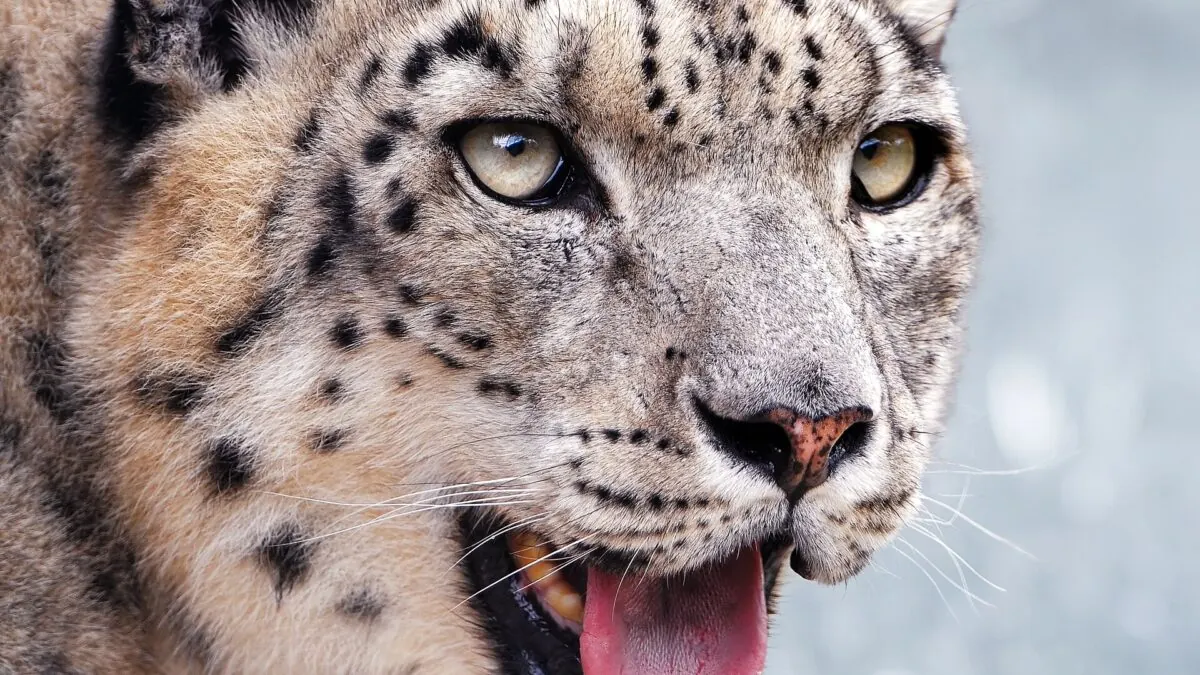
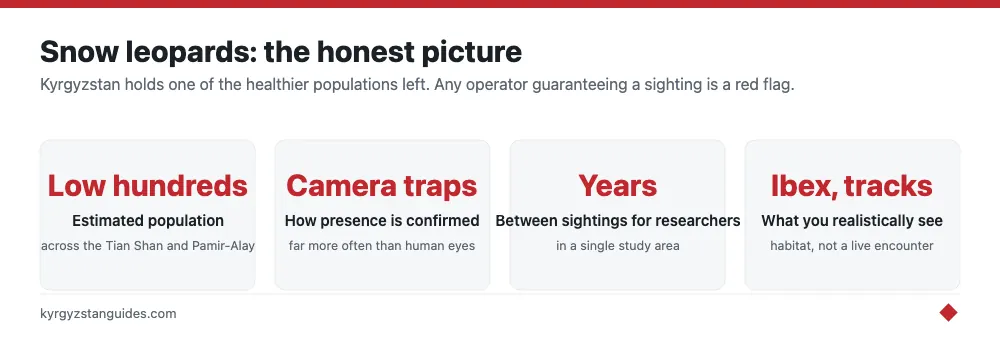
Short answer: almost never, and anyone selling a Kyrgyzstan trip on the promise of seeing a snow leopard in the wild is overselling it. Kyrgyzstan does hold one of the healthier remaining snow leopard populations anywhere, estimated in the low hundreds of individuals across the Tian Shan and Pamir-Alay ranges, but the cat is solitary, mostly nocturnal, camouflaged against scree and snow, and lives at altitudes and in terrain that keep it away from people by design. Camera traps confirm presence in specific valleys far more often than human eyes do.
That doesn’t make Kyrgyzstan a bad place for snow leopard-interested travel: it makes it a place where the trip has to be reframed around habitat, conservation work, and the realistic wildlife you'll see, rather than around a leopard sighting as the goal.
Where they actually live
The strongest concentrations in Kyrgyzstan are in the Sarychat-Ertash State Reserve in the central Tian Shan near the Chinese border, and across the Naryn and Alay mountain ranges further south and west, including terrain bordering the Pik Lenin massif. These are places chosen by the animal for isolation: steep, rocky, high-altitude terrain with enough ibex and argali sheep to hunt and few reasons for anyone else to pass through.
Sarychat-Ertash specifically was established as a protected area largely because of its snow leopard population, and it remains the closest thing Kyrgyzstan has to a dedicated snow leopard reserve. Even there, researchers who spend entire field seasons in the reserve often go without a direct sighting, relying instead on tracks, scat, and camera-trap footage to confirm the population.
Why sightings are so rare
A few things stack against you. Snow leopards exist at low density even in good habitat, a single individual’s territory can span dozens of square kilometers. They’re most active at dawn, dusk, and through the night, when most travelers are asleep or off the mountain. Their coat pattern is built for exactly this kind of terrain, breaking up their outline against rock and snow to the point that even experienced trackers often spot fresh prints before they spot the animal. Estimates commonly cited by conservation groups suggest that even dedicated, long-term wildlife researchers may go years between confirmed visual sightings in a single study area.
If a tour operator guarantees a sighting or prices a trip specifically around one, treat that as a red flag rather than a selling point. Reputable operators working in this space are upfront that camera-trap footage, fresh tracks, and habitat access are the realistic product, not a live encounter.
Camera-trap tourism and what it actually offers
Over the past decade, a small niche of camera-trap-based wildlife tourism has developed around snow leopard habitat in Central Asia, including parts of Kyrgyzstan. The model works like this: researchers or trained local guides maintain camera traps at known scent-marking or travel corridors, and visitors join multi-day treks that include checking and resetting these cameras, learning to read tracks and sign, and reviewing footage collected over recent weeks or months. It’s a slower, more honest version of wildlife travel, built around the idea that participating in monitoring is itself the experience, not a guaranteed photo of a live animal.
These trips typically run through specialist operators rather than general tour agencies, often in partnership with conservation organizations, and they lean heavily on trekking fitness since the routes into snow leopard habitat sit well above 3,000 meters. Anyone considering one should already be comfortable with the demands covered in our Kyrgyzstan trekking guide, since altitude and terrain, not the wildlife itself, are what most affect trip difficulty.
Conservation work on the ground
Several organizations work on snow leopard conservation in Kyrgyzstan, including international groups like the Snow Leopard Trust and Panthera, alongside local rangers and reserve staff at Sarychat-Ertash. Their work covers population monitoring through camera traps and GPS collaring, anti-poaching patrols, and community programs that reduce conflict between herders and predators — since livestock losses to snow leopards are a real economic issue for families grazing animals near leopard territory, and are a bigger driver of population pressure than tourism ever is.
Community-based insurance schemes, where herders are compensated for livestock losses confirmed to be from snow leopards rather than retaliating against the animal, have become one of the more effective tools regionally. Travelers who want their trip to meaningfully support this work are generally better off booking through operators who visibly fund or partner with these programs than through a generic adventure tour that mentions snow leopards mostly as marketing.
What responsible wildlife travel looks like here
A few ground rules make a real difference. Choose operators who partner with reserve authorities or recognized conservation groups rather than ones offering informal off-trail access. Keep expectations centered on habitat, terrain, and secondary wildlife. Ibex, argali, marmots, and a wide range of high-altitude birdlife are genuinely likely to be seen, and are worth the trip on their own. Avoid any operator promising a guaranteed sighting, baiting wildlife, or offering off-reserve access that bypasses permits, since that kind of pressure on a fragile population does more harm than a trip with no leopard at all.
If snow leopard habitat is the main draw of your trip, pair it with a realistic itinerary built around one of the accessible protected areas — Pik Lenin base camp sits within the same broader Alay range ecosystem and is a far more achievable add-on than a dedicated leopard-tracking expedition for most travelers. Budget accordingly too, since specialist wildlife treks with permits, rangers, and camera-trap access run well above standard trekking costs. Check our travel budget guide before committing.
FAQ
How likely am I to see a snow leopard in Kyrgyzstan?
Very unlikely on a standard trip. Even researchers spending full field seasons in known habitat often go without a direct sighting, relying on camera traps and tracks instead.
Where is the best place to try?
Sarychat-Ertash State Reserve has the strongest documented population and the most established camera-trap monitoring, followed by parts of the Naryn and Alay ranges.
What time of year is best for snow leopard habitat treks?
Summer, roughly June through September, when high passes and reserve tracks are snow-free enough for access. Winter access is limited and far more physically demanding.
Are snow leopard tours ethical?
It depends heavily on the operator. Ones that work with reserve authorities, fund conservation or herder compensation programs, and don’t promise guaranteed sightings are the ones worth booking.
What wildlife will I realistically see instead?
Ibex, argali sheep, marmots, and high-altitude birds of prey are common sightings in the same terrain, and are a reasonable and genuine payoff even without a leopard.
Twenty minutes from Naryn town there is a national park that survived four privatisation auctions: see Salkyn-Tor.
For a gorge with no facilities, no ticket and almost nobody in it, ninety minutes from the capital, see Shamsi — a former hunting concession turned snow leopard sanctuary.