Two things happened in the Shamsi gorge that are worth a visitor's attention, and they are about fifteen hundred years apart.
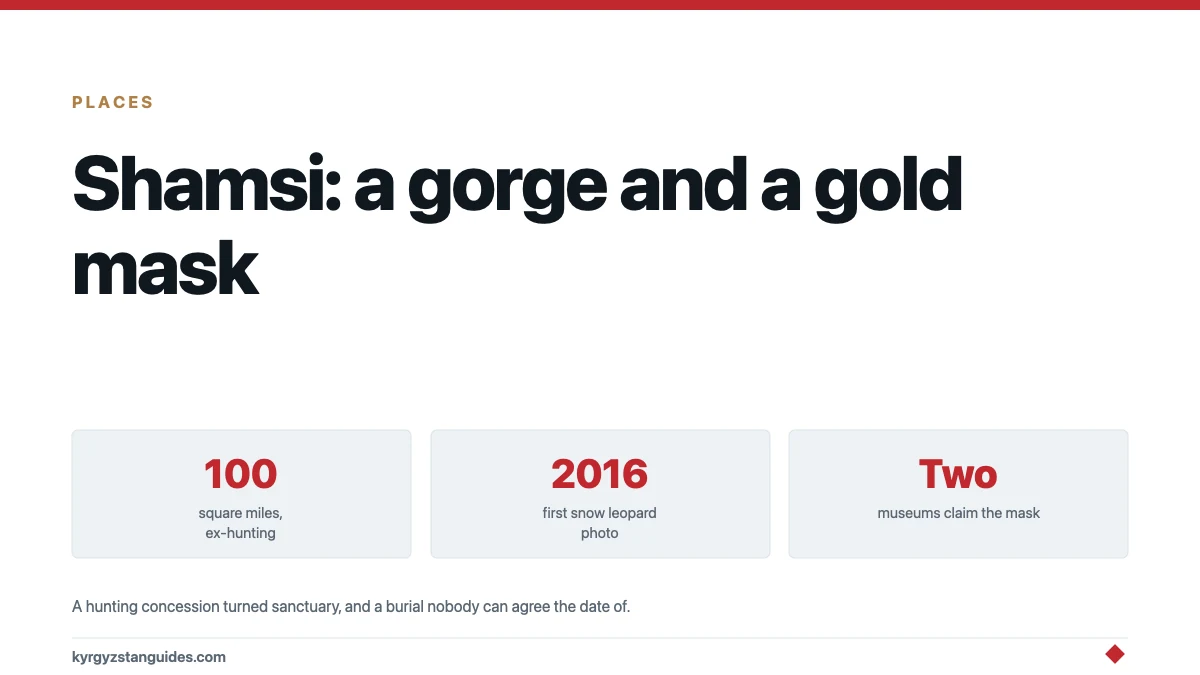
In the late 1950s or early 1960s, a gold funerary mask came out of a field at the mouth of the valley. In December 2015, the hunting concession that occupied the upper gorge was converted into a wildlife sanctuary, and within a year a snow leopard was photographed there for the first time.
Neither story is settled. We will give you both, with the disagreements marked.
Getting there
Шамшы (Shamsi, also Shamshy) runs south from the Chuy valley into the Kyrgyz Ala-Too, south of Tokmok. Published distance from Bishkek is 85 kilometres in one source and about 120 kilometres in another — probably the difference between the mouth of the gorge and the end of the road.
The gorge entrance sits at about 1,700 metres. Tuyuk-Keltor lake, the Shamsi river's source, is at 2,725 metres, and the Shamsi pass is above 3,500 metres, linking the Chuy valley to Kochkor. That pass was a caravan route toward Balasagun — the neighbouring gorge to the west is Kegety.
There is no public transport into the gorge. You take a marshrutka or the train to Tokmok, then continue by taxi. Marshrutka 350 from Bishkek was 100 som and the train 26 som. From Tokmok the road goes south through Kalinovka.
Entry is free and no permit is needed. Shamsi is entirely inside Chuy oblast, nowhere near a frontier.
The sanctuary
This is the part that has changed recently.
The upper gorge was a state hunting concession administered by the President's office, transferring to the natural-resources department in 2013. On 28 December 2015 a pilot agreement between the Snow Leopard Trust, the Snow Leopard Foundation Kyrgyzstan and the Kyrgyz hunting department converted it into a wildlife sanctuary — a zakaznik, meaning partial protection rather than a strict reserve.
The area given is about 100 square miles, roughly 259 square kilometres. That is the only published figure and it is a rounded imperial one, which tells you how thin the documentation is.
The terms matter and are unusually sensible: hunting is banned, but local herders keep their grazing rights, to be exercised in a managed way. Partners split ranger salaries, training and equipment. Activities are research, education and limited ecotourism.
In 2016 snow leopards were photographed in Shamsi for the first time. A preliminary winter camera-trap survey recorded lynx, ibex, red fox, marmots, badgers, wild pigs and many birds, plus snow leopard tracks, and a ranger saw one directly.
The wider fauna list for the gorge runs to snow leopard, Turkestan lynx, wolf, red fox, Siberian ibex, argali, wild boar, stone marten and ermine — which one source notes survives "despite intensive grazing activity." Grazing pressure is the named threat here, managed rather than excluded.
The cabin built for a shah
The ranger base is a log cabin with a story attached: it was built, locals say, to host the Shah of Iran on a hunting trip that never happened. The date is given as the 1970s, or 1968.
It was about 70 per cent renovated as of July 2017 with a new roof, windows and donated solar panels, and now works as an eco-education centre for rangers.
We are reporting the shah story as local tradition rather than documented history. It is consistent across sources but none of them cites anything.
The Shamsi gold
Now the older story, and the one where the sources fight.
When: 1958 according to several accounts, including one that has a farmer making the find and notes that Academy of Sciences expeditions recovered further material in 1960. 1962 according to another, which tells a vivid story of a combine harvester bogging down in a wheat field and the tractor sent to pull it out breaking through into the tomb.
What: a burial of the 4th to 5th century CE, sometimes given as 3rd to 5th — the Great Migration period, in the polychrome garnet-inlay style of the Hunnic horizon.
How much: "more than 150 gold, silver and bronze artefacts" in one account; "approximately 80 precious items" in another.
The mask is the object people come for. Thin gold foil, life-size, with inset eyes — carnelian according to one source, amber according to another. Three tree-of-life designs are rendered in dotted perforations picked out with white pigment: two on the cheeks, one running over the nose and forehead.
With it: a komuz with silver casing, a gold-and-silver headdress set with gemstones and pendants, a medallion with carved amber and garnet inlay, temporal and braid ornaments, earrings, rings with red garnets, a garnet necklace in gold, bracelets, a gold cup, decorated horse tack and a bronze cauldron. Jade and glass appear among the materials.
The burial is conventionally attributed to a woman of a rich and noble family, and she is called the "Shamsi queen" or the "Chuy beauty".
Where the mask actually is
This is the question and we cannot answer it.
One account places the assemblage in the State Historical Museum in Bishkek and the Archaeological Museum of the Institute of History at the Academy of Sciences. Kyrgyz museum coverage of the redesigned National Historical Museum likewise puts the mask on display in the capital.
Another account places it in the State Hermitage in St Petersburg.
There is a context that may reconcile them. Kyrgyz reporting says a great deal left the country during the Soviet period, and that attempts to recover around 120 items from the Hermitage have stalled on the Russian side. It is entirely plausible that part of the find is in Bishkek and part in St Petersburg.
If seeing the mask is the reason you are going to the museum, ask before you buy a ticket. We would rather tell you that than send you confidently to the wrong city.
Why a sanctuary rather than a park
Worth understanding, because the category decides what you will find.
A zakaznik is partial protection. It restricts specific activities — here, hunting — while leaving other uses in place. A zapovednik excludes people almost entirely, and a national park manages for visitors as well as for wildlife.
Shamsi is the middle option, and deliberately. The herders who used these pastures before 2015 still use them. That is not a compromise the agreement apologises for; it is the mechanism. A sanctuary that had expelled its herders would have had nobody with a reason to keep poachers out.
What it means for you is that there are no facilities. No visitor centre, no marked trails, no ticket, no toilets. What there is: a road, pasture, forest, rangers who are working rather than guiding, and a good chance of seeing nothing more dramatic than marmots.
That is the honest pitch. Shamsi is not a place with attractions. It is a place with almost nobody in it, ninety minutes from a capital city.
What to do there
Realistically this is a day trip from Bishkek or Tokmok: drive in, walk up, see the cascade on the western bank, eat, come back. The valley is fir and pine, wild strawberries, mushrooms, and the herbs — oregano, thyme, sage — that give the local honey its reputation.
Going over the Shamsi pass to Kochkor is a serious undertaking needing a proper vehicle and settled weather, not a casual detour.
For the Chuy valley context see Burana Tower, which is the surviving piece of Balasagun the pass road once served.
FAQ
Where is Shamsi gorge?
In Chuy oblast, running south from the Chuy valley into the Kyrgyz Ala-Too, reached from Tokmok via Kalinovka. Published distances from Bishkek vary between about 85 and 120 kilometres. The gorge entrance is around 1,700 metres and the pass at its head is above 3,500 metres.
Do I need a permit for Shamsi gorge?
No. Entry is free and no permit is required — the gorge lies entirely within Chuy oblast, away from any frontier zone. There is no public transport in, so you go by taxi from Tokmok or on an organised day trip.
Are there snow leopards in Shamsi?
Yes. The upper gorge became a wildlife sanctuary in December 2015 under an agreement that banned hunting while preserving local grazing rights, and snow leopards were photographed there for the first time in 2016. Lynx, ibex, wolf, argali and wild boar are also recorded.
What is the Shamsi treasure?
A 4th to 5th century burial found at the gorge in either 1958 or 1962, containing a life-size gold funerary mask with inset stones and tree-of-life designs, along with a silver-cased komuz, a jewelled headdress, garnet-set rings and a gold cup. It is attributed to a woman of high rank, called the "Shamsi queen".
Where can I see the Shamsi gold mask?
Sources conflict. Some place the find in the State Historical Museum in Bishkek and the Academy of Sciences archaeological museum; another places it in the Hermitage in St Petersburg. Kyrgyz reporting notes that recovery of around 120 items from the Hermitage has stalled. Ask the museum before travelling specifically to see it.
Is Shamsi gorge a good day trip from Bishkek?
Yes, if you have a vehicle. It is a half-day to full-day trip taking in fir and pine forest, a waterfall cascade and high pasture, with almost none of the traffic that Ala-Archa gets. Crossing the pass to Kochkor is a different proposition and needs a capable vehicle and good weather.
Above the waterfall, the Kegeti pass crosses to Kochkor at 3,805 metres — and not, despite what you may read, to Chong-Kemin.