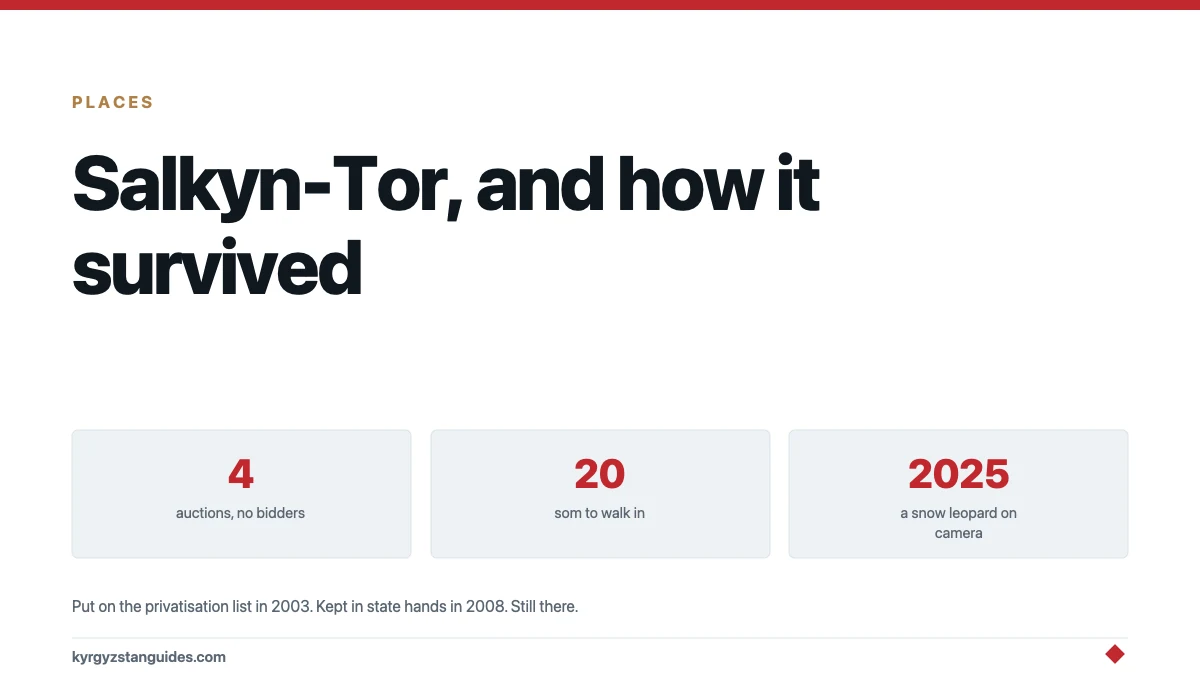
Salkyn-Tor was put on Kyrgyzstan's privatisation list in 2003. Four auctions were held. The fourth, scheduled for July 2005, drew no bidders at all.
That is why there is still a national park twenty minutes from Naryn town, and it is a more interesting fact about the place than anything in its brochure.
What it is
Salkyn-Tor means roughly "cool hollow" — salkyn, cool, and tör, the far upper end of a valley, the same word used for the seat of honour in a yurt.
It is a state nature park, not a strict reserve, established in May 2001, covering 10,448 hectares in Naryn oblast. The entrance sits at about 2,200 metres, up the Naryn river road past the small airport, under a rainbow-shaped arch you cannot miss.
Distance from Naryn town depends who you ask: sources give 12, 16, 18 and 20 kilometres. Call it a half-hour taxi ride and do not plan around the number.
Why it exists
The stated founding purpose was restoring the population of the Tien Shan maral, the red deer subspecies Cervus elaphus songaricus, which is on the Kyrgyz Red Data Book and whose numbers fell sharply after independence.
The park holds Red Book species across the board: four mammals, six birds, ten insects and two plants.
What you walk through is dense Schrenk spruce mixed with Tien Shan rowan, with wild rose, willow and barberry underneath. Above the trees the slopes open out.
Beyond maral and roe deer, the mammal list runs to Eurasian lynx, brown bear and snow leopard. That last one is not aspirational: a scientific expedition set camera traps here in June 2025 and recorded wildlife including the snow leopard.
The privatisation fight
This is the part worth knowing, because it explains the condition of the place.
After the park was created in 2001, its recreation zone was transferred illegally to the Naryn city administration and then leased out to private individuals. In 2003 the park went onto the privatisation list. Auctions followed. The fourth and final one, in July 2005, attracted no bidders.
The Naryn oblast governor petitioned against the sale. In February 2008 the prime minister signed an amendment keeping the entire property complex of the recreation zone in state administration.
So the park was saved partly by political effort and partly because nobody wanted to buy it. Seven years of uncertainty left their mark on the infrastructure, which is functional rather than polished.
There is a live administrative oddity too. The park's registered name attaches it to the Ministry of Natural Resources, but it has also been reported among organisations listed under the President's Administration. We could not resolve which is current.
What is actually inside
Named features, in Kyrgyz, because signage uses them:
Кожо-Үңкүр (Kozho-Unkur), a cave. Дүбөлү (Dubeli), a historic hill. Кургак (Kurgak), a spring. And three rock gorges — Көк-Жайык (Kok-Zhaiyk), Бүркүт-Уя (Berkut-Uya, "eagle's nest") and Кызыл-Зоо (Kyzyl-Zoo).
Trails are informal. This is a picnic-and-ramble park for the people of Naryn rather than a waymarked hiking destination, and on a summer weekend that is exactly what you will find: families, samovars, car boots open.
Practicalities
Entry is cheap and the figure is muddled. One guide reports 20 som per person; another gives "$1 per person", which is roughly 87 som and cannot be the same ticket. Take 20 som as the local rate and expect the possibility of a vehicle charge.
Worth watching: in June 2026 a member of parliament proposed at committee stage that foreigners pay US$20 to 50 to enter national parks and reserves rather than the resident rate. It has not passed, but fee policy across the country is visibly in flux — Ala-Archa now charges 250 som for an adult and bans internal-combustion vehicles outright.
No border permit is needed. Naryn town is well north of the restricted frontier zone, unlike Chatyr-Kul further south.
Season: open year round, but May to September is when people actually come. Winter here is serious.
Getting there: taxi from Naryn bus station. See Naryn town for the town itself and Bishkek to Naryn for the journey.
The park that is not on the ministry's list
Here is something that tells you more about Kyrgyz conservation than any species count.
Salkyn-Tor does not appear on the Ministry of Natural Resources' own current page listing the country's protected areas. Neither does Kara-Shoro national park in Osh oblast. That page names eight reserves and seven parks; both of these demonstrably exist, are staffed, and charge admission.
The national figures wobble for the same reason. Kyrgyzstan's protected-area network is described variously as 83 areas covering around 800,000 hectares, about 4 per cent of the country, made up of six to ten strict reserves, eight to ten national parks and 67 or 68 partial-protection sanctuaries. The counts differ between the ministry's page, independent ecological registers and news summaries.
None of that means the parks are fictional. It means the published record is incomplete, which is worth knowing before you plan a trip around an official list.
What a day here actually looks like
There is no waymarked circuit and no visitor centre handing out maps, so it helps to know the shape of a visit before you arrive.
You pay at the arch, drive or walk in along the valley floor, and the spruce closes over you within a few hundred metres. The main track follows the water. Side gorges — Kok-Zhaiyk, Berkut-Uya, Kyzyl-Zoo — open off it, and how far up any of them you go is entirely your decision, because nobody has signed them.
Most Naryn families go a kilometre or two, find a spot by the river, and stay there. That is the local idea of the place and it is a good one. If you want height, pick a side gorge and climb until the trees stop.
Two hours gets you a walk and a picnic. A full day gets you above the treeline with a view back down the Naryn valley. You will not need technical gear for either, but you will want proper shoes: the ground is loose and the slopes are steeper than they look from the track.
The wildlife you are realistically going to see is birds, marmots and, with luck and an early start, roe deer. Maral, lynx, bear and snow leopard are all here and none of them intends to be seen by you.
Why it is worth an afternoon
Naryn is a town most travellers pass through on the way to Tash-Rabat or the Torugart, usually with an afternoon to fill and nothing obvious to fill it with.
This is the answer. It is twenty minutes away, it costs almost nothing, and it is real forest — which matters more than it sounds in a country where the tree cover is thin and most of what travellers see is grassland and rock. Standing under closed spruce canopy in Kyrgyzstan is less common than the photographs suggest.
It also gives you altitude in a manageable dose. If you are heading up toward the Torugart, a few hours walking at 2,200 to 2,600 metres out of Naryn is a sensible thing to have done first.
What entry costs elsewhere, for comparison
Fees here are changing fast enough that any single number needs its date attached. For calibration, as of 2026:
| Place | Charge |
|---|---|
| Ala-Archa | 250 som adult, 180 som ages 7–14, free under 7 |
| Ala-Archa, electric vehicle | 880 som; internal-combustion vehicles banned outright |
| Kara-Shoro | 50 som per person, June 2025 |
| Salkyn-Tor | 20 som per person |
| Shamsi gorge | Free |
Karakol installed an "ecopost" with its own charge in November 2025. The direction of travel is clear: more gates, higher charges, and a live proposal to price foreigners separately.
Carry small som notes. None of these places takes a card.
One thing we could not confirm
There is a well-known "forest swastika" near Tash-Bashat village, about 30 kilometres from Naryn — a spruce planting roughly 180 metres across, variously dated to 1939 or the 1940s and 1950s, forming the ancient solar symbol rather than anything later.
Several travel sites imply it lies inside Salkyn-Tor. None of the sources we checked places it within the park boundary. If seeing it matters to you, ask locally rather than assuming a park ticket gets you there.
FAQ
Where is Salkyn-Tor National Park?
In Naryn oblast, up the Naryn river road east of Naryn town, past the small airport, with the entrance marked by a rainbow-shaped arch at about 2,200 metres. Published distances from the town range from 12 to 20 kilometres; it is roughly a half-hour taxi ride.
How much does it cost to enter Salkyn-Tor?
One guide gives 20 som per person and another gives about a dollar, which do not reconcile — treat 20 som as the local rate. A parliamentary proposal in June 2026 would charge foreigners US$20 to 50 at national parks, but it has not been adopted.
Are there snow leopards in Salkyn-Tor?
Yes. A scientific expedition placed camera traps in the park in June 2025 and recorded wildlife including snow leopard. Lynx, brown bear, maral and roe deer are also present.
Why was Salkyn-Tor National Park created?
To restore the population of the Tien Shan maral, a Red Data Book red deer subspecies whose numbers declined sharply after independence. The park was established in May 2001 and covers 10,448 hectares.
Do I need a permit for Salkyn-Tor?
No. It sits in Naryn oblast well away from the restricted border zone, so unlike sites near the Chinese frontier it needs no border permit — just the entrance ticket.
Is Salkyn-Tor worth visiting?
For a half-day from Naryn, yes: spruce forest, gorges and a real chance of wildlife within twenty minutes of a town most travellers only pass through. It is a local picnic park rather than a waymarked hiking destination, and the trails are informal.