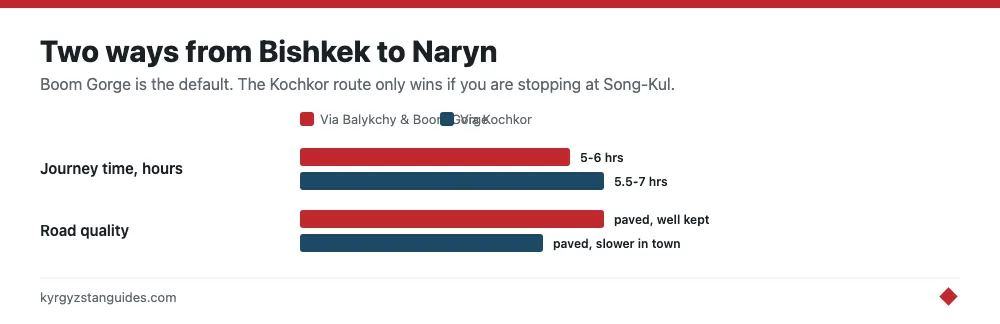
Naryn sits roughly 300 kilometers southeast of Bishkek, and the drive takes about 5-6 hours depending on the route, your vehicle, and how many stops you make along the way. Two roads get you there: the faster route via Balykchy and the Boom Gorge, or the slightly longer but more scenic route via Kochkor. Most shared taxis and marshrutkas run the Balykchy route by default; the Kochkor route makes sense mainly if you’re stopping there anyway, since it’s the jumping-off point for Song-Kul.
Almost nobody treats Naryn itself as a destination. It’s a functional, fairly plain administrative town that exists on most itineraries as the overnight stop before or after Tash-Rabat and the Torugart pass crossing into China. Plan it that way and it makes complete sense; expect a lakeside-Karakol-style highlight and you’ll be disappointed.
The two routes compared
| Route | Approx. time | Road conditions | Best for |
|---|---|---|---|
| Via Balykchy & Boom Gorge | 5-6 hours | Paved, well-maintained, follows the gorge and skirts Issyk-Kul’s western tip | Directness, the default for shared taxis and marshrutkas |
| Via Kochkor | 5.5-7 hours | Paved but slower through Kochkor town; onward tracks to Song-Kul are rougher | Combining the trip with a Song-Kul stop or Kochkor’s Sunday livestock market |
The Balykchy route follows the Chuy River through the Boom Gorge. A genuinely dramatic stretch of red rock canyon that’s worth staying awake for if you’re on a night departure or feeling drowsy from the earlier flat driving out of Bishkek, before skirting the western edge of Issyk-Kul and turning south toward Naryn through increasingly bare, high-altitude terrain. The Kochkor route branches off earlier and takes you through Kochkor town itself, useful if you want to break the journey or arrange a Song-Kul horse trek from one of the community-based tourism offices there before continuing on.
Getting there: shared taxi, marshrutka, or private car
Shared taxis are the standard option and the one most independent travelers end up using. They leave from Bishkek’s main bus station on Alma-Atinskaya 1/1 once full, generally through the morning and early afternoon, and cost roughly 500-700 KGS per seat depending on demand and season. There’s no fixed timetable: cars fill up and leave, so arriving mid-morning gives you the best chance of a reasonably fast departure rather than a long wait.
Marshrutkas (shared minibuses) cover the same route for slightly less money but take longer and are less comfortable for a 5-6 hour ride, particularly with luggage. They’re a reasonable budget option but not the fastest or most comfortable way to make this specific trip.
A private car or hired driver costs considerably more (often several times the shared-taxi fare) but buys flexibility: stopping at Boom Gorge viewpoints, detouring through Kochkor, or timing the drive around Tash-Rabat or Torugart connections on the other end. For travelers combining Naryn with Tash-Rabat and a border crossing, arranging a private driver for the whole loop, rather than separate shared-taxi legs, is often simpler and not dramatically more expensive once split across a small group.
Why Naryn is a stopover, not a destination
Naryn’s role on the map is almost entirely logistical. It’s the last sizeable town before the high plateau routes toward Tash-Rabat caravanserai and the Torugart pass into China, and it’s where onward transport, permits, and guides for that stretch are typically arranged. The town itself has a modest historical museum, a functional bazaar, and a scenic river running through it, but it doesn’t compete with Karakol, Osh, or Bishkek as a place to spend multiple days.
Most travelers spend one night in Naryn (enough to arrange onward transport and rest after the drive from Bishkek) before continuing to Tash-Rabat the next morning. Guesthouses and a handful of small hotels handle this steady stream of overnighters reasonably well, and prices stay well within the country’s usual budget-guesthouse range.
What to expect along the way
The drive out of Bishkek starts flat and unremarkable — farmland and small towns along the Chuy Valley — before the Boom Gorge narrows the route into red-rock canyon walls with the Chuy River running alongside the road. This is the visual highlight of the whole trip, and it’s over relatively quickly, so keep a camera within reach rather than packed away. After the gorge, the road opens onto Issyk-Kul’s western shoreline briefly before turning inland and climbing toward Naryn’s higher, drier plateau, where the landscape shifts noticeably from lake-country green to steppe-like brown and gold, especially by late summer.
Roadside stops are limited but not absent — small chaikhanas (tea houses) and shashlik stands appear at a few points along the Balykchy route, useful for a break roughly halfway through the drive. Don’t expect much beyond basic food and tea; this is a functional transit road, not a route built around traveler amenities, and most drivers push through with only brief stops.
Practical timing notes
If your goal is reaching Tash-Rabat or the Torugart crossing on a specific schedule, build in a buffer day around the Naryn leg. Shared-taxi departure times aren’t fixed, winter conditions on the higher sections toward Tash-Rabat can add delays, and the region’s altitude means weather changes faster than lowland itineraries account for. Summer (June through September) is the most reliable window for the whole Bishkek-Naryn-Tash-Rabat run; outside that, check conditions locally before committing to a tight connection, particularly if a border crossing is involved.
For travelers not continuing to Tash-Rabat, Naryn still works as a quieter, less touristed stop on a broader loop, and it connects reasonably well back toward Song-Kul via the Kochkor road if you want to loop rather than backtrack. Anyone planning the onward leg toward the caravanserai should read our dedicated Tash-Rabat guide, and if China is the eventual goal, check current conditions at Kyrgyzstan’s border crossings well before finalizing dates, since Torugart in particular has stricter advance-notice requirements than most crossings. For general transport logistics across the rest of the country, our getting around Kyrgyzstan guide covers shared taxi and marshrutka norms in more depth, and Bishkek-based travelers planning their departure day can check things to do in Bishkek to fill the morning before an afternoon shared-taxi departure.
The bottom line: treat Bishkek-Naryn as a transit leg, not a scenic drive in its own right, budget 5-6 hours plus buffer, and book onward Tash-Rabat arrangements from Naryn itself rather than trying to pre-arrange everything from the capital.
What Naryn is for, beyond the overnight stop
The town is usually written off in a sentence, and mostly that is fair — but the reason it exists explains the drive. Naryn sits at around 2,000 metres on the Naryn River, the longest river in Kyrgyzstan and the one that eventually becomes the Syr Darya. It is the administrative centre of the country's largest and emptiest province: Naryn region covers a sizeable share of Kyrgyzstan's territory and holds one of its smallest populations, which is why the road between Bishkek and here runs for long stretches with nothing on either side of it.
Two things give the town more substance than its main street suggests. The University of Central Asia opened a campus here, which has put a genuinely international student body into a provincial Kyrgyz town and improved the cafes measurably. And Naryn is the last real supply point before Tash-Rabat and the Torugart pass into China — the last bank machine you should rely on, the last pharmacy worth the name, the last place to buy a proper sleeping bag liner before a caravanserai night at 3,200 m.
Plan accordingly. If you're heading for Torugart, do your shopping in Naryn rather than assuming At-Bashy will cover you, and remember that the Torugart crossing isn't a place you can turn up at — it needs a permit and a vehicle arranged on both sides, organised well in advance.
The stops worth breaking the drive for
Done straight through, Bishkek to Naryn is five to six hours of sitting. Two stops turn it into a better day. The Boom Gorge, about two hours out, is the stretch where the Chuy River has cut a red-rock canyon that the road and the old railway line share; there are pull-offs and it's worth using one rather than watching it through glass.
Kochkor is the other, and it is the reason to take the slower route. It's the main base for felt-work cooperatives and the standard jumping-off point for Song-Kul, and its Sunday livestock market is a working animal bazaar rather than a staged one — go early, it is effectively over by mid-morning. If you want a shyrdak from the people who made it rather than from a Bishkek gallery, this is where that happens.
One timing note that catches people out: shared taxis from Bishkek’s main bus station on Alma-Atinskaya 1/1 fill mostly in the morning, and the later in the day you turn up, the longer you wait for the fourth passenger. Aiming to leave before about 10am is the difference between a five-hour journey and a five-hour journey with two hours of car park in front of it.
FAQ
How long is the drive from Bishkek to Naryn?
Roughly 300 km and five to six hours via Balykchy and the Boom Gorge, or five and a half to seven via Kochkor. Shared taxis default to the Balykchy route; the Kochkor route only makes sense if you're stopping there.
What is the best way to travel from Bishkek to Naryn?
Shared taxi, for most people — faster and more comfortable than a marshrutka for a modest premium. They leave from Bishkek’s main bus station on Alma-Atinskaya 1/1 and fill mostly in the morning, so arrive before about 10am to avoid waiting for the car to fill.
Is Naryn worth visiting?
As a destination in itself, not especially — it's a plain administrative town. As the overnight stop before Tash-Rabat and the Torugart pass, and the last proper supply point before them, it is genuinely useful. Plan it that way and it works.
What altitude is Naryn?
About 2,000 metres, on the Naryn River. That is high enough to be noticeably colder than Bishkek year-round and to make Naryn a sensible acclimatisation night before Tash-Rabat at roughly 3,200 m.
Can you stop at Song-Kul on the way to Naryn?
Not directly — Song-Kul is a detour from Kochkor on rough tracks, not a stop on the highway. If you want the lake, treat Kochkor as the base and budget a separate day rather than trying to fold it into the drive.
What is there to see between Bishkek and Naryn?
The Boom Gorge, about two hours out, where the Chuy River has cut a red-rock canyon shared by the road and the old railway. And Kochkor, on the slower route, for its felt cooperatives and a Sunday livestock market that is over by mid-morning.
One thing older guidance gets wrong. Bishkek’s Western Bus Station (Zapadnyi Avtovokzal) and the “Akzhol” mini-station both closed on 23 October 2024. Services moved to the municipal Bishkek Bus Station, which had opened that January: east-direction routes — Issyk-Kul, Karakol, Kochkor, Naryn — now leave from Alma-Atinskaya 1/1, and west-direction routes, including Osh and Talas, from Frunze 209. Any source still sending you to the Western Bus Station is out of date.
Twenty minutes from Naryn town there is a national park that survived four privatisation auctions: see Salkyn-Tor.