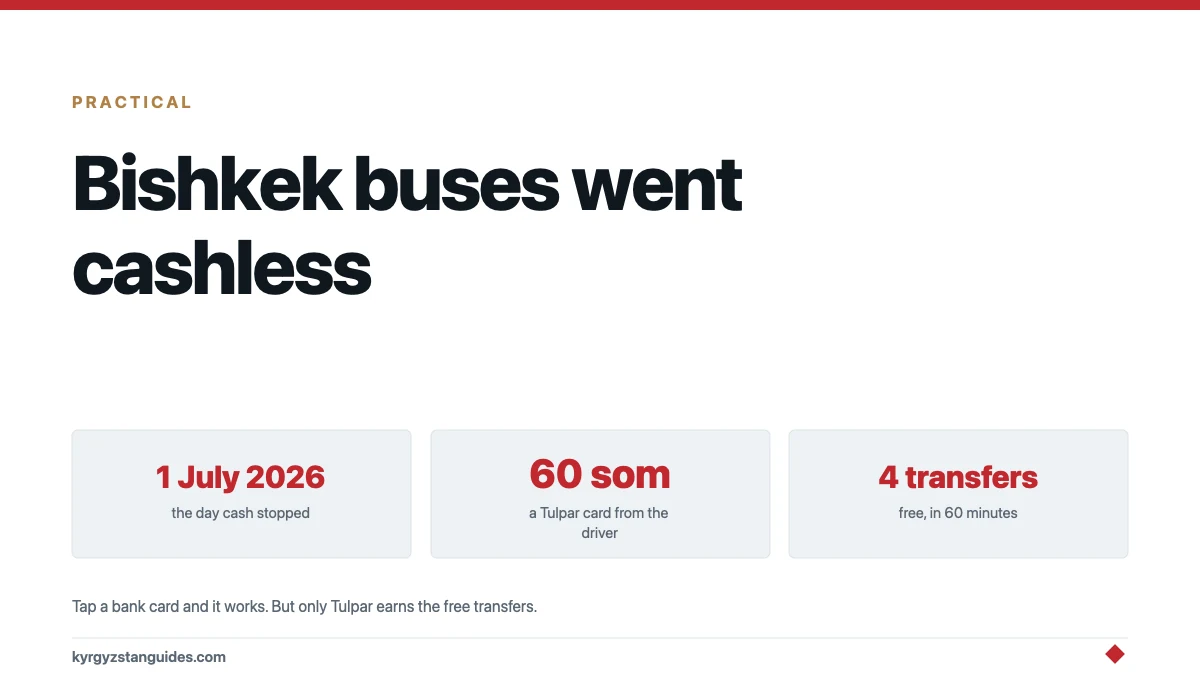
On 1 July 2026 Bishkek stopped taking cash on its buses. If you arrive with a pocket of som expecting to hand coins to a driver, that no longer works, and the replacement is not obvious from inside the bus.
This is the part of the city almost no guide has caught up with, so here is how it actually functions now.
What replaced cash
The city council approved the change on 30 June 2026 and it took effect the next day. What the validator accepts:
The Tulpar transport card, student and municipal travel cards, Visa, Mastercard and Elkard bank cards tapped directly on the validator, a QR code scanned with a banking app, and a virtual card inside the Tulpar app.
For a visitor the second of those is the answer. A contactless bank card works. Tap it on the validator as you board, the same as London or Warsaw. You do not need a local card or a local app to ride a Bishkek bus.
If you would rather have a physical card, you can buy a Tulpar card from the driver for 60 som, which includes one ride. On-board inspectors and terminals also sell single tickets.
One practical warning from the rules themselves: if the payment equipment fails because of a fault in the Tulpar system, you ride free. If the system is working and you simply cannot pay, that is your problem. Carry more than one payment method.
The free transfer, and the catch in it
This is the detail worth knowing before you choose how to pay. Bishkek now gives you up to four transfers free within 60 minutes of your first payment.
But the free transfer only applies to Tulpar card and app holders. Paying with a Visa, Mastercard, Elkard or QR code does not earn it. Tap a bank card onto a second bus and you pay again.
So the rule of thumb: for one or two rides, a contactless bank card is simplest. If you are in Bishkek for several days and will change buses, the 60-som Tulpar card pays for itself quickly.
You must tap again on every transfer for it to register. Free travel is retained for pensioners, people with disabilities, children under seven, carers of disabled children and postal workers, though not on express routes.
The city is paying for all of this: compensating operators for free transfers and lost cash revenue was costed at around 307.2 million som.
What a ride costs
Bishkek city hall publishes a tariff table, and it is worth reading with one eye open because parts of it are out of date.
17 som for a bus, 20 som for a small-class bus. A monthly travel card is 1,020 som and a student card 360. Luggage over 40 kg or 50 by 60 by 100 cm costs 17 som.
The page also still prints a cash fare for buses and trolleybuses fitted with validators. Ignore that line — cash was abolished on 1 July 2026 and the trolleybuses no longer exist. The page carries no effective date, which is your cue to treat it as indicative.
Seven routes leave the city limits and carry a 10 som surcharge paid through additional QR codes on board: routes 153, 51, 32, 1, 226, 23 and 34.
The airport express is separately priced. Route 153 from Asanbay to Manas is 122 som cashless or 140 in cash, set by mayoral decree in July 2024.
The routes that matter to a visitor
Only a few are worth committing to memory, and these are the ones with an official source behind them.
153 — Asanbay to Manas International Airport. Twelve-metre air-conditioned Isuzu buses, seated passengers only, fixed stops, every ten to twelve minutes. Launched in July 2024 with seventeen buses, and since 17 October 2025 it also runs at 00:00, 03:00 and 05:00, which matters because most long-haul flights land in the small hours.
35 — West Bus Station to Railway Station to East Bus Station, 18.2 km. This is the link between Bishkek's two intercity terminals and the train station, and it is the single most useful route if you are moving between long-distance services.
48 — a West to East Bus Station circular, 18 km, covering similar ground.
A night service already ran between the airport and Asanbay, and from July 2026 night runs were to be piloted on other routes, 22:00 to 05:00 at roughly 40-minute intervals.
Route numbers: a renumbering that has not happened
You may read that Bishkek renumbered every route from 1 July 2026, scrapping three-digit numbers and running everything from 1 to 72. The plan was announced by the director of the city transport enterprise.
It has not taken effect. A city hall notice of 28 August 2026 lists live routes including 103, 107, 118, 166, 215, 222, 227 and 254 — three-digit numbers still in service. Reporting in late June said no numbers had been fixed and no date set.
No source states whether the renumbering has slipped or been abandoned. Treat the numbers on the bus as the real ones and ignore anything you read about a new scheme until it visibly happens.
Eight routes did change their schemes from 1 July 2026: 100, 101, 13, 33, 40, 44, 104 and 226. The city ran 72 bus routes as of June 2026.
The trolleybuses, and the reason that was not true
If a guidebook tells you to take a trolleybus, it is describing a system that no longer exists. The municipal trolleybus enterprise was liquidated in late 2024. At the end it ran 11 routes with 179 trolleybuses and 616 staff, closing a 75-year history that began with route 1 in January 1951. The overhead wiring was dismantled and more than a hundred vehicles were sent to Osh, where they sit unused.
The stated justification was that the Asian Development Bank required it as a condition of its transport investment. The ADB has officially confirmed that it did not. Scrapping the trolleybuses was a decision of the Bishkek authorities, not a condition of the agreement. That exchange is worth knowing if you want to understand why the city’s transport policy is argued about so fiercely.
What replaced them was partly electric buses and partly gas buses. One campaign group calculates a net loss of around 200 units of electric transport, in a city with the air-quality problem described in our air quality guide.
The electric bus numbers themselves do not reconcile. The ADB-financed project procures at least 120 electric buses along with charging infrastructure, substations and the rebuilding of two depots, at a reported $50 million. But a January 2026 report says the project actually launched 21. No source I could find resolves the gap between the target and what is on the street, and nobody publishes which routes run them.
Use the city's own app
Bishkek city hall runs Moy Gorod, which shows buses in real time, builds routes and announces arrivals aloud for visually impaired users. City hall cites over 800,000 downloads and 490,000 active users, and it also tracks intercity Chuy services.
The Tulpar app does the same real-time tracking and is the one you need if you want the transport card and the free transfers.
Between them they answer the question the bus stop does not: electronic arrival boards at stops were still only promised as of mid-2026, with no installation dates.
One thing I cannot give you is a route-by-stop list for Osh Bazaar, Ala-Too Square or Dordoi. No official list was retrievable, and the commonly quoted bus 380 to the airport — 40 som, every fifteen minutes — comes only from travel blogs, with the airport's own site unreachable. Use the app rather than a number you read somewhere.
FAQ
Can you pay cash on Bishkek buses?
No, not since 1 July 2026. The validator takes the Tulpar transport card, municipal and student cards, Visa, Mastercard or Elkard tapped directly, a QR code scanned in a banking app, or a virtual card in the Tulpar app.
How do tourists pay for buses in Bishkek?
A contactless Visa or Mastercard tapped on the validator works, with no local card or app needed. If you prefer a physical card, a Tulpar card costs 60 som from the driver and includes one ride.
Are transfers free on Bishkek buses?
Up to four transfers within 60 minutes, but only for Tulpar card or app holders. Paying with a bank card or QR code does not earn free transfers, so for several days of travel the 60-som Tulpar card pays for itself.
How much is a bus in Bishkek?
17 som for a bus and 20 for a small-class bus per the city tariff table, which carries no effective date and still lists obsolete trolleybus and cash lines. Seven routes leaving the city add a 10 som surcharge.
How do you get from Bishkek to Manas airport by bus?
Express route 153 from Asanbay, 122 som cashless or 140 in cash, every ten to twelve minutes, with additional departures at 00:00, 03:00 and 05:00 since October 2025.
Did Bishkek renumber its bus routes?
It was announced for 1 July 2026 but has not taken effect. A city hall notice of 28 August 2026 still lists three-digit routes such as 103, 166 and 254. Go by the number on the bus.
The same pattern of unmarked, unprotected Soviet-era work runs through the city itself: see Bishkek’s Soviet mosaics, eleven catalogued panels and one that was destroyed in 2025 while still on the register.
An evening at one of the city’s five state theatres is the cheapest good night out in Kyrgyzstan: see theatre and opera in Bishkek, where the opera house’s own ballet starts at 300 som.
One thing older guidance gets wrong. Bishkek’s Western Bus Station (Zapadnyi Avtovokzal) and the “Akzhol” mini-station both closed on 23 October 2024. Services moved to the municipal Bishkek Bus Station, which had opened that January: east-direction routes — Issyk-Kul, Karakol, Kochkor, Naryn — now leave from Alma-Atinskaya 1/1, and west-direction routes, including Osh and Talas, from Frunze 209. Any source still sending you to the Western Bus Station is out of date.
Twenty kilometres east of Bishkek, Kant has a cement works that opened a new line in 2025 and a Russian air base that has been there since 2003.