If you arrive in Bishkek between November and February you may not see the mountains at all, and the reason is not cloud. The city has one of the worst winter air-quality problems of any capital, and on 15 January 2026 it ranked fifth most polluted major city in the world with an air quality index of 206, which is classed as very unhealthy.
This is genuinely worth planning around, and the data on it is messier than you would expect.
How bad, in numbers
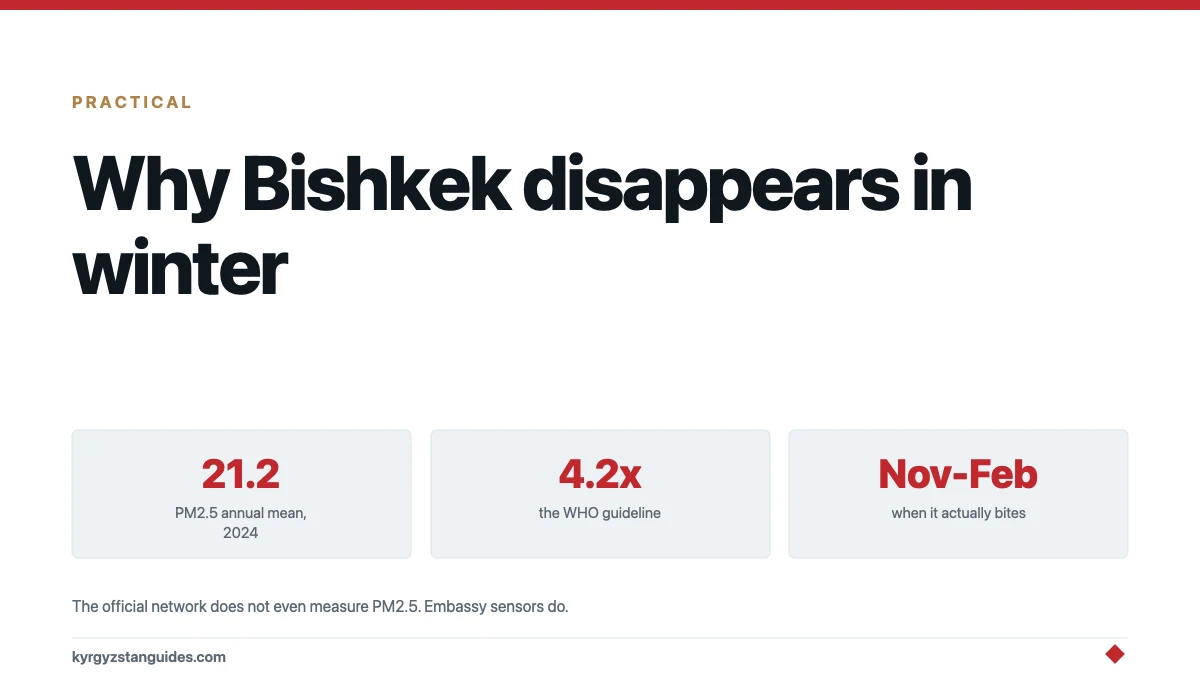
The annual mean PM2.5 concentration for 2024 was 21.2 micrograms per cubic metre, which is 4.2 times the World Health Organization annual guideline of 5.
A second figure gives a different picture of the same problem. The World Bank reported that the 2022 annual mean exceeded the WHO guideline by nearly sevenfold, and that across recent winters the average daily PM2.5 was often above 200 micrograms — more than thirteen times the WHO 24-hour guideline of 15.
Those two numbers come from different measurement networks and different years and I am not going to reconcile them. The useful takeaway is that the annual average understates the experience, because the pollution is concentrated into the heating season. A yearly mean of 21 is the product of clean summers and appalling Januaries.
What causes it, and where the sources disagree
The World Bank attributes over 75% of annual average ambient PM2.5 to three things together: residential coal heating, vehicle emissions, and windblown dust from outside the city.
On which of those leads, the sources do not agree. The World Bank's ordering puts residential coal heating first. IQAir's assessment puts vehicle emissions as the largest contributor, citing high car ownership, an ageing fleet and limited public transport, with coal heating in homes and power plants rising sharply in winter. Kyrgyz officials list coal use, exhaust from old vehicles, and emissions from the Bishkek combined heat and power plant and industry.
What everyone agrees on is the geography. Bishkek sits in a valley and suffers frequent temperature inversions in cold months, where a layer of warmer air traps colder air beneath it and nothing disperses. The city does not produce dramatically more pollution in January than a comparable city; it just cannot get rid of it.
A structural note that explains the coal: the novostroiki, the unplanned residential belt around the city, were largely built without gas connections. Households there heat with coal because that is what is available.
The official network does not measure PM2.5
This one matters if you want to check conditions yourself. Kyrgyzstan's official monitoring body is Kyrgyzhydromet, under the emergencies ministry, and it runs stationary posts across Bishkek and publishes monthly bulletins.
Those bulletins report sulphur dioxide, nitric oxide and nitrogen dioxide, expressed as multiples of the Kyrgyz maximum allowable concentration. They do not report PM2.5, which is the pollutant the health guidance and the world rankings are about.
For a sense of what they do show: in August 2026 the monthly means were SO₂ at 0.08 of the allowable concentration and NO₂ at 2.0, with nitrogen dioxide exceeding the one-off limit on ten days. Data covered only the first ten days of the month because of station modernisation.
The real-time PM2.5 figures everyone actually uses come from a non-governmental sensor network, including one at the Swiss Embassy in Bishkek — seven contributing stations in the city. That is worth knowing: the number in the app on your phone is probably not a government number.
What is being done
More than is usually reported, and it is recent.
Cabinet Resolution No. 639 of 6 October 2025 banned the import, sale, storage and use of loose unsized coal of the 0 to 13 millimetre fraction in Bishkek and Chuy oblast, excepting supplies to heat-supply enterprises. That fraction is the cheap, dirty, dusty coal that households burn. I could not find the resolution's own text in the legal database, so treat the detail as reported rather than verified.
On gasification: 54 of 105 residential massifs have been connected, with 69,520 homes connected to gas supply, of which 52,316 are actually on gas and 37,124 use gas boilers for heating. The preferential loan rate for connecting was cut from 8% to 3%.
On transport: 120 electric buses purchased in 2025, a clean-emission municipal fleet of 1,567 vehicles including 1,447 gas buses, and over 3,000 diesel minibuses removed from central streets. Also 18,755 saplings planted in 2025 against a target of 12,460.
Behind it is a $50 million World Bank project approved on 29 November 2023 and running to December 2030, funding air quality management systems, household transition to clean heating and urban greening.
What a visitor should actually do
Go in the warm months and the question does not arise. Kyrgyzhydromet's summer bulletins record no episodes of extremely high pollution, and the air in the mountains is not the issue at any time of year.
If you are in Bishkek in November through February, treat it the way you would any polluted city in winter: check a PM2.5 reading rather than looking out of the window, keep hard exercise out of the city on bad days, and consider an FFP2-grade mask if you have a respiratory condition. On the worst days an index above 200 is not a statistic you should ignore.
And it is a reason to structure a winter trip around leaving the capital. Karakol and the mountain valleys do not have this problem, and one of the odder features of a Kyrgyz winter is that the air gets better as you go higher and colder.
FAQ
How bad is air pollution in Bishkek?
The 2024 annual mean PM2.5 was 21.2 micrograms per cubic metre, 4.2 times the WHO guideline. On 15 January 2026 Bishkek ranked fifth most polluted major city in the world with an index of 206. Winter daily means have often exceeded 200.
When is Bishkek air pollution worst?
The heating season, roughly November to February. The annual average understates it badly, because summers are clean and the problem is concentrated into cold months when temperature inversions trap air in the valley.
What causes Bishkek's air pollution?
Residential coal heating, vehicle emissions and windblown dust account for over 75% of annual PM2.5 according to the World Bank. Sources disagree on the ranking: the World Bank puts coal heating first, IQAir puts vehicles first.
Where can I check Bishkek air quality?
Not from the official network, which reports sulphur dioxide and nitrogen oxides rather than PM2.5. Real-time PM2.5 comes from a non-governmental sensor network of seven stations in the city, including one at the Swiss Embassy.
Is Kyrgyzstan doing anything about air pollution?
Yes. A Cabinet resolution of 6 October 2025 banned loose 0-13 mm coal in Bishkek and Chuy oblast, 69,520 homes have been connected to gas, 120 electric buses were bought in 2025 and over 3,000 diesel minibuses removed from central streets, backed by a $50 million World Bank project running to 2030.
Should I avoid Bishkek in winter because of air quality?
Not necessarily, but plan around it. Check a PM2.5 reading rather than the view, avoid hard exercise in the city on bad days, and consider structuring the trip so you spend the cold months in the mountains, where the problem does not exist.