Drive out of central Bishkek in any direction and the city changes. The tree-lined grid ends. The streets become unpaved. Single-storey houses appear, many unfinished, built one room at a time as money arrived. There are few shops and fewer street lights.
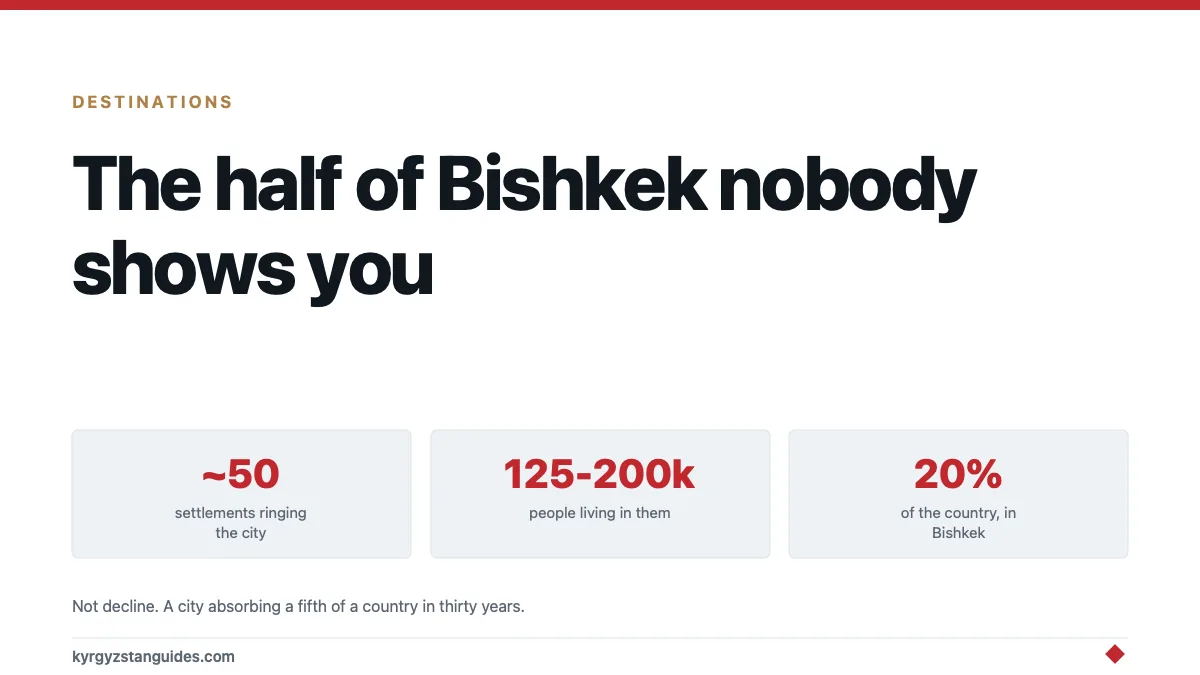
These are the novostroiki, "new buildings", and around fifty of them ring the capital, with a combined population estimated at between 125,000 and 200,000 people.
That is roughly a fifth of Bishkek, and essentially no visitor sees it.
Where they came from
Three waves, each with a cause.
The late 1980s. The Soviet administration began distributing land plots on the edge of Frunze to internal migrants, to relieve a housing shortage. That was official, sanctioned and orderly.
The early 1990s. The Soviet Union dissolved, the collective farms collapsed, rural employment vanished, and people moved to the capital in very large numbers. Much of the land occupation from this period wasn't sanctioned.
After 2005. The Tulip Revolution removed a president and, in the disorder, produced a wave of land seizures on the city's edge. This was the largest wave and it's when the novostroiki took their current form.
Underneath all three is the same fact: Bishkek now houses close to 20% of Kyrgyzstan's entire population, in a country whose other cities are much smaller.
The propiska problem
This is the mechanism that turned migration into a legal category, and it still matters.
The Soviet propiska was a residence registration tying a person to an address. It governed access to services, schooling, healthcare, voting, some employment. It was designed to control internal movement.
Kyrgyzstan inherited it. People who moved to Bishkek without a legal claim to the land they lived on could not register, and unregistered residents struggled to enrol children in school, access clinics, or vote in the city where they actually lived.
The result was a population living physically inside the capital and administratively outside it: the subject of academic work on the propiska and post-socialist urban change in Bishkek.
That has been progressively addressed. Many settlements have been legalised, plots titled and residents registered. The World Bank's study of urban novostroiki settlements sets out where the process stands and what remains.
Who lives there
The demographic data is revealing.
Fewer than 2% of novostroiki residents were pensioners, against 11% of Bishkek residents above working age in the 1999 census.
That is not a slum profile. It is a migration profile: working-age adults and their children, who moved for work, leaving older relatives in the village. The same household structure produced by labour migration to Russia, operating one scale down and one country closer.
There is also a regional dimension that Bishkek residents discuss openly and outsiders should handle carefully. A substantial share of internal migration is from the south and from poorer northern regions, and "novostroika" carries class and regional connotations in the way that such words do everywhere.
What they actually look like
Not what the word "informal settlement" suggests to most people.
Houses, not shacks. Single-storey, brick or block, often built over many years. A family puts up two rooms, lives in them, and adds more when there is money.
Unpaved roads, which in spring become the mud that defines the place.
Patchy services. Water standpipes rather than household connections in some areas; electricity generally present; gas often not, which means coal, which feeds the winter air pollution problem.
Schools under pressure. The single most cited grievance. A school built for a neighbourhood that has quadrupled runs two or three shifts a day.
Real community. Mosques, shops, neighbourhood organisation, and a great deal of mutual support. The toi obligations that structure rural social life travel with people, and a novostroika wedding draws the same three hundred guests a village one would.
Livestock. Sheep and cows in yards inside the capital's boundary, because people who moved from villages brought villages with them.
They are poor, underserved and not dangerous, which is the combination that outsiders find hardest to hold together.
The north-south thing
Worth understanding, because it shapes a lot of Kyrgyz politics and you'll hear it referenced.
Kyrgyzstan divides, in the way people talk about it, into north and south — Chuy, Issyk-Kul, Naryn and Talas against Osh, Jalal-Abad and Batken. The two are separated by mountains, connected by one road, and differ in religiosity, language balance, economy and political alignment.
Internal migration to Bishkek brings southerners into a northern capital, and the discourse around novostroiki is entangled with that. Academic work on how "north" and "south" are perceived in post-Soviet Bishkek examines exactly this.
Two things a visitor should take from it. First, when Kyrgyz people discuss regional origin, they are referencing something real and long-standing rather than being parochial. Second, do not repeat the stereotypes back. You will hear generalisations about southerners in Bishkek and about northerners in Osh, and neither is yours to carry around.
Should you go?
Honestly: not as sightseeing.
There is nothing to see in the sense a visitor usually means, and walking around someone's underserved neighbourhood photographing it's exactly as unwelcome as it would be at home. Poverty tourism is not a thing to do here.
What is worth doing:
Notice them from the road. You'll pass through on the way out of the city toward Ala-Archa, the airport or the road east. Look.
Understand what you're seeing. Not decline. Growth: a city absorbing a fifth of a country.
Connect it to the rest. Every structural thing in these guides shows up here: farm collapse pushing people off the land, education gaps between rural and urban schools, migration as the household strategy, and 2010 as what happens when a political vacuum meets an unresolved grievance.
If you're invited, go. Hospitality here isn't diminished by not having much, and that is a thing worth learning rather than being told.
The heating question is the environmental one. Households in the unconnected massifs burn coal, which is a large part of why Bishkek’s winter air is among the worst of any capital, and why gasification is being pushed so hard.
FAQ
What are novostroiki in Bishkek?
Informal and semi-formal settlements on the edge of the capital, established from the late 1980s onward by internal migrants. Around fifty of them house an estimated 125,000 to 200,000 people.
Why did people move to Bishkek?
The collapse of collective farms in the 1990s removed rural employment, and the capital was the only large domestic labour market. Bishkek now holds close to 20% of the national population.
What is a propiska?
A Soviet residence registration tying a person to an address and governing access to schooling, healthcare and voting. Unregistered novostroiki residents were long excluded from services in the city they lived in.
Are Bishkek's novostroiki dangerous?
No. They are underserved rather than unsafe. The main issues are unpaved roads, patchy water and gas supply, and overcrowded schools.
Can tourists visit the novostroiki?
There is no reason to visit as a sightseer, and photographing an underserved neighbourhood is unwelcome. You will pass through them on the roads out of the city.
Why do novostroiki have so few older residents?
Because they are migration destinations. Fewer than 2% of residents were pensioners, against 11% citywide, working-age adults moved, and older relatives generally stayed in the villages.