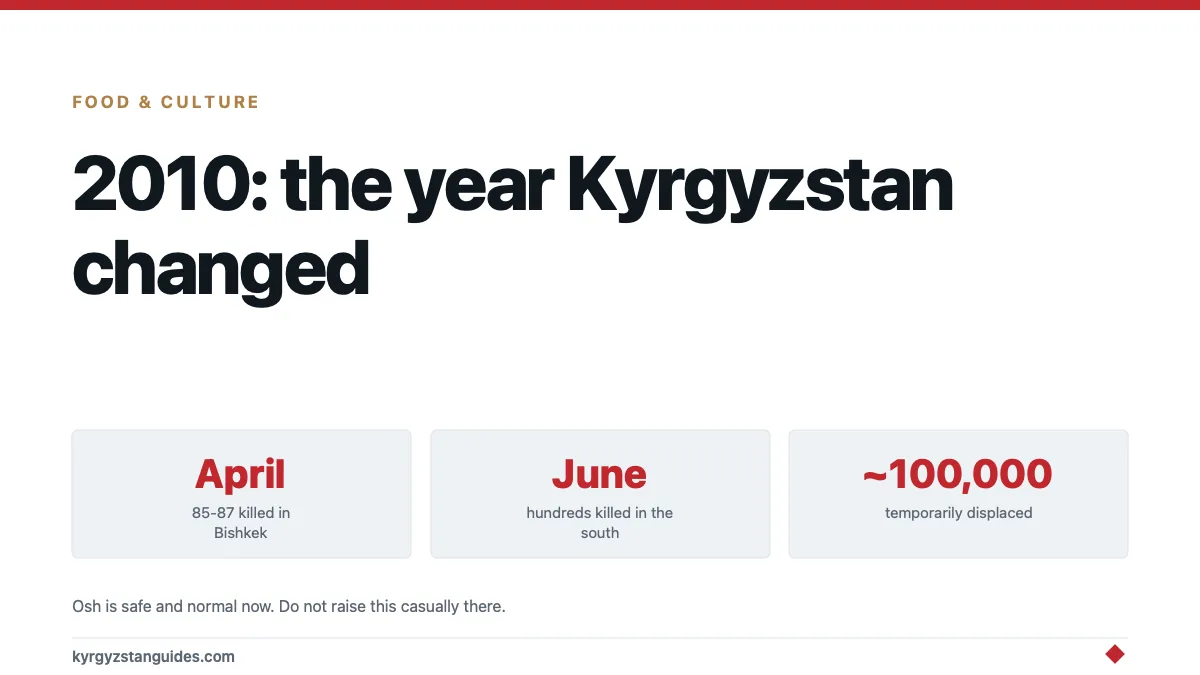
In April 2010 a protest in Bishkek was met with force. Around 85 to 87 people were killed and hundreds wounded. Within days President Kurmanbek Bakiyev had left office and the country had an interim government.
Two months later, in June, violence broke out in the south between ethnic Kyrgyz and ethnic Uzbek communities in and around Osh. Over four days, hundreds of people were killed, thousands were injured, over 2,600 homes were destroyed, and close to 100,000 ethnic Uzbeks fled temporarily across the border into Uzbekistan.
This is the most difficult part of modern Kyrgyz history and it is almost entirely absent from travel writing about the country. It should not be, because it explains things you'll notice in Osh and because visitors sometimes raise it without any idea of what they are raising.
What happened in April
Bakiyev had come to power in 2005, himself through a protest movement that removed his predecessor. By 2010 there was widespread anger over utility price rises, corruption allegations centred on the president's family, and the concentration of state assets.
Protests spread from the regions to Bishkek. On 7 April security forces fired on demonstrators outside the White House. The death toll is generally given as 85 to 87, with around 600 wounded.
Bakiyev left the capital and formally gave up office on 15 April. An interim government under Roza Otunbaeva took over, and Kyrgyzstan subsequently moved to a parliamentary system, the only country in Central Asia to do so.
What happened in June
The June events are harder to summarise responsibly, and anyone who summarises them confidently should be treated with suspicion.
Violence began in Osh on 10 June, after fighting between groups of ethnic Kyrgyz and ethnic Uzbek men escalated. Crowds gathered; crowds from surrounding villages came into the city; Uzbek neighbourhoods and businesses were attacked, looted and burned. It spread to Jalal-Abad. It continued until roughly 14 June.
Death tolls are contested. Official figures were lower; independent estimates have run to around 500 killed. Displacement figures are also disputed, with the immediate cross-border exodus put at close to 100,000 and total displacement estimated far higher.
Human Rights Watch documented the violence and its aftermath in a detailed report, Where is the Justice?, which remains the most careful account available in English. Its central finding about what followed is the uncomfortable one: the investigations and prosecutions that came afterwards fell disproportionately on the Uzbek community, which had also suffered the majority of the deaths and property destruction.
Why the south
Some context that isn't an explanation and should not be mistaken for one.
The Fergana valley is where three countries meet and where Soviet boundaries were drawn through a mixed population. Osh has had a substantial ethnic Uzbek population for a very long time. There had been serious violence in the same region in 1990, at the end of the Soviet period. The Global Centre for the Responsibility to Protect maintains a standing summary of the country's situation, which is a useful corrective to both alarmism and dismissal.
In 2010 a national government had just collapsed, the security services were divided and unreliable, and the south was where the ousted president's support base lay. Whatever else was involved, there was a vacuum of authority in a place with existing tensions and a recent precedent.
What is not a responsible framing: that this was inevitable, or ancient, or a property of the people who live there. Cities live alongside each other for decades and then don't, and the difference is usually political rather than primordial.
What it means today
Osh is a normal, busy, functioning city and has been for many years. Our Osh guide treats it as what it is: the second city, the gateway to the Pamir, and the more interesting of Kyrgyzstan's two big towns.
But some things follow.
Do not raise it casually. You are talking to people who lost family, homes or neighbours, on both sides. It isn't a conversation starter, and asking someone their ethnicity in order to work out which side they were on is as crude as it sounds.
If someone raises it, listen. Do not arbitrate. You'll hear accounts that contradict each other, and both people will be telling you what they experienced.
Read before you go, not while you are there. The HRW report, and openDemocracy's decade-on assessment, will give you more than any conversation will.
Understand the politics you're seeing. The American air base at Manas and its fuel contracts were part of the political weather of that spring, and the interim government reopened those contracts immediately. Kyrgyzstan's parliamentary experiment came directly out of April 2010, and the subsequent consolidation of presidential power came out of what followed. That arc is compressed in our history overview.
Don't photograph memorials without thinking. They exist in both cities. They are not attractions.
Note what the city actually looks like now. Osh's bazaar is one of the oldest continuously operating markets in Central Asia and it functions, daily, as a mixed space. The wholesale trade economy of the south runs through communities on both sides of a division that outsiders often assume is total. It isn't.
Why include this at all
Because the alternative is a guide that presents Kyrgyzstan as uncomplicated mountains and hospitality, and that's a false picture that does the country no favours.
Kyrgyzstan has removed three presidents by protest — 2005, 2010 and 2020. That is a genuinely unusual political culture for the region, and it is often described admiringly from outside as the exception in Central Asia. It has also been costly, and June 2010 is what the cost looked like.
Both things are true. A visitor who knows only the first half isn't informed, and a visitor who knows only the second half won't come at all. Which would be its own kind of error, because this is a safe and welcoming country to travel in and has been for a long time.
FAQ
What happened in Kyrgyzstan in 2010?
Two separate events. In April a crackdown on protests in Bishkek left around 85–87 people dead and led to President Bakiyev's removal. In June, interethnic violence in Osh and Jalal-Abad killed hundreds and displaced very large numbers of people.
How many people died in the June 2010 Osh violence?
Figures are contested. Official counts were lower; widely cited independent estimates put the toll at around 500 killed, with thousands injured and over 2,600 homes destroyed.
Is Osh safe to visit now?
Yes. Osh has functioned normally for many years and is a standard stop for travellers, including as the gateway to the Pamir Highway.
Should I ask people about 2010?
No, not unprompted. Many residents lost family members or homes. If the subject comes up, listen rather than asking questions or taking a position.
Why did the 2010 violence happen in southern Kyrgyzstan?
The immediate context was a collapsed national government and divided security forces. The south has a mixed population in the Fergana valley, borders drawn across communities in the Soviet period, and serious prior violence in 1990.
Did anything change politically after 2010?
Yes. Kyrgyzstan adopted a parliamentary system, unique in Central Asia at the time, under the interim government of Roza Otunbaeva. Presidential power was substantially re-consolidated in later years.