If you fly into Kyrgyzstan you land at Manas. For thirteen years, the same runway you taxi along was the main transit point for the American war in Afghanistan.
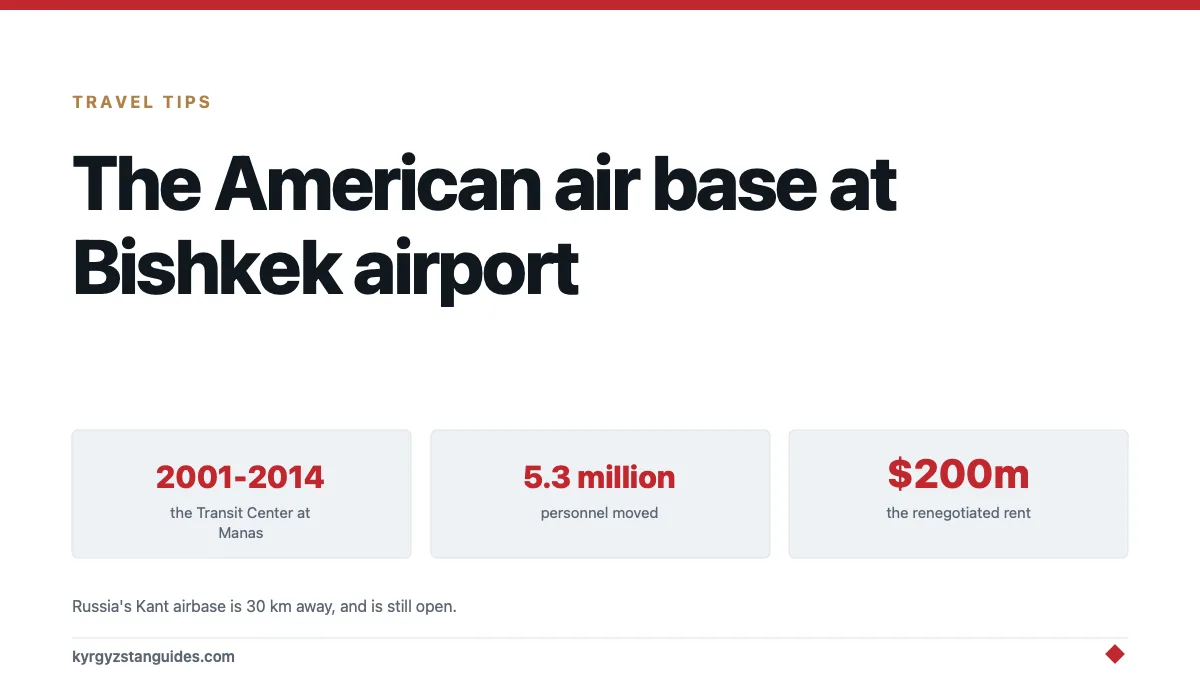
Between December 2001 and June 2014, the Transit Center at Manas moved more than 5.3 million personnel in and out of Afghanistan (over a thousand troops a day) and flew 33,000 air-to-air refuelling missions.
It is gone now, completely, and almost nothing at the airport tells you it was ever there. Our Manas airport guide covers the arrival practicalities; this is the thing underneath them.
How a US base ended up in Kyrgyzstan
After September 2001, the United States needed somewhere within reach of Afghanistan to stage from. Afghanistan is landlocked and surrounded by countries with complicated relationships with Washington.
Kyrgyzstan said yes. The base opened in December 2001, on the civilian airport outside Bishkek, ten years into the country's independence and at a point when its economy needed the money badly.
The scale of the anomaly is worth stating clearly. Russia had. And has. Its own military airbase at Kant, about thirty kilometres away. For over a decade, Russian and American military aircraft operated from bases half an hour apart, in a country of five million people, on former Soviet territory. There is no other example quite like it.
The money
This is what the argument was really about.
The base was a major source of hard currency: rent, fuel contracts, local employment, construction. Fuel supply in particular became notorious, generating a set of contracting arrangements that drew persistent allegations of corruption reaching into Kyrgyz politics.
In February 2009 the Kyrgyz parliament voted to close the base after the two governments failed to agree on higher rent. Negotiations continued anyway, and by June a new arrangement was reached: the US would pay $200 million, roughly three times the previous rent, and the installation was renamed from "Air Base" to "Transit Center", a relabelling that fooled nobody and was not really meant to.
That episode tells you most of what you need to know. The base was leverage, it was understood as leverage by everyone, and it was renegotiated under pressure.
Why it closed
Russia, essentially.
Almazbek Atambayev was elected president in 2011, having assured Moscow that he would shut the base. In June 2013 the Kyrgyz parliament voted to end the lease, and the base closed in June 2014, with the commander handing over a symbolic golden key.
It was the last American military installation in Central Asia. The Diplomat covered the closure at the time and revisited the relationship a decade later, which is the more interesting read: what Kyrgyzstan got, what it gave up, and how thin the bilateral relationship became afterwards.
The incident nobody forgot
On 6 December 2006, a US airman on security duty shot and killed Alexander Ivanov, a Kyrgyz fuel-truck driver, at an entry checkpoint. Ivanov was waiting to complete a security check. The base said deadly force had been used in response to a threat; the Kyrgyz account was that he was shot twice from five or six metres away without cause.
The Kyrgyz foreign ministry demanded that the airman's immunity be lifted. He left the country in March 2007, and Kyrgyz law enforcement reportedly only found out in April. The charge against him was dismissed by the base commander. He was never tried in Kyrgyzstan.
That case did more damage to public support for the base than any rent dispute. The specific grievance, that a foreign soldier could kill a Kyrgyz citizen on Kyrgyz soil and leave, is the kind of thing that outlasts a lease, and it came up repeatedly in the years afterwards whenever the base was debated in parliament.
Jamestown reported at the time that the case put the base itself at risk. It's also a reasonably standard feature of the basing relationships the United States has held elsewhere, from Okinawa to Italy, and the political arithmetic it produces is similarly standard. A detailed analysis of the Transit Center published by a NATO-affiliated centre treats the domestic politics as central rather than incidental, which is the right reading.
What remains
Physically, very little. The facilities were handed to Kyrgyzstan and the airport went back to being an airport. There is no memorial, no museum, no marker.
What remains is in the politics and in people's memories.
The Kant question. Russia's airbase at Kant is still operating, on a long lease. The symmetry ended in 2014; only one side left.
The 2010 revolution. The base and its contracts were part of the political weather of that period. When the president was overthrown in April 2010, the fuel contracts were among the things immediately scrutinised. That history is compressed in our Kyrgyzstan history overview.
The economics. Losing the base cost real revenue in a country that does not have many revenue streams. It also removed a permanent irritant in relations with Moscow. Which of those mattered more is still argued about in Bishkek.
Name confusion. The airport is named for Manas, the hero of the Kyrgyz national epic: not for anything to do with the base. The base took its name from the airport, not the other way round.
Why a traveller should care
It's not a sight. You cannot visit it. But it's useful context for two things you'll actually encounter.
Why Kyrgyzstan is the way it's geopolitically. This is a small, landlocked, mountainous country that spent thirteen years hosting the militaries of two rivals simultaneously, and then chose. That choice explains a lot about current alignment, the visa regime, the labour migration relationship with Russia and the railway being built with Chinese money.
Why people will ask you where you are from, with interest. Americans in particular are still a recognised category here in a way that's neither hostile nor neutral. A great many Bishkek residents worked at the base or knew people who did.
For a country that gets described as remote and untouched, Kyrgyzstan spent the 2000s at the centre of the largest military logistics operation of its era. It happened at the airport you land at.
FAQ
Was there a US military base in Kyrgyzstan?
Yes. The Transit Center at Manas operated at Manas International Airport outside Bishkek from December 2001 until June 2014, supporting US operations in Afghanistan.
How big was the Manas air base operation?
Over its thirteen years it moved more than 5.3 million personnel in and out of Afghanistan, upwards of a thousand a day, and conducted around 33,000 in-air refuelling missions.
Why did Kyrgyzstan close the Manas base?
Primarily Russian pressure. President Atambayev, elected in 2011, had committed to closing it, parliament voted to end the lease in June 2013, and the base shut in June 2014.
How much did the United States pay for Manas?
After a 2009 dispute in which parliament voted to close it, a new deal set rent at $200 million (about three times the previous figure) and the facility was renamed a Transit Center.
Is there still a foreign military base in Kyrgyzstan?
Yes. Russia's airbase at Kant, around thirty kilometres from Bishkek, remains in operation. Manas was the last American base in Central Asia.
Can you visit the old Manas base?
No. The facilities reverted to Kyrgyzstan in 2014 and the site is part of a working international airport. There is no memorial or visitor access.