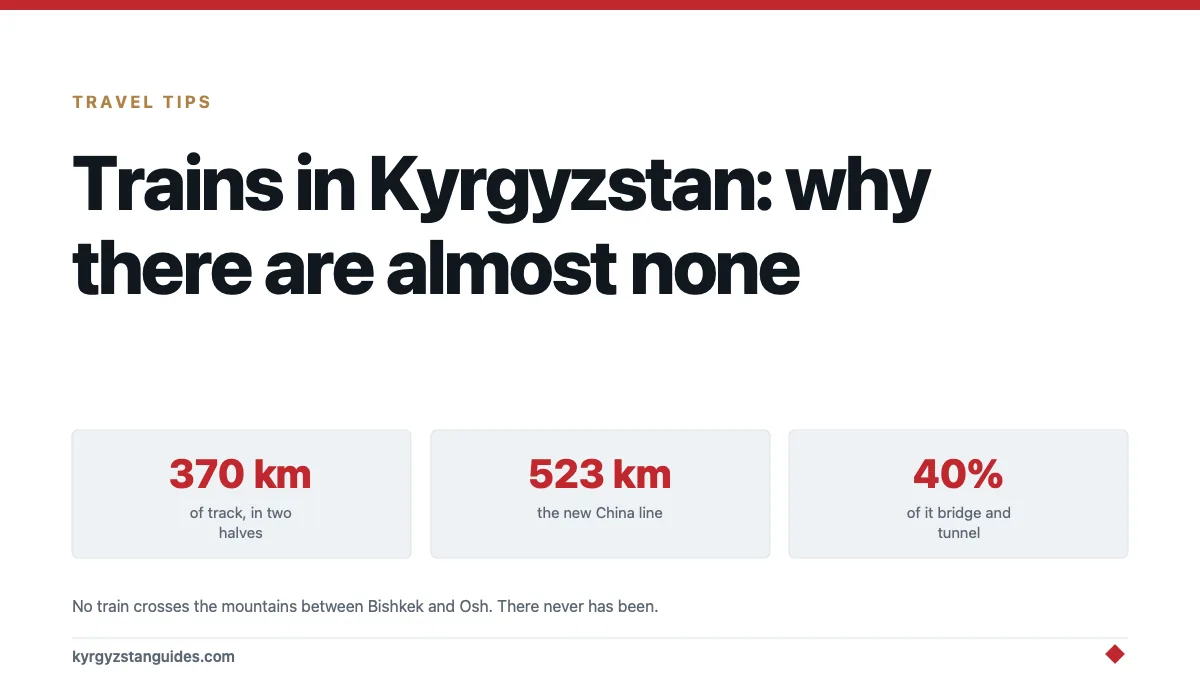
Kyrgyzstan has 424.6 kilometres of railway, split into two sections that do not connect to each other. You cannot take a train from Bishkek to Osh. You can't take a train to Karakol, Naryn, or anywhere in the mountains.
This confuses people who arrive from Uzbekistan, where the high-speed Afrosiyob runs between the big cities and the railway is simply how you get around. Kyrgyzstan is the opposite case, and the reason is a mix of geography, Soviet planning logic, and a border that was drawn in 1991 straight through the middle of a working rail system.
That is now changing, in the most consequential infrastructure project in the country's history.
What exists today
The network is small enough to list.
| Line | Status |
|---|---|
| Bishkek → Kazakhstan border | Operating, broad gauge |
| Bishkek → Balykchy | Passenger service reopened June 2023 |
| Osh area → Uzbekistan border | Operating, separate network |
| Balykchy → Karakeche (186 km) | Under construction since 2022 |
Everything runs on 1,520 mm Russian broad gauge, which matters more than it sounds — it's why the line coming from China will need a gauge change at the border, and why the whole network is oriented toward the former Soviet space rather than southward.
The Bishkek–Balykchy service is the one a traveller might realistically use. It reaches the western tip of Issyk-Kul, and from Balykchy you continue around the lake by road. It's slow, it's infrequent, and it isn't faster than a marshrutka. People take it because it's pleasant, not because it's efficient.
For everything else, the honest answer is that road transport is the transport system here. Our Bishkek to Osh guide exists because there's no alternative to that road.
Why the network is a stub
Two reasons, and both are worth understanding because they explain a lot about the country beyond railways.
The mountains. Around 90% of Kyrgyzstan sits above 1,500 m. Railways dislike gradient. Building one through the Tien Shan means tunnels and bridges rather than track, which is expensive per kilometre in a way that road-building isn't.
The borders. The Soviet network was designed for a country that no longer exists. Lines were laid across the Chüy and Fergana valleys with no regard for republic boundaries, because those boundaries were administrative. In 1991 they became international. The result is a northern network that functionally belongs to the Kazakh system and a southern network that functionally belongs to the Uzbek one, with 300 km of mountains and two customs regimes in between.
The state operator, Kyrgyz Temir Joly, runs 28 stations across a network the TRACECA programme’s country data describes as separate, unrelated lines geographically divided into two sections: 323.4 km in the north, linked to Kazakhstan, and 101.2 km in the south, linked to Uzbekistan. That is the official description, not a critic’s. The CAREC programme’s 2021 railway sector assessment sets out what follows from it: track built to move bulk freight across one large country, left serving two dead ends.
The China–Kyrgyzstan–Uzbekistan railway
Construction was launched at a ceremony in Jalal-Abad on 27 December 2024. This is the project that has been discussed since the 1990s and repeatedly stalled.
The numbers:
- 523 km total — 213 km in China, 260 km in Kyrgyzstan, 50 km in Uzbekistan - $4.7 billion, with financing finalised in December 2025 - Route: Kashgar → Torugart Pass → Makmal → Jalal-Abad → Andijan - 50 bridges and 29 tunnels, together making up 40% of the entire route
That last figure deserves a moment. Four out of every ten kilometres of this railway is either a bridge or a tunnel. That is what building through the Tien Shan actually costs, and it is precisely why the line did not get built for thirty years.
The Torugart Pass is already the crossing point for the road to Kashgar, and anyone who has looked at our border crossings guide will have some sense of the terrain involved.
The other line nobody mentions
While the CKU gets the headlines, a second project has been under construction since 2022: Balykchy to Karakeche, 186 km, heading into the interior from the western end of Issyk-Kul.
Karakeche is a coal basin. The purpose of this line is to move coal out of central Kyrgyzstan without trucking it over passes, which is both expensive and seasonal. It isn't glamorous and it isn't aimed at passengers.
It is, however, the first significant railway Kyrgyzstan has built through its own mountains rather than across a valley floor, and it's a reasonable preview of what the CKU's Kyrgyz section will involve. If you want to know whether the big project is going to work, watch this small one.
What it means, and what people worry about
The stated case is connectivity: a freight corridor from China to Europe that bypasses Russia and Kazakhstan, shortening the route by around 900 km, with Kyrgyzstan collecting transit revenue instead of being routed around.
The concerns raised locally and in regional coverage are real ones:
Debt. $4.7 billion against a Kyrgyz GDP in the low tens of billions. Coverage in The Diplomat has tracked both the progress and the outstanding questions on financing structure.
Gauge. China uses 1,435 mm standard gauge; Kyrgyzstan uses 1,520 mm. Whichever gauge is chosen, something has to be transhipped somewhere, and the choice signals which economic sphere the line ultimately serves.
Labour and benefit. Whether the construction workforce and the eventual operating jobs are Kyrgyz is a live political question rather than a settled one. Global Voices collected the domestic debate around this while the financing was still being negotiated, and the split between optimism and unease hasn't resolved since.
Environment. The route crosses high-altitude terrain that includes pasture and protected areas. Twenty-nine tunnels through the Tien Shan is not a low-impact undertaking.
Will you be able to ride it?
Not soon, and possibly not ever in the way you're imagining.
The CKU is primarily a freight corridor. Passenger service has been discussed but isn't the project's purpose, and the completion timeline for the freight line alone runs into the 2030s.
If you are planning a Kyrgyzstan trip in the next few years, plan it around roads. Shared taxis, marshrutkas and hired drivers will remain the way the country moves, and our getting around Kyrgyzstan is the practical starting point.
What the railway will change, eventually, is Jalal-Abad and the southwest — towns like Jalal-Abad that have been economic backwaters since the Soviet system sustaining them dissolved. Whether that turns out well for them is a different question from whether the track gets laid.
FAQ
Is there a train from Bishkek to Osh?
No. Kyrgyzstan's northern and southern rail networks are not connected, and no line crosses the mountains between them. The journey is by road or by domestic flight.
How long is Kyrgyzstan's railway network?
424.6 km of 1,520 mm broad gauge across 28 stations: a 323.4 km northern section linked to Kazakhstan and a 101.2 km southern section linked to Uzbekistan.
Can I take a train to Issyk-Kul?
Yes, as far as Balykchy at the lake's western end. Passenger service on the Bishkek–Balykchy line reopened in June 2023. You continue around the lake by road.
When will the China–Kyrgyzstan–Uzbekistan railway open?
Construction formally began in December 2024 on a 523 km route with a projected completion in the 2030s. It's designed principally for freight.
How much does the CKU railway cost?
Around $4.7 billion, with the financing agreement finalised in December 2025. Bridges and tunnels account for 40% of the route.
Why doesn't Kyrgyzstan have more railways?
Mountainous terrain makes construction extremely expensive, and the Soviet-era network was designed across borders that became international in 1991, cutting the existing lines into disconnected stubs.