For most travelers, the right move in Balykchy is to change vehicles and keep going. This town at the western tip of Lake Issyk-Kul is a transport junction, not a destination, and there is no shame in treating it as one. That is the honest verdict up front.
But “pass through” isn't the same as “pretend it doesn’t exist.” Balykchy is where nearly every overland route to Issyk-Kul converges — the road from Bishkek through the Boom Gorge arrives here, then splits along the lake’s north and south shores. If you are traveling by shared taxi or marshrutka, you'll likely stand in Balykchy at some point, and knowing how the junction works saves you time and money. This guide explains what the town is, why it looks the way it does, the handful of reasons you might actually stop, and how to use it as the transport hub it really is.
What Balykchy is — and why it looks tired
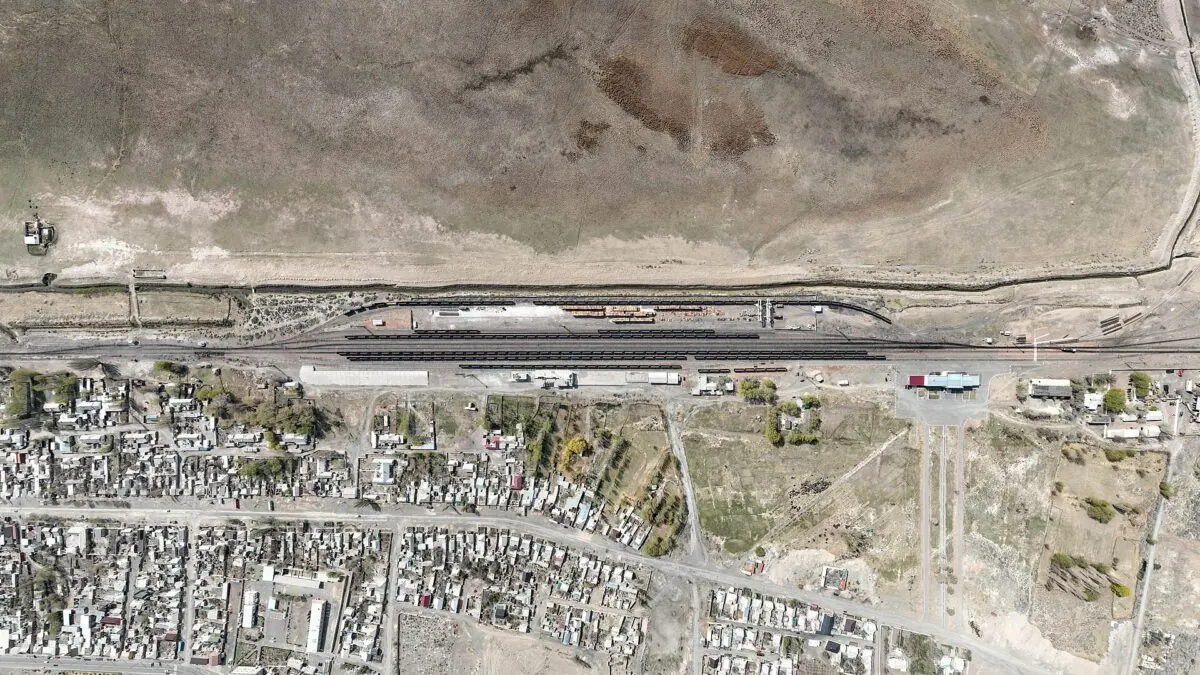
Balykchy (formerly Rybachye, and briefly Issyk-Kul town) sits where the Chu River once joined the lake and where the railway from Bishkek terminates. In Soviet times it was an industrial and fishing port, the name itself comes from the word for “fisherman”, with factories, a working harbor, and a rail link that mattered. The collapse of the Soviet economy hit it hard. Many factories closed, the population shrank, and today the town of 57,837 wears that decline visibly: half-empty industrial lots, weathered apartment blocks, a port that's a shadow of its past. It isn't ugly so much as unpolished, a working town rather than a resort.
That character is exactly why it disappoints people expecting the lake’s holiday face. The resort strip is on the north shore around Cholpon-Ata; the scenic south shore has the canyons and yurt camps. Balykchy is the industrial doorway you pass through to reach either. Understanding that reframes the visit: judged as a resort it fails, but judged as a junction it does its job.
The junction: how transport actually works here
This is the practical heart of any Balykchy visit. The town is the pivot for the whole lake. Coming from Bishkek (about 180 km, 3 to 3.5 hours by marshrutka or shared taxi for roughly 250–350 KGS), you arrive in Balykchy, and this is where routes divide:
- North shore: continue toward Cholpon-Ata and on to Karakol along the developed resort coast
- South shore: branch onto the quieter road past Bokonbaevo, the canyons, and the yurt camps, also ending at Karakol
- Onward south / to Naryn: Balykchy is also a stepping-off point toward the road south into the interior
If you are heading to the south shore specifically, changing in Balykchy is often necessary because through-services are thinner than on the busy north-shore route. Expect to be dropped near the bazaar or the main junction, then to find or negotiate a shared taxi for your onward leg. Fares are informal and seats fill as they fill, so patience helps; morning is the reliable time for onward transport, and by late afternoon options thin out. Because so much of a Kyrgyz trip runs on this shared-transport system, it is worth reading our getting around Kyrgyzstan guide before you rely on it.
Reasons you might actually stop
They are modest, but they exist. If you have an hour between vehicles, the lakeshore on the town’s edge gives you your first real look at Issyk-Kul (the vast, faintly saline alpine sea that never freezes) with the old port and rusting boats making for a melancholy, photogenic scene that the polished resorts cannot offer. The bazaar is a genuine local market, good for stocking up on food and water before a south-shore leg where shops thin out. And railway enthusiasts occasionally come for the terminus itself, the end of the line from Bishkek. That is roughly the full list. None of it justifies a special trip; all of it's fine to fold into a transfer.
For the lake proper, its size, its history, and where to actually swim and stay, our Issyk-Kul travel guide is the place to plan, and it makes clear why Balykchy is not where you linger.
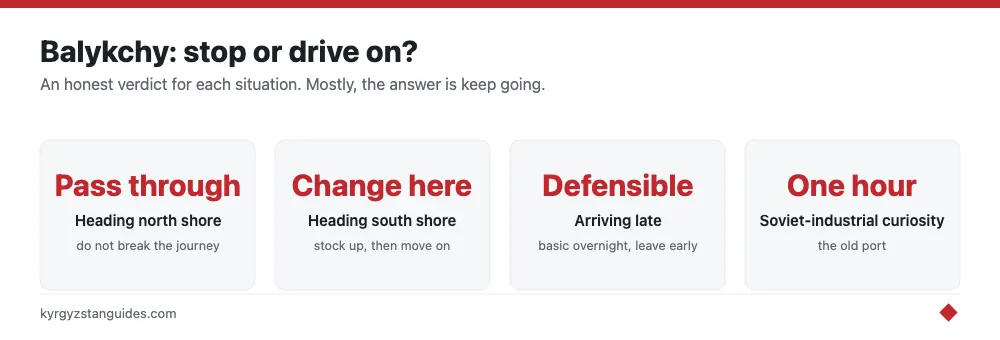
Stop or pass through: a quick decision
| Your situation | Verdict |
|---|---|
| Heading to the north shore / Cholpon-Ata | Pass straight through; don’t break the journey |
| Heading to the south shore / canyons | You’ll likely change vehicles here — stock up, then move on |
| Arriving late in the day | A basic overnight is defensible; leave early |
| Chasing scenery, beaches, or resorts | Not here, keep going to the lakeshore towns |
| Curious about Soviet-industrial decline | An hour by the old port rewards you |
If you do overnight
Sometimes the timing forces it. You arrive late, onward transport has dried up, or you have an early start toward the south shore or the interior. Balykchy has basic guesthouses and simple Soviet-style hotels, generally cheaper than the lakeside resort towns, in the $15–30 range for a room. Do not expect charm or lake views; expect a functional bed and an early exit. Carry cash, as card acceptance is limited and ATMs can be unreliable. Eat at the bazaar or a main-street cafe (lagman, plov, samsa) and turn in, because the reason to be here is to leave in the morning.
Where to go instead
Since Balykchy is a means, not an end, the useful question is where you are pointing it. If you want beaches, boat trips, and the resort scene, continue along the north shore to Cholpon-Ata, the lake’s holiday capital. If you want canyons, yurt camps, quiet, and the wilder side of Issyk-Kul, take the south-shore road toward Bokonbaevo and beyond. And if you're ultimately headed for the mountains, hot springs, and trekking of the eastern lake, everything funnels toward Karakol, the regional base for the best of the range. Whichever you choose, Balykchy’s job is the same: get you moving in the right direction, then get out of your way.
The summer train, which is the actual reason to care about Balykchy
Balykchy is where the railway from Bishkek stops, and for two and a half months a year that makes it worth a deliberate trip rather than a drive-through.
The service is seasonal only. In 2026 it resumed on 5 June, ran Friday to Sunday until 21 June, then daily from 26 June to 13 September. Timings: depart Bishkek-2 at 08:06, reach Balykchy station at 12:12 and Balykchy Beach at 12:37; the return leaves the Beach at 18:40 and gets into Bishkek-2 at 23:11. Operator is the state enterprise Kyrgyz Temir Zholu.
Fares in 2026, cash then cashless: inter-regional 180 / 150 som, luxury 600 / 500, a VIP car 1,000 / 800, a VIP compartment 7,200 / 6,000. Children aged five to ten travel at half price. For the trend, the standard fare was 150 som in 2025, so it has moved.
The reason to take it is the Boom Gorge. The line threads the canyon the Chu has cut between the Kyrgyz and Küngöy Ala-Too, and the 2025 stock included panoramic-window carriages with air conditioning, Wi-Fi and a buffet. As transport it is slower than a shared taxi. As a way to see the gorge it has no competition.
Those dates are year-specific and the 2026 season has already ended. Check the current schedule rather than assuming it repeats exactly.
A town with a bigger role than its reputation
Balykchy has been a city since 1954 and has been called Rybachye and, confusingly, Issyk-Kul before settling on its present name, which comes from the word for fisherman. It covers 19.546 km² and is roughly 90% Kyrgyz and 9.3% Russian.
Its own administration describes it as an important transport hub, and the list is longer than travellers assume: terminus of the Bishkek railway at Rybachye station, base port of the Issyk-Kul shipping company, and the road junction where routes to Bishkek, Karakol, Naryn and the Torugart crossing to China separate.
On the economy, one figure worth having because it cuts against the abandoned-town impression: industrial output in 2025 was 1,636 million som, 117.1% of the previous year. And there is new rail construction — a capsule-laying ceremony on 14 June 2026 marked the start of a Balykchy-Tamchy-Cholpon-Ata line, which would put trains on the north shore for the first time.
What I cannot give you is the decline in numbers. The story that most factories closed in the 1990s is universally repeated, and I could find no official or news statistics quantifying it — no factory names, no employment figures, no job-loss counts. It is visible in the half-empty industrial lots, and it is not documented anywhere I could reach.
FAQ
Is there a train from Bishkek to Balykchy?
Yes, but summer only. In 2026 it ran from 5 June, daily from 26 June to 13 September, leaving Bishkek-2 at 08:06 and returning from Balykchy Beach at 18:40. Dates are set each year, so check rather than assume.
How much does the Bishkek to Balykchy train cost?
In 2026, 180 som cash or 150 cashless for an inter-regional seat, rising through 600/500 for luxury to 7,200/6,000 for a VIP compartment. Children aged five to ten pay half.
Is Balykchy worth visiting?
As a destination, not really. As the railway terminus, the road junction for Karakol, Naryn and Torugart, and the port for Issyk-Kul shipping, it is a place you pass through with a purpose. The train ride through Boom Gorge is the genuine draw.
How big is Balykchy?
57,837 people at the start of 2026 according to the National Statistical Committee, across 19.546 km². It has been a city since 1954 and was previously called Rybachye.
Why does Balykchy look run down?
Soviet-era industry contracted sharply after independence. The scale is not documented anywhere official — no factory names or job figures could be found — but industrial output was still 1,636 million som in 2025, up 17% on the year, so it is not a dead town.
How do you get from Balykchy to the north or south shore of Issyk-Kul?
Routes split in Balykchy itself: marshrutkas and shared taxis continue along the north shore toward Cholpon-Ata and Karakol, or branch onto the quieter south-shore road past Bokonbaevo and the canyons, also ending at Karakol. Coming from Bishkek it is about 180 km and 3–3.5 hours for roughly 250–350 KGS, and heading to the south shore usually means changing vehicles here.