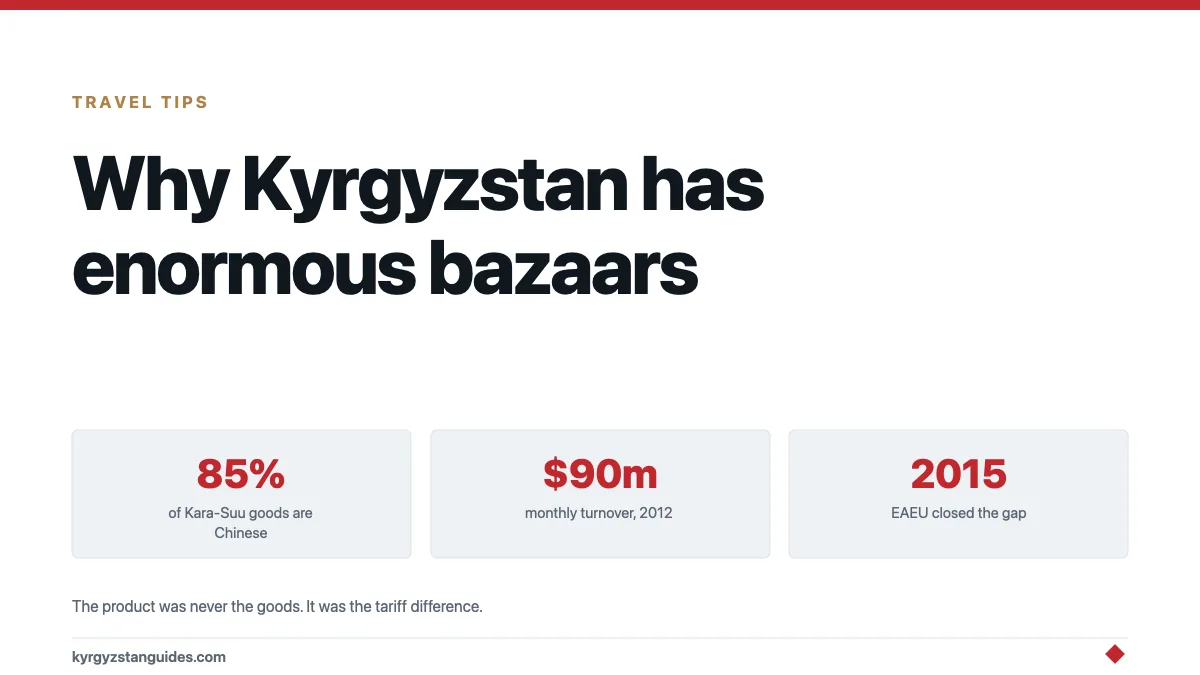
Twenty-three kilometres north-east of Osh there's a market where roughly 85% of the goods come from China, and where monthly turnover was reported at around $90 million as far back as 2012.
Kara-Suu bazaar isn't a tourist market. Neither is Dordoi in Bishkek, which is also the supply hub for the country’s garment workshops and the front line of every attempt to tax the informal economy. They are wholesale distribution hubs, and between them they have been described by economists as one of the two largest economic activities in the entire country.
This is genuinely strange, and once you understand why it happened, a lot of Kyrgyzstan makes more sense — including why the bazaars are shrinking.
The mechanism
Kyrgyzstan makes very little. It has gold, some hydropower, some agriculture, and a great deal of mountain. What it had that its neighbours did not was an open trade policy.
After independence, Kyrgyzstan joined the WTO in 1998, the first post-Soviet Central Asian state to do so, and kept import tariffs low. Uzbekistan, Kazakhstan and Russia did not. Their markets were larger and better protected.
That gap is a business. Chinese goods enter Kyrgyzstan cheaply over the Torugart and Irkeshtam passes, are broken into smaller lots at a bazaar, and are carried onward to Uzbekistan, Kazakhstan, Tajikistan and Russia by traders who do the paperwork, or who don't.
Kyrgyzstan's contribution is the tariff differential and the logistics. Dried morels leave the same way, at a very different price per kilo. That is the whole product.
It's worth being clear about what this isn't. It isn't manufacturing, and it's not adding value in any conventional sense. A container arrives, it's opened, the contents are divided and moved on. The skill involved is real: sourcing, credit, customs, transport, knowing which goods sell in which market in which season — but none of it produces anything.
Economies built this way are fragile in a specific way: they depend on a policy difference between neighbours, and policy differences can be legislated away in an afternoon. Which is exactly what happened.
The two hubs
| Dordoi (Bishkek) | Kara-Suu (near Osh) | |
|---|---|---|
| Faces | Kazakhstan, Russia | Uzbekistan, Tajikistan |
| Scale | Among the largest markets in Central Asia | ~$90m monthly turnover reported in 2012 |
| Structure | Stacked shipping containers, shop below, storage above | Sprawling riverside market complex |
The container architecture at Dordoi is worth seeing on its own terms. Two shipping containers, one on top of the other: the lower one is the shop, the upper one is the warehouse, and there are thousands of them arranged in rows. It is an entire commercial district built out of the transport packaging the goods arrived in.
Kara-Suu sits close to the Uzbek border, which is precisely the point. Our Osh guide covers the city; the bazaar is a short trip out.
Why it is shrinking
Kyrgyzstan joined the Eurasian Economic Union in 2015, alongside Russia, Kazakhstan, Belarus and Armenia.
Membership brought real benefits — above all for the enormous number of Kyrgyz citizens working in Russia, whose legal position improved substantially. But it required adopting the union's external tariff, which is higher than Kyrgyzstan's was.
That closed the gap the whole re-export model ran on. If Chinese goods pay the same tariff entering Kyrgyzstan as entering Kazakhstan, there is no reason to route them through Kyrgyzstan. RFE/RL reported on bazaar traders feeling the squeeze as this came in, and Eurasianet has covered the strategic bind the country's most famous bazaar ended up in: closer to Russia, or closer to China, with the trade model depending on the answer.
This is the real backdrop to the China–Kyrgyzstan–Uzbekistan railway. A country whose transit advantage was erased by a customs union has an obvious interest in building a new transit advantage out of infrastructure.
The resentment underneath
It's worth being aware of, because it occasionally surfaces in conversation.
Chinese goods built these markets and Chinese investment has built a good deal else. Roads, the power plant refit, and now the railway. That dependence isn't universally welcomed. Eurasianet has reported on the resentment that China's economic weight has generated in Kyrgyzstan, and it is a live domestic political issue rather than an academic one.
The complaints are fairly consistent: debt owed to Chinese lenders, projects staffed by imported labour, the sense that Kyrgyz traders are middlemen in someone else's business rather than principals in their own. Whether any of that's fair is a separate question from whether people feel it.
You do not need a position on this. You should just know that if you praise the new road to a taxi driver, you may get a more complicated answer than you expected.
Visiting one
They are worth going to, with the right expectations.
They are wholesale, not retail. Prices are keen because the buyer is usually purchasing a carton, not an item. You can buy one thing and you'll not be refused, but you aren't the customer the place is designed for.
Go early. Wholesale markets do their real business in the morning. By mid-afternoon at Dordoi you are looking at a lot of shutters.
It isn't the place for souvenirs. Manufactured goods, clothing, tools, household items. For felt, silver and craft, see our souvenirs guide — different markets entirely.
Bargaining rules apply but are different. In a wholesale market the price is closer to fixed than it's at a craft stall, because margins are thin and volume is the model. Our bargaining guide covers the etiquette; apply it more lightly here.
Watch your bag. Crowded, busy, and the usual advice applies as it would in any large market anywhere.
Photography: ask. Traders are generally relaxed, but a camera in a wholesale market reads as officialdom rather than tourism.
Why it's interesting beyond shopping
Because it's the clearest visible answer to the question of how this country earns money.
Kyrgyzstan's economy is remittances from migrant workers, gold from one mine, and trade. It's not tourism, which is small, and it isn't industry, which largely left in 1991. When you stand in a bazaar built out of shipping containers, you're looking at the improvised solution a small landlocked state found to being between China and Russia with nothing much of its own to sell.
It also explains the border obsession from a different angle than the Tajik settlement does. Borders here aren't just security lines. They are price differentials, and people live on them.
FAQ
What is Kara-Suu bazaar?
A major wholesale market 23 km from Osh, importing Chinese consumer goods for onward distribution to southern Kyrgyzstan, Uzbekistan and Tajikistan. Around 85% of its goods come from China.
What is Dordoi bazaar?
One of Central Asia's largest markets, on the northern edge of Bishkek, built from stacked shipping containers and oriented toward re-export to Kazakhstan and Russia.
What is the re-export trade?
Importing goods cheaply into Kyrgyzstan under low tariffs and re-selling them into neighbouring markets with higher tariffs. The profit is the difference, plus the logistics.
Why are Kyrgyz bazaars in decline?
Joining the Eurasian Economic Union in 2015 required adopting a higher common external tariff, eroding the price gap that made routing goods through Kyrgyzstan worthwhile.
Can tourists shop at Dordoi or Kara-Suu?
Yes, though both are wholesale markets rather than tourist ones. Go in the morning, expect manufactured goods rather than crafts, and don't expect the experience to be curated.
Where do Chinese goods enter Kyrgyzstan?
Principally over the Torugart and Irkeshtam passes on the Chinese border, from where they are distributed through the bazaar network.