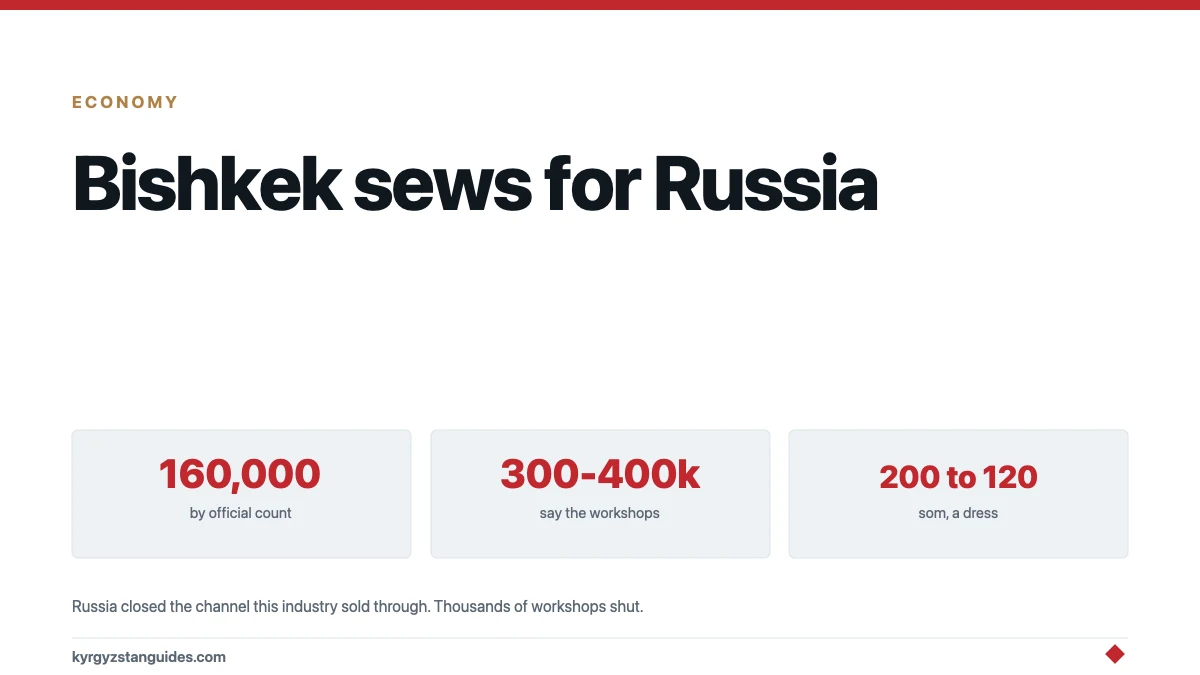
Nobody knows how many people sew clothes for a living in Kyrgyzstan. The National Statistical Committee counts about 160,000 in textiles and garments. The industry's own association says 300,000 to 400,000. A third estimate puts it at 200,000, or 8 to 8.5 per cent of the entire labour force, with over 80 per cent of output produced by individual entrepreneurs working under the patent system.
That gap — a factor of two and a half between the official count and the industry's — is the most honest introduction to the sector there is. The work happens in basements, converted flats and small workshops that may or may not be registered, and the state can only count what registers itself.
What is not in doubt is the scale of what has just happened to it. In 2025 and 2026 Russia closed the channel that this entire industry sold through, and the industry is now in the worst crisis it has faced since independence.
How Bishkek became a garment city
The Soviet Union built Kyrgyzstan real light industry: cotton processing, woven and knitted goods, leather and footwear, garments, carpet weaving. Fabric did not have to come from China because some of it was made here.
That system did not survive the 1990s. Roughly ten large Soviet-era factories were replaced by over a thousand small and medium enterprises, which is the transformation in one sentence. One state plant with a thousand workers became a hundred workshops with ten each. Ilbirs in Bishkek, a Soviet knitwear factory, is described as the last remaining enterprise of its kind still making knitted outerwear and underwear to the old standards.
What replaced the factories was well suited to the market that opened up. Small workshops can change a product line in a week. Labour was cheap. And Dordoi Bazaar, built out of stacked shipping containers on the edge of Bishkek, supplied Chinese fabric wholesale and sold finished garments onward to Russia and Kazakhstan in the same trip. Our post on the re-export economy covers how that mechanism worked.
Roughly 80 to 90 per cent of production is exported, overwhelmingly to Russia, and until recently most of it travelled through informal "cargo" customs schemes rather than formal declaration. Hold onto that detail, because it is the fault line.
The numbers, and why they disagree
Export figures for Kyrgyz garments range from about $150 million to $520 million depending on which customs categories and which year you take. Official statistics committee trade data for 2024 records decorative knitted and textile items at $94.7 million across 55,200 tonnes and knitted fabrics at $56.1 million, with almost the entire volume going to Russia and a negligible share to Kazakhstan. Other sources put 2022 garment exports at $326 million, up from $127.7 million in 2010, and a trade association claims 78 per cent growth over six years.
I am not going to pick one. Any single dollar figure for "Kyrgyz garment exports" is a choice of HS category, and the honest version is that the sector exports somewhere in the low hundreds of millions of dollars and that almost all of it goes to one country.
What Russia did
From September 2025, and formalised through early 2026, Russia shut the cargo route. The changes, as documented by Kloop, came together:
Goods can no longer be declared as personal parcels or non-commercial shipments. VAT of 20 per cent must be paid immediately on import, and only a Russian legal entity can pay it. Quality certificates must now come from Russia-accredited laboratories rather than being issued in Kyrgyzstan. "Chestny Znak" digital marking must be applied at the point of import. A registry called SPOT requires Russian buyers to register expected shipments in advance. And cash and card payments between the parties are out — bank transfers only.
Read that as a list of tasks and it sounds like paperwork. Read it as a description of who can comply and the picture changes: every single one of those requirements needs a registered Russian counterparty, a bank relationship, and formal accounting. A workshop of twelve seamstresses selling through a trader who drove a van to Novosibirsk has none of those things.
The marketplace side closed in parallel. Commissions on Wildberries reached up to 40 per cent, and total costs including advertising and logistics were consuming 70 to 80 per cent of the sale price for Kyrgyz sellers.
The consequences reached the piece rate directly. Payment for sewing a dress fell from 200 som to 120 som. Shirts run 40 to 60 som a garment. Kloop describes workshop closures running into the thousands by winter without giving a precise count, and calls it the hardest crisis the industry has faced since independence.
Before that, 2024 had already shaken it
The current crisis landed on a sector that had just taken a different hit. In May 2024, 64 garment workshops in Bishkek closed within three days following an incident involving migrant workers. By that autumn workshops were still closing, but for the opposite reason — a shortage of workers, because many foreign staff who left did not come back.
The migrant labour question in this sector is more complicated than it is usually presented. Industry figures describe significant numbers of foreign workers, many undocumented, and employers who legally sponsor a worker's visa complain of that worker being poached by a competing workshop offering more money, which creates legal problems for the sponsor. Illegal employment of a foreign worker carries fines of over 70,000 som for the business and from 5,500 som for the worker. An industry association representative attributed part of the problem to shell companies bringing in workers against fraudulent quotas.
One assumption worth correcting: the migrant labour here is often described as Uzbek and Tajik, but 2024 reporting points to significant South Asian labour as well. The sources conflict and I could not resolve the composition.
What the work is like
The ILO's picture of the sector, from before the current crisis: 80 per cent of garment workers are women, and 70 per cent of the textile workforce is under 30. Seamstresses earned 6,000 to 8,000 som a month in peak season, which was several times the national average wage at the time.
And then the part that gets left out of that comparison: only 35 per cent of large factories provided written contracts. In the small informal workshops — basements, private houses — workers reported twelve-hour peak-season shifts in poor ventilation and poor light, with some reporting the loss of 30 to 40 per cent of their eyesight over two to three years.
This sector is not a sweatshop story imported from somewhere else. It genuinely paid above average, and it genuinely did so under conditions that the country's own labour institutions have documented as harmful.
There is precedent for the current shock, too. In the 2008–2009 crisis, demand in Russia and Kazakhstan fell 40 per cent and 20 per cent of garment factories had closed by February 2009, mostly the smaller ones. Before that crisis the sector had been growing at about 125 per cent a year since 2006.
The tax carve-out
Kyrgyzstan abolished patent-based taxation for general trading from 1 January 2024. The garment sector was carved out and kept.
More than kept, in fact: garment entrepreneurs were exempted from profit tax, VAT and sales tax until 1 January 2027, with an alternative unified tax of 0.25 per cent of revenue in place of those three. Enterprises with more than 50 employees also had their insurance contribution rate cut from 27.25 per cent to 12 per cent.
A quarter of one per cent of revenue is close to no tax at all, and it is a measure of how seriously the state takes this sector's employment numbers. It also tells you the state knows the sector cannot bear formal taxation and stay competitive.
Fabric, wool, and the thing that does not connect
Around 90 per cent of raw material is imported from China, by most estimates — a figure I could not attach to a primary source, so treat the precise percentage as approximate. It arrives through Dordoi and the trade routes our Osh Bazaar and Dordoi coverage describes.
Meanwhile Kyrgyzstan produces a great deal of sheep's wool that mostly has no buyer. Most goes out unprocessed or goes unsold, because the processing capacity was part of what the 1990s took. The arithmetic that ought to work — a country with millions of sheep and a large garment industry — does not, because the industry sews Chinese synthetics into fast fashion for Russian marketplaces and has no use for domestic coarse wool. Our post on the Kyrgyz wool problem goes into it.
There is movement at the margin. A company called Wool KG buys around 400 tonnes of wool a year from farmers in Issyk-Kul, Naryn, Talas and Chui and plans to expand processing with 50-plus new jobs. Against nine million hectares of pasture, that is a start and not a solution.
The sanctions layer
In 2026 the European Union sanctioned Kyrgyzstan for the first time, in its twentieth package, over the re-export of dual-use goods to Russia. The measures ban export to Kyrgyzstan of European CNC machine tools and telecoms equipment including routers and switches. Kyrgyzstan was reportedly the first former Soviet republic sanctioned this way.
That does not target garments. But it is the same underlying fact — that Kyrgyzstan functions as a conduit into the Russian market — being squeezed from the opposite end at the same time.
Where you can see it
Dordoi Bazaar, on the northern edge of Bishkek, is the place. It is a city of stacked shipping containers, the largest wholesale market in Central Asia, and Kyrgyz-made clothing sells there alongside Chinese and Turkish imports. Bishkek's malls and smaller bazaars carry local production too, usually without labelling it as such.
Named Kyrgyz brands that export include Tumar Art Group, which grew from a felting co-operative into a shoe factory shipping thousands of pairs a month, plus Chapansar, Oimok Art, GB Concept, Sherden and Altai Osmo. That list comes from secondary industry compilations rather than primary data, so read it as indicative. There is also a Bishkek Fashion and Textile trade exhibition covering the full range from fabric and yarn to finished garments.
If you buy a shirt in Bishkek, ask where it was sewn. A good share of the time the answer is a workshop within a few kilometres, and in 2026 the honest follow-up question is whether it is still open.
FAQ
How big is Kyrgyzstan's garment industry?
The official count is about 160,000 workers in textiles and garments, while the industry association estimates 300,000 to 400,000, and a third estimate says 200,000 or roughly 8 per cent of the labour force. The gap exists because most production comes from small workshops and individual entrepreneurs under the patent system, many unregistered.
Where do Kyrgyz clothes get sold?
Russia, almost entirely, with a small share to Kazakhstan. Around 80 to 90 per cent of production is exported, and official 2024 trade data shows almost the whole volume of knitted and textile goods going to Russia.
Why is the Kyrgyz garment industry in crisis in 2026?
From September 2025 Russia closed the informal "cargo" customs channel the sector sold through, requiring 20 per cent VAT paid by a Russian legal entity on import, certification from Russia-accredited labs, Chestny Znak digital marking at import, advance registration of shipments in the SPOT registry, and bank transfers only. Small workshops cannot meet those requirements, and thousands have closed.
What do garment workers in Kyrgyzstan earn?
Before the current crisis, seamstresses earned 6,000 to 8,000 som a month in peak season, several times the national average wage at the time. Piece rates have since fallen — payment for sewing a dress dropped from 200 som to 120 som, and shirts pay 40 to 60 som per garment.
Does Kyrgyzstan use its own wool or cotton for clothing?
Barely. Around 90 per cent of raw material is imported from China. Kyrgyzstan produces a lot of sheep's wool but most of it goes unprocessed or unsold, because the Soviet-era processing capacity did not survive the 1990s and the garment sector works with imported synthetics instead.
Does the garment sector pay tax in Kyrgyzstan?
Very little, by design. Garment entrepreneurs were exempted from profit tax, VAT and sales tax until 1 January 2027, with an alternative unified tax of 0.25 per cent of revenue, and larger enterprises had insurance contributions cut from 27.25 to 12 per cent. Patent-based taxation was abolished for general trading in 2024 but kept for this sector.
Where can I buy Kyrgyz-made clothing in Bishkek?
Dordoi Bazaar on the city's northern edge is the main place, a vast market built from stacked shipping containers where local production sells alongside Chinese and Turkish imports. City malls and smaller bazaars also carry Kyrgyz-sewn garments, though usually without identifying them as local.