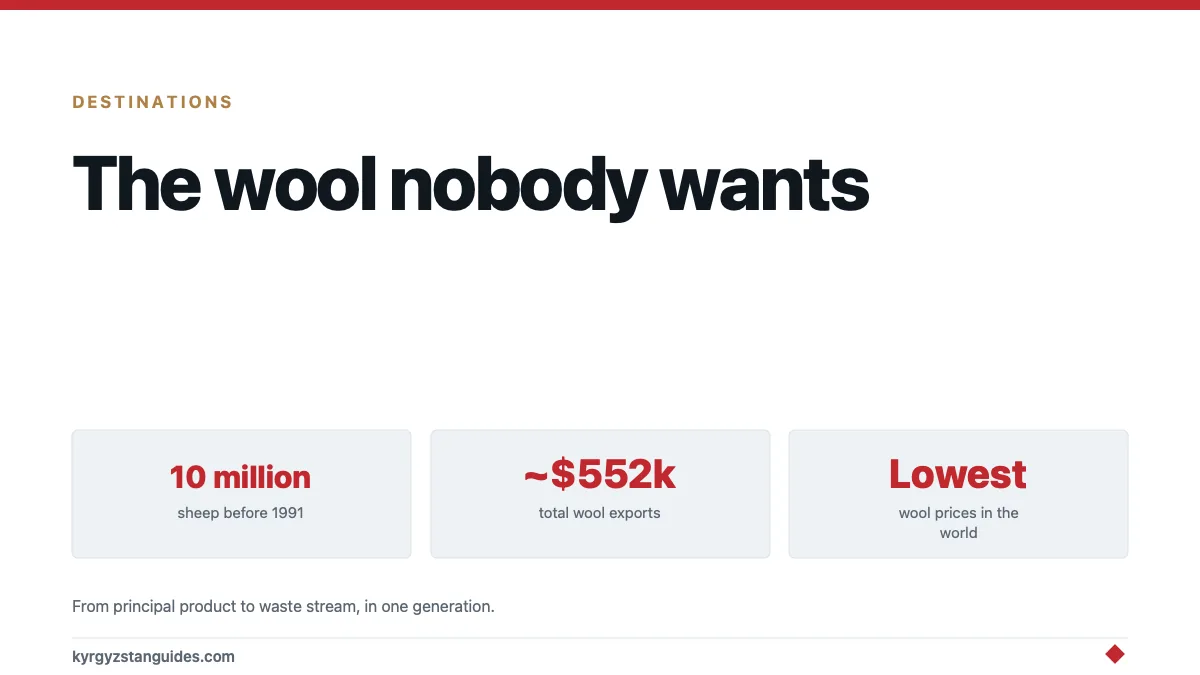
Shortly before the Soviet Union collapsed, Kyrgyzstan had around 10 million sheep. Wool was one of the two things the republic had been assigned to produce for the whole union.
Today the flock is roughly half that, and the wool is close to worthless.
Kyrgyz wool exports fell from about $864,000 in 2021 toward roughly $552,000 by 2026 — figures so small for a national commodity that they read like a misprint. Kyrgyz wool prices were among the lowest in the world in 2023, and market analyses project continued decline rather than recovery.
In some villages, shearing produces a pile that nobody comes to buy, and it's burned or left.
Tobacco tells the same story with different numbers. This is the single starkest illustration of what happened to this economy after 1991, and you will walk past the evidence constantly.
What the Soviet system built
Central planning assigned the Kyrgyz SSR wool, low-grade cotton and livestock. That was the republic's job.
To do it, the state built the whole chain: breeding programmes producing fine-wool sheep, veterinary services, shearing brigades, collection points, washing and scouring plants, and: crucially, a guaranteed buyer at a guaranteed price.
Nobody had to find a customer. The wool went into the union's textile industry, which was elsewhere.
What broke
Everything downstream of the sheep.
The buyer vanished. The textile mills were in other republics, which became other countries with their own currencies and tariffs.
The processing left. Which is why the country’s large garment industry sews imported Chinese fabric rather than domestic wool. Washing and scouring wool is an industrial operation. Those plants largely didn't survive the 1990s, and without them Kyrgyzstan can only sell greasy wool, the lowest-value form of the commodity.
Quality fell. The fine-wool breeding programmes depended on the same institutional structure as everything else. A Kyrgyz assessment of sheep and wool production sets out the technical decline in fibre characteristics that followed. As the collective farms disintegrated and flocks fragmented into household ownership, selective breeding stopped and the fleece coarsened.
Distance became decisive. ODI's work on Kyrgyz sheep herders at the crossroads identifies the combination bluntly: remote producers, no local purchasing power, and low wool quality. A buyer will not drive to a high valley for a small quantity of coarse greasy wool.
So the price at the farm gate fell below the cost of getting it to a buyer, which is the definition of worthless.
What herders do instead
Sheep are still the centre of the rural economy. They are just a meat economy now, not a wool one.
An animal is raised for meat, for the toi that will consume it, for sale at the animal market, and for dairy. The fleece is a by-product that comes off once a year because the animal needs shearing, not because anybody wants it.
That inversion (wool from principal product to waste stream) happened inside a single generation.
The environmental cost of worthless wool
There is a second-order effect that nobody planned and it is worse than the economics.
If wool is worthless, the only reason to keep a sheep is meat. If the only reason is meat, the incentive is more sheep, not better ones. Because you are paid by the head rather than by fleece quality.
That is a direct driver of overstocking on pasture that's already under pressure. Around 94% of Kyrgyz rangeland has been degraded in at least one season, as our piece on yak herding and pasture sets out.
Under the Soviet system, wool value gave a reason to invest in fewer, better animals. Removing that value removed the brake.
There is a further twist. Coarse wool from poorly bred sheep is worth less, which pushes herders further toward quantity, which degrades pasture, which produces thinner animals with worse fleece. It's a loop, and nobody inside it is making an unreasonable decision.
The craft exception
There is one route that works, and it's small.
Felt. Shyrdak and ala-kiyiz carpets are made from local wool, and felting doesn't require industrial washing. It can be done by hand by the people who own the sheep.
That is why craft cooperatives matter economically and not only culturally. A shyrdak sold at a fair price converts a few kilos of otherwise unsellable wool into a meaningful amount of money for a rural household, without any of the missing infrastructure.
It is also why those crafts are on UNESCO's urgent safeguarding list rather than the ordinary one: the practitioners are ageing, synthetic carpets are cheaper, and good raw wool, counterintuitively, in a country drowning in it, is hard to source in the quality required.
Why this keeps happening here
Because it's the same shape as everything else.
Medicinal herbs leave as raw plant matter because the processing plants went. Gold leaves as ore. Labour leaves as people. Wool leaves, barely: as greasy fleece.
The recommendation in every analysis is identical and obvious: process it here. The obstacle is identical too: processing needs capital, certification and a reliable power supply, and the country has limited amounts of all three.
Our piece on yak herding covers one partial answer. Yak wool is a genuinely premium fibre with an international market, produced in small quantities by households at altitude — a high-value product rather than a bulk commodity, which suits a country that cannot compete on bulk.
What a visitor can do about it
Not much, and the little there is matters.
Buy felt, and pay properly. A shyrdak, an ala-kiyiz, felt slippers, a kalpak. Our souvenirs guide covers what's worth buying.
Buy through cooperatives where you can, so the maker is paid rather than a middleman.
Do not haggle hard on handmade felt. The hours in a shyrdak are not reflected in the asking price to begin with.
Ask what it's made of. Synthetic-blend "felt" souvenirs exist. Real wool felt is heavier, smells faintly of lanolin and does not squeak.
Notice the piles. In a village in early summer, the heaps of fleece by the roadside are not waiting for collection. That is the story in one image.
FAQ
What happened to Kyrgyzstan's wool industry?
The Soviet system that provided breeding programmes, processing plants and a guaranteed buyer collapsed after 1991. Without washing and scouring capacity, only low-value greasy wool can be sold, and prices fell below the cost of transport.
How many sheep does Kyrgyzstan have?
Roughly half the peak of around 10 million reached shortly before the Soviet Union dissolved.
Is Kyrgyz wool valuable?
No. Kyrgyz wool prices were among the lowest in the world in 2023, and national wool exports are measured in the hundreds of thousands of dollars.
What do Kyrgyz herders raise sheep for now?
Meat and dairy, plus sale at livestock markets. Wool has become a by-product of shearing rather than a product in its own right.
Why does felt-making matter economically?
Felting can be done by hand without industrial processing, so it converts otherwise unsellable local wool into income for rural households. Buying shyrdak and ala-kiyiz at a fair price is the practical support available.
Is there any high-value wool in Kyrgyzstan?
Yak wool has a genuine premium international market, produced in small quantities by high-altitude households, which suits an economy that can't compete in bulk commodities.