In the back of a yurt, behind where the guests of honour sit, there is usually a large embroidered panel on the wall. Deep colours, dense stitching, borders within borders, animals and horns and stylised flowers worked across a cloth ground.
That is a tush kyiz, and somebody's grandmother probably spent a very long time on it.
It's the most valuable textile in a traditional Kyrgyz household and the one visitors most often mistake for decoration.
What it is, and what it isn't
The distinction matters and is constantly confused.
| Item | What it's |
|---|---|
| Tush kyiz | Embroidery on a cloth ground, hung on the wall behind the place of honour |
| Shyrdak | Felt floor carpet, made by cutting and inlaying two contrasting felts |
| Ala kiyiz | Felt rug made by rolling coloured wool into the felt as it's made |
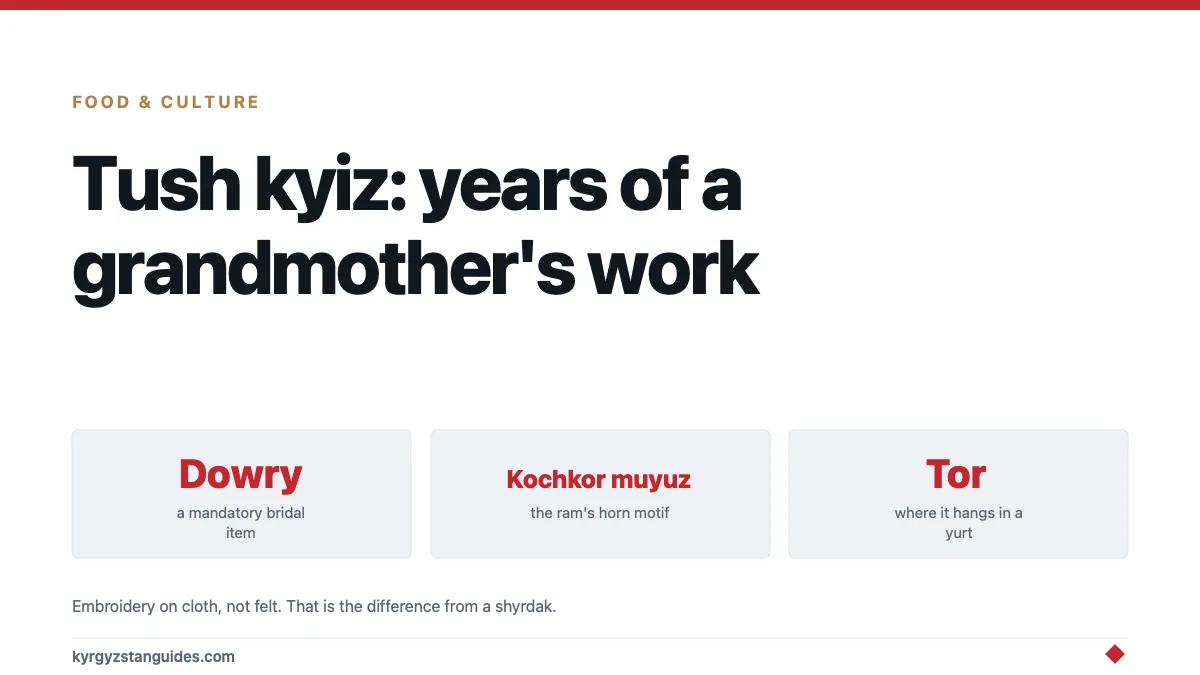
Shyrdak and ala kiyiz are felt, made from wool, on the floor. Tush kyiz is needlework on fabric, on the wall. Our shyrdak guide covers the felt side; this is the other craft entirely.
They are all part of the same household textile system and none of them is ornament in origin. In a felt tent, textiles are the walls, the floor, the insulation and the status display.
The marriage connection
A tush kyiz is made to mark a wedding.
The traditional practice: a grandmother, or the older women of a family, make one to commemorate the marriage of a grandchild. It was a mandatory item in a bride's dowry, and it went with her.
Think about what that means practically. A large, densely embroidered panel represents months or years of intermittent work. Starting one is a statement that a marriage is anticipated. Completing one is a transfer of a serious asset between families.
This sits alongside the other exchanges covered in our wedding customs guide, and it is the one that takes the longest to produce.
Reading the patterns
The motifs are not random and most have names. Learning half a dozen changes what you see.
Kochkor muyuz: ram's horn. The single most common motif in all Kyrgyz decorative art. A pair of opposed spirals, representing wealth, protection and abundance, because wealth was sheep.
Karga tyrmak. Crow's claw. A hooked, clawed form.
Aichyk — the moon. A crescent element, part of a set of motifs connected to older cosmological ideas.
Beyond those: flowers, plants, running water, stylised birds, and abstract forms whose names vary by region and by family. The encyclopaedic record of saima embroidery and tush-kiiz catalogues the technique and the vocabulary.
Ask the maker or the owner what a motif is called. This is a good question and people enjoy it, and you will frequently be told something that isn't in any book.
One thing worth noticing: the same ram's horn appears on felt carpets, on wooden chests, on the kalpak, on silver jewellery and carved into doorframes. It isn't a textile motif that spread to other objects. It's a single visual vocabulary applied across everything a household owned, which is what you would expect from a culture where one family made most of its own goods.
Where it hangs, and why that spot
Position inside a yurt isn't casual. A yurt has a fixed internal geography, and the tush kyiz marks the most important part of it.
The tör is the section opposite the door, at the back. It's where guests of honour are seated, where the family's valuables and bedding are stacked, and where the household displays what it has. A tush kyiz hangs there.
Everything in that structure is organised — men's equipment on one side, women's and kitchen equipment on the other, the hearth in the middle under the tunduk. If you are seated at the back of a yurt facing the door, you have been given the place of honour, and the embroidery behind you is the household's best object.
Buying one
They are genuinely worth buying, with caveats.
Old versus new. Antique pieces have natural dyes, hand-spun thread, wear, and considerably more work in them. New ones use commercial thread and often synthetic fabric. Both are legitimate; the price difference is large and so is the quality difference.
Price reflects hours. A large hand-embroidered panel that took months isn't a $30 item. If it's priced like one, it is machine work or it was made fast for the tourist trade.
Where to buy. Craft cooperatives and women's collectives in Kochkor, Karakol and Bishkek. Buying through a cooperative means the maker is paid properly, which is the same logic as the community tourism model.
Antique export is regulated. Genuinely old textiles may require documentation to take out of the country. Ask the seller directly, and get whatever paperwork exists.
They are large. A full tush kyiz is a wall hanging, not a scarf. Plan your luggage. Our souvenirs guide covers the smaller options.
Why the craft is at risk
The usual mechanism, and it isn't the one people expect.
Nobody is banning it. The problem is that the work is enormously time-consuming and the market price doesn't reflect the hours. A woman who can earn more doing almost anything else will, rationally, do almost anything else.
Felt carpet-making faced exactly the same pressure and got a degree of protection through UNESCO recognition. Ala-kiyiz and Shyrdak were inscribed in 2012 on the list of intangible heritage in need of urgent safeguarding — not the ordinary Representative List, but the one for practices that may not survive.
UNESCO's own assessment of why is worth quoting in substance: the number of practitioners is falling, most are over forty, there is little state support, younger women aren't taking it up, cheap synthetic carpets dominate the market, and good raw wool is hard to get.
Every one of those applies to embroidery too, and embroidery has had less of the attention.
It survives because older women still do it, and because cooperatives have created a route to sell it at something closer to a fair price. UNESCO has run preservation and promotion work on the felt carpets specifically to reconnect makers with markets, which is the model that works.
Buying one at a proper price is the whole intervention. There is not much else a visitor can do.
FAQ
What is a tush kyiz?
A large embroidered wall hanging made in Kyrgyzstan and Kazakhstan, traditionally by older women to mark the marriage of a grandchild and included in a bride's dowry.
What is the difference between a tush kyiz and a shyrdak?
A tush kyiz is embroidery on cloth, hung on a wall. A shyrdak is a felt carpet made by cutting and inlaying contrasting felts, used on the floor.
What do the patterns mean?
Common motifs include kochkor muyuz (ram's horn, for wealth and protection), karga tyrmak (crow's claw) and aichyk (moon), alongside flowers, plants and animals.
Where does a tush kyiz hang in a yurt?
On the tör, the section opposite the door at the back, where guests of honour are seated and the household's valuables are displayed.
How much should a tush kyiz cost?
Enough to reflect months of hand embroidery. Very cheap pieces are machine-made or produced quickly for the tourist market. Buy through a craft cooperative where possible.
Can I take an antique textile out of Kyrgyzstan?
Genuinely old pieces may require export documentation. Ask the seller and obtain whatever paperwork is available before buying.