Almost every yurt stay, homestay and horse trek you book in Kyrgyzstan traces back to a decision made in one small town in May 2000.
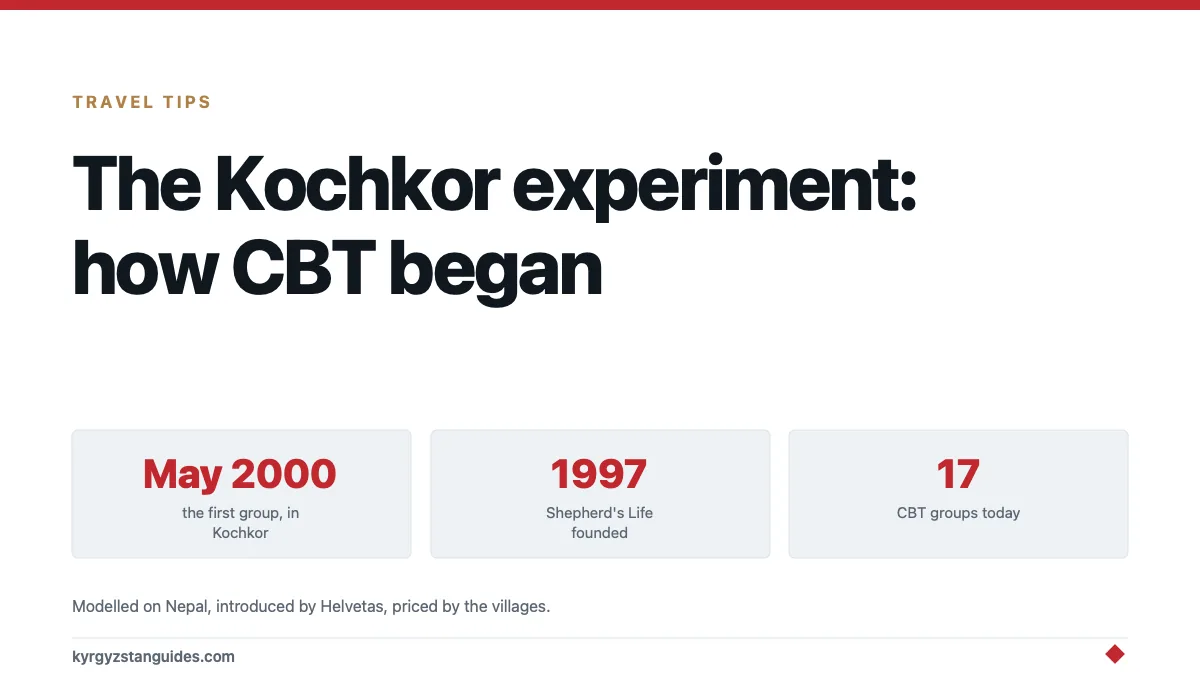
That month, the first community-based tourism group in the country was set up in Kochkor, modelled on something that had been working in Nepal. By 2003 there were ten such groups, which formed an association. Today there are around seventeen, covering most of the country.
This is why Kyrgyzstan's tourism feels different from its neighbours', and it's worth understanding before you book anything.
What came before
Very little, and what existed wasn't for you.
Soviet tourism in the Kyrgyz SSR meant sanatoria on Issyk-Kul and mountaineering expeditions to Khan Tengri and Pik Lenin. Both were organised, allocated and state-run. Independent travel was not a category.
After 1991 that system collapsed along with everything else. What remained was a country with extraordinary mountains, a culture still practising seasonal herding within living memory, and no tourism industry whatsoever.
The Helvetas intervention
The Swiss development organisation Helvetas was working in Kyrgyzstan on agricultural and rural advisory programmes. In 1997 it helped establish an ecotourism association called Shepherd's Life, whose proposition was simple: a traveller spends a night in a yurt with a herding family.
That is the origin of the thing you are probably here to do.
In May 2000 the first proper CBT group was formed in Kochkor. The model was deliberately borrowed from Nepal, where community-based trekking tourism was already well established.
The design principle matters. A CBT group is a local association of service providers, guesthouse owners, drivers, guides, horse owners, yurt camp families, who set their own prices, take bookings through a shared office, and keep the money locally. The coordinating office takes a small commission to run itself. There is no foreign tour operator taking the margin.
Groups trained with Helvetas, and in 2003 ten of them formed the Kyrgyz Community Based Tourism Association, which still coordinates them. Their own account of the history sets out the sequence, and academic work mapping the location of CBT groups across the country captured the network as it stood in 2003.
Why it worked here
Three things lined up.
The product already existed. Kyrgyz families were already spending summers on the jailoo with animals and already had a hospitality obligation toward guests built into the culture. CBT didn't have to invent an experience; it had to add a booking system and a price.
Nobody else was serving the market. There were no hotels in Kochkor, Sary-Mogol or Jyrgalan. The alternative to a homestay was nothing.
The barrier to entry was near zero. A family needed a spare room, bedding and the ability to cook. That is a business a rural household can actually start, which isn't true of most development interventions. A case study of the programme framed it in exactly those terms: value created for participants who had no capital to invest.
The result is that Kyrgyzstan built a tourism industry from the bottom rather than the top — the opposite of the resort-first model applied in a lot of the world, and a large part of why the country has a reputation among independent travellers that its visitor numbers do not really justify.
What the visa decision did
CBT built the supply. A separate decision built the demand.
Kyrgyzstan introduced visa-free entry for citizens of a long list of countries. The change that turned it from a place requiring letters of invitation and agency handling into a place you could simply fly to. For independent travellers that removed the last structural reason to book through a foreign operator, and it is the reason the country became a fixture on Central Asia overland routes while its neighbours were still processing paperwork.
The two things reinforced each other. Visa-free entry brought people who could not have afforded an organised tour; CBT gave them somewhere to stay when they arrived in a town with no hotel. Neither would have worked nearly as well alone.
Our visa guide covers the current position, which does change and should be checked rather than assumed.
What it means for your booking
Practical consequences, because this isn't just history.
Prices are set locally and are broadly standard. In a CBT area you will find homestay, meal and horse rates that barely vary between families. That is deliberate: it stops undercutting and it means nobody loses out for being further from the office.
The office allocates fairly. A CBT coordinator generally rotates bookings between families rather than sending everyone to the best-known one. If you insist on a specific house, you may be working against that.
Booking direct is fine and often better. Many guesthouses now take direct bookings, WhatsApp messages and online reservations. That is not a betrayal of the model; it's the model maturing.
Not everything branded "CBT" is a CBT group. The term has been widely adopted. The association's own network is one thing; a hostel using the words is another. Check who you're actually paying.
Standards vary and that's the deal. A homestay is somebody's house. Hot water may be a bucket, the toilet may be outside, and the food will be what the family eats. If you want a hotel, book a hotel — our Issyk-Kul accommodation guide covers the range.
Where to use it
The network is strongest exactly where you would want it.
Kochkor. Where it started, and the gateway to Song-Kul. Also the centre for shyrdak felt workshops.
Jyrgalan and Karakol for trekking in the east.
Sary-Mogol and Alay for Pik Lenin and the southern mountains.
Arslanbob for the walnut forests.
In each case the local office can arrange a driver, horses, a guide and a bed, usually on a day's notice, at a price that's written on a board on the wall.
The honest assessment
CBT isn't a perfect system and it is worth saying so.
Quality is uneven, because it's a network of households rather than a managed chain. English is patchy. Some offices are far more active than others. And there is a real tension between the rotation principle and the reality that travellers now read reviews and choose.
There is also a structural point. Tourism remains small in Kyrgyzstan: very small next to labour migration and remittances. CBT hasn't transformed the rural economy. What it has done is create an income stream that stays in the village, and that's a narrower and more defensible claim.
Twenty-five years on, it remains one of the more genuinely successful development projects anywhere, mostly because it was designed around something people were already doing.
FAQ
What is community-based tourism in Kyrgyzstan?
A network of local associations in which guesthouse owners, drivers, guides and yurt camp families set their own prices, take bookings through a shared local office, and keep the income in the community.
When did community-based tourism start in Kyrgyzstan?
The first CBT group was formed in Kochkor in May 2000, following the Shepherd's Life ecotourism association established with Helvetas support in 1997.
Who set up CBT in Kyrgyzstan?
The Swiss development organisation Helvetas introduced the model, borrowing from community-based tourism in Nepal. Ten groups formed the Kyrgyz Community Based Tourism Association in 2003.
How many CBT groups are there?
Around seventeen actively operating groups, covering most regions of the country.
Is CBT cheaper than a tour operator?
Usually, because there's no intermediary margin. Prices are set locally and are fairly standard within each area.
What should I expect from a CBT homestay?
A room in a family home, meals with the household, and basic facilities — often an outside toilet and limited hot water. Standards vary by family; that's inherent to the model.