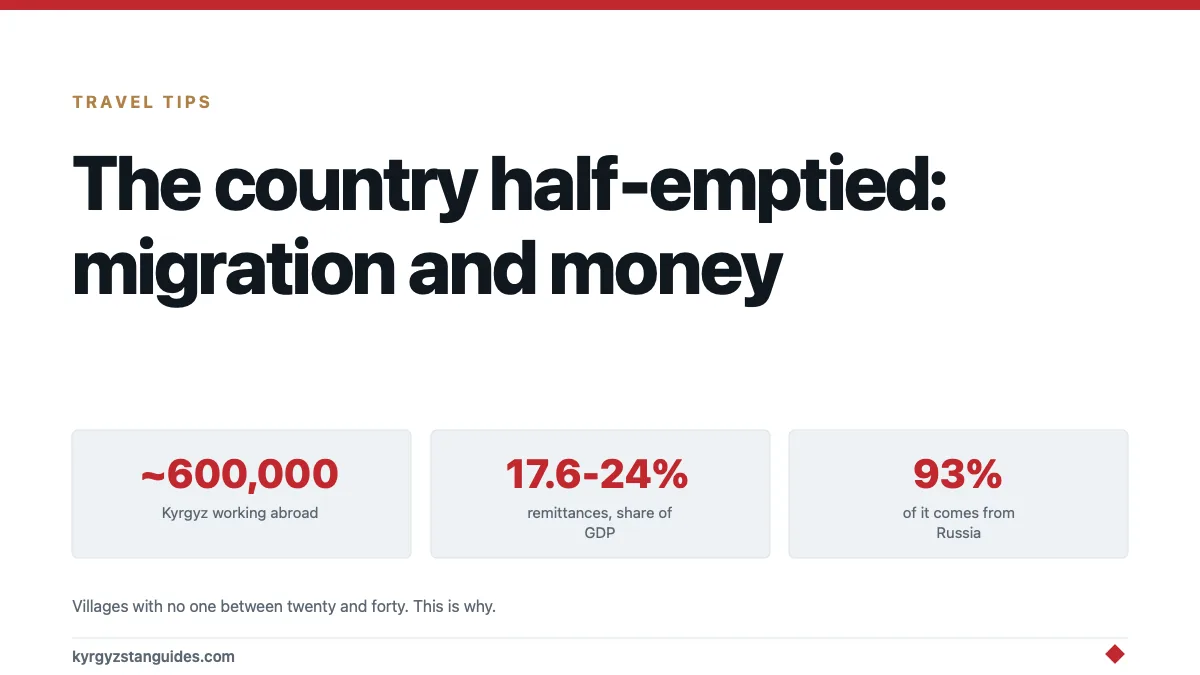
Somewhere between 350,000 and 600,000 Kyrgyz citizens work abroad, the overwhelming majority in Russia. In a country of roughly seven million, that's close to one in ten of the entire population and a much higher share of working-age adults.
The money they send home isn't a supplement to the economy, and their absence is also why the pension system now has 1.8 contributors per pensioner. Depending on which measure you take, remittances run at somewhere between 17.6% and 24% of GDP, and 93% of the inflow comes from Russia alone.
This is the single most important fact about modern Kyrgyzstan, and it's invisible in every travel guide, including the parts of this one that are about yurts.
The numbers
Sources differ, which is itself informative, so here is the range honestly.
| Measure | Figure |
|---|---|
| Remittances as share of GDP (2024) | 17.6% (World Bank) to 24% (other estimates) |
| Kyrgyz labour migrants total | Around 600,000 |
| Share in Russia | About 63% of migrants; 93% of money |
| Registered migrants in Russia | Fell from ~650,000 to around 350,000 by 2025 |
| Remittance inflow, Jan–Oct 2025 | About $2.96 billion |
The discrepancy between "600,000 migrants" and "350,000 registered in Russia" isn't sloppiness. It is the gap between people working and people working legally, and it is the whole problem in one line.
The World Bank's country data tracks the official series.
What it looks like on the ground
You'll see this without recognising it.
Villages with no men between twenty and forty. Particularly in the south and in poorer rural districts. Grandparents raising grandchildren while both parents are in Moscow or Yekaterinburg is an ordinary family arrangement here, not an unusual one.
Houses half-built. Remittances go into construction. A concrete frame that has been standing unfinished for three years is a family adding a floor as money arrives, not an abandoned project.
Everyone has a relative abroad. If you talk to anyone for ten minutes, this will come up. It's not a sensitive topic in the way you might expect; it is completely normal and people discuss it matter-of-factly.
The money transfer offices. In every town, often several on the same street. This is the infrastructure of the actual economy.
Why Russia
Several reasons stack.
Language. Russian is widely spoken in Kyrgyzstan and remains the working language of a large share of the labour market. That is the single biggest advantage Kyrgyz migrants have over, say, Tajik ones with less Russian.
The Eurasian Economic Union. Kyrgyzstan joined in 2015, which gave its citizens the right to work in Russia without a work permit. That is an enormous practical benefit and it's the main thing the country got from membership. As covered in our piece on the bazaar economy, it also cost the re-export trade.
Networks. Migration is self-reinforcing. Once a village has people in a particular Russian city, the next person from that village goes there. The money that comes back buys apartments, which is why the state now writes mortgages for migrants who never come home to sign.
Paperwork. As our guide to Kyrgyz naming explains, many families reverted to Russian-format surnames in the 2000s specifically because it smooths the documentation. That is how deep this goes: it reaches into what people call themselves.
Why it's getting harder
The picture has changed sharply since 2022.
The ruble's movements alone change the value of a remittance without anybody's wages changing. Tighter migration policy, increased document checks and raids, and a harder political climate for Central Asian migrants in Russia have all been reported extensively. Registered numbers have fallen substantially.
The Diplomat has covered the re-evaluation under way. Migrants weighing Russia against alternatives, and the beginnings of diversification toward South Korea, Turkey, the Gulf and elsewhere. None of those absorb anything like the numbers.
A country where a fifth of GDP arrives from one foreign labour market is exposed in a way that is difficult to hedge.
The cost that doesn't show up in GDP
Remittance statistics measure money. They don't measure what the arrangement costs.
Children raised by grandparents. A generation growing up with parents present on a phone screen. Kyrgyz researchers and NGOs have flagged this repeatedly as an emerging social issue, and the effects aren't yet fully understood because the cohort is still young.
Marriages conducted across four thousand kilometres. Long separations, one partner abroad for years at a time, and the strain that produces.
Skills leaving. A nurse or a teacher earns more on a Moscow construction site than in a Kyrgyz hospital or school. That is a rational individual decision and a collective loss.
Vulnerability abroad. Undocumented workers have limited recourse when wages are withheld, accommodation is unsafe or documents are confiscated. Reporting from openDemocracy documented migrants unable to feed their families when the situation in Russia turned.
None of that appears in the 17.6% figure. The money is real and it is keeping households solvent; the arrangement generating it isn't free.
Why a traveller should care
Not out of guilt. Out of accuracy.
It changes what you are looking at. A guesthouse in a mountain village may be one of very few local income options that doesn't involve leaving the country. That reframes what your money is doing.
It explains the demographics. If a village seems to consist of older people and children, that isn't decline in the abstract. It is a specific economic arrangement.
It explains the Russian language. Russian isn't a colonial residue that people have kept out of habit. It's a working asset that a substantial share of households depend on, which is a different thing — and sits alongside the picture in our piece on Russians in Kyrgyzstan.
It's a good conversation. People will tell you about it directly and without drama. Ask where somebody's family is, and you will learn more about the country in five minutes than from a museum.
Spend locally and deliberately. Tourism is small here, much smaller than remittances — but it's one of the few things that puts foreign currency into rural households without anyone having to emigrate for it. Staying in community guesthouses and yurt camps rather than only in town hotels is the practical version of that.
FAQ
How many Kyrgyz people work abroad?
Estimates put the total around 600,000, with roughly 63% in Russia. Registered numbers in Russia fell from about 650,000 to around 350,000 by 2025.
How important are remittances to Kyrgyzstan?
Extremely. Estimates for 2024 range from 17.6% of GDP (World Bank) to around 24%, and inflows reached roughly $2.96 billion in the first ten months of 2025.
Where do Kyrgyz remittances come from?
About 93% comes from Russia, far ahead of any other source.
Why do so many Kyrgyz people work in Russia?
Widespread Russian language ability, the right to work without a permit under Eurasian Economic Union membership since 2015, and long-established migration networks.
Is Kyrgyz migration to Russia declining?
Registered numbers have fallen since 2022 amid tighter migration policy and a harder climate for Central Asian workers, and there's growing interest in South Korea, Turkey and the Gulf, though none absorb comparable numbers.
Does this affect travellers?
Indirectly but meaningfully. It shapes village demographics, explains the prevalence of Russian, and means that rural tourism income is one of the few local alternatives to emigration.