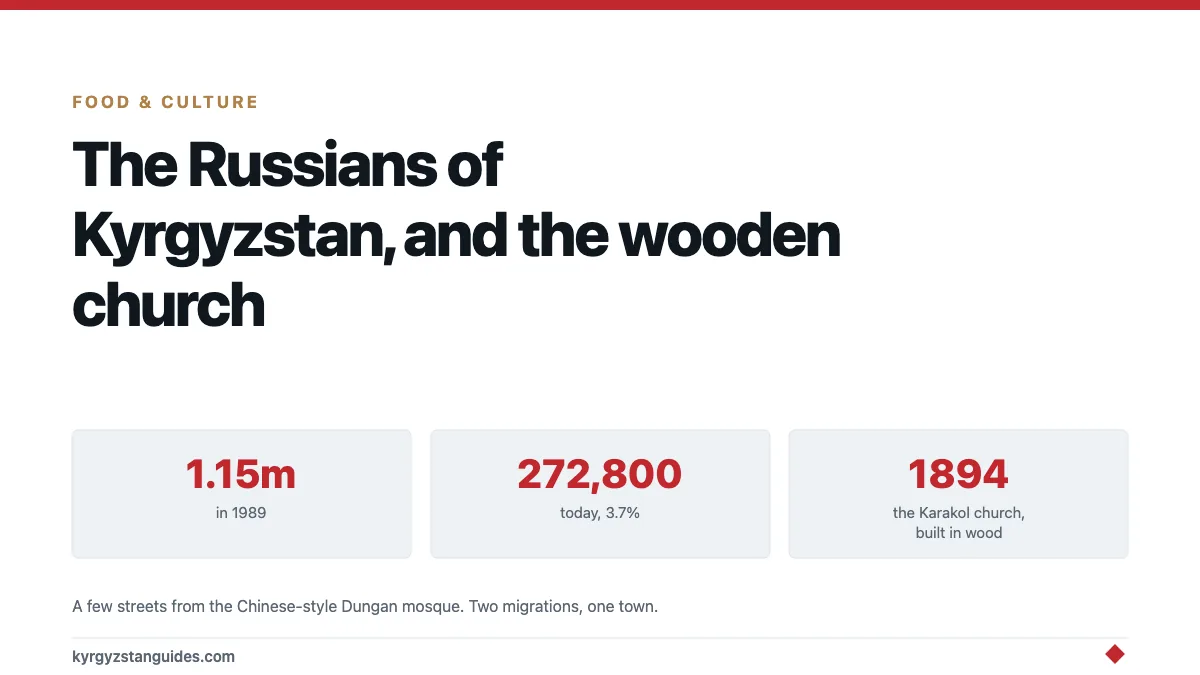
A few streets from Karakol's Chinese-style Dungan mosque stands a Russian Orthodox church built entirely of wood in 1894, replacing one an earthquake had brought down. Two migrations, two refuges, one small town at the far end of Issyk-Kul. Neither community came here by choice in any simple sense, and both are still here.
The Russian one is shrinking fast. There were around 1.15 million Russians in Kyrgyzstan at the 1989 Soviet census. Official estimates now put the figure near 272,800. About 3.7% of the population.
How they got here
Not with the Soviet Union, which is the common assumption. Earlier.
Russian and Ukrainian settlers began arriving in northern Kyrgyzstan towards the end of the nineteenth century, as the Tsarist empire pushed its control south. Some came as workers — building the roads, the forts and the administrative buildings a new frontier needed. More came as farmers, taking up land in the Chuy valley around what would become Bishkek.
That is why the Russian population is a northern phenomenon. The Chuy valley is flat, watered and farmable in a way most of this country is not, and it was the part of Kyrgyzstan that looked most like something a Russian peasant family could work.
The Orthodox church followed the forts. Parishes opened in Pishpek, Naryn and Osh in the 1870s, serving garrisons rather than converts.
The church at Karakol
Wooden, green-roofed, and genuinely unusual.
Holy Trinity Church was consecrated in 1895 after a six-year build, replacing a church destroyed by the 1889 earthquake — which tells you something about why a town in this valley might choose to build in timber rather than brick. Our piece on Kyrgyzstan's earthquakes explains the ground it stands on.
It has had a rough century. Closed and repurposed under Soviet rule, used variously as a club, a school and a store, then returned to the church and restored. It functions as a parish church now, not a museum.
Visiting is straightforward: outside service times, dressed appropriately, women covering their heads. There's no ticket. It sits in an ordinary residential street a short walk from the centre, and our Karakol guide covers the rest of the town, including the mosque.
The two buildings together are the best single argument for spending an extra day in Karakol rather than treating it as a trailhead for Ala-Kul.
The decline
A million people is a large number to lose.
The fall from roughly 1.15 million in 1989 to under 300,000 today is mostly emigration, concentrated in the years after independence in 1991. The reasons were the familiar post-Soviet ones: economic collapse, better prospects in Russia, uncertainty about what an independent Kyrgyzstan would mean for a Russian-speaking minority, and the simple gravity of family members who had already gone.
Low birth rates did the rest. A community that's older on average than the population around it shrinks even without anyone leaving.
What this means on the ground: villages in the Chuy valley that were Russian-majority within living memory now have a handful of elderly residents and a church that opens occasionally. Bishkek remains substantially Russian-speaking, but that is a different thing from being ethnically Russian, plenty of Kyrgyz families in the capital speak Russian at home.
The Dungan comparison
Put the two communities side by side and the difference is instructive.
The Dungan arrived in 1877 as refugees with nothing, settled on land nobody wanted, and are still here in roughly stable numbers, speaking their own language at home and running the vegetable trade around Karakol. They had nowhere to go back to.
The Russians arrived with an empire behind them, held the administrative and technical jobs for a century, and then left in enormous numbers within a decade of that empire ending. They had somewhere to go back to — or at least a country that would have them.
Neither community chose the terms. But a minority that arrived as part of a ruling structure behaves differently when the structure goes than one that arrived as refugees, and the two churches-and-mosques of Karakol stand there as a fairly blunt illustration of it.
The Orthodox eparchy, meanwhile, has gone the other way institutionally: in 2011 the Russian Orthodox Church separated Kyrgyzstan from the Tashkent diocese and established the Eparchy of Bishkek, giving a shrinking congregation its own structure for the first time.
What a traveller actually notices
More than you'd expect, because the legacy outlasts the population.
The language. Russian is an official language and the working language of Bishkek. Our Cyrillic guide covers why learning the alphabet matters more than learning phrases.
The city itself. Bishkek was laid out as a Russian colonial town and then rebuilt as a Soviet one — the grid, the wide boulevards, the irrigation ditches running alongside the pavements, the parks. It does not look like an old Central Asian city, because it isn't one.
The food. Borscht, pelmeni, smetana on everything, dill in quantities that surprise people. It sits alongside the Kyrgyz, Dungan and Uighur strands our food guide covers.
The churches. Bishkek's cathedral, the Karakol church, smaller parishes in Chuy valley towns.
Names on shopfronts, Soviet mosaics on apartment blocks, and the general texture of a place that spent seventy years inside a different country.
The fourth community
This site now has guides to the Dungan, who walked over the mountains from China in 1877; the Koreans, deported here from the Pacific coast in 1937; and the Russians, who arrived with an empire and are leaving with its aftermath.
Add the Uzbeks in the south, the Uighurs, and what remains of the German villages, and you get the actual demographic picture of Kyrgyzstan: which is considerably more complicated than the yurts-and-eagles version, and considerably more interesting.
Our history for travellers sets out the sequence that produced it.
FAQ
How many Russians live in Kyrgyzstan?
Around 272,800 according to official 2025 estimates, about 3.7% of the population. That's down from roughly 1.15 million at the 1989 Soviet census, a fall driven by post-independence emigration and low birth rates.
Why are there Russians in Kyrgyzstan?
They began arriving in the late nineteenth century as the Tsarist empire expanded south: as workers building forts and roads, and as farmers settling the Chuy valley around present-day Bishkek. The Soviet period added more.
Where is the Russian Orthodox church in Karakol?
Holy Trinity Church sits in a residential street a short walk from Karakol's centre. It was built in wood between 1894 and 1895 after an earthquake destroyed the previous building, and it's an active parish church rather than a museum.
Can tourists visit Orthodox churches in Kyrgyzstan?
Yes, outside service times and dressed appropriately, women cover their heads, and shoulders and knees covered for everyone. There's generally no entry fee. These are working churches, so be quiet and don't photograph people praying.
Is Russian widely spoken in Kyrgyzstan?
Yes, particularly in Bishkek and the north, where it's the working language. It's an official language alongside Kyrgyz. In the south, in villages and in the mountains, Kyrgyz dominates.
Why does Bishkek look Russian rather than Central Asian?
Because it was built that way — laid out as a Russian colonial settlement and then rebuilt on Soviet lines, with a grid plan, wide boulevards, parks and roadside irrigation channels. Osh, by contrast, is an old Central Asian city.